2.48-2.50 - Anion and water tests
Many ionic compounds look similar as colourless solutions or white solids, so chemists use chemical tests that give visible evidence. In this lesson, the evidence is a precipitate, a gas test, a colour change in anhydrous copper(II) sulfate, or a fixed physical property of pure water. The exam skill is to give both the test and the positive result.
Planning qualitative tests
An anion is a negatively charged ion. In this cluster, the anions to test for are chloride, bromide, iodide, sulfate and carbonate ions.
Precipitate
A precipitate is an insoluble solid formed when two solutions react.
Most ion tests are done on small samples in test tubes. If the unknown is a solid, dissolve a small amount in distilled water first unless the test specifically says to add acid to the solid. Use a fresh sample for each test so that the reagent from one test does not contaminate the next test.
[DIAGRAM: asset_name: Anion and water tests - diagram 01; asset_slug: c39_anion_and_water_tests__diagram_01; recommended_method: image_gen; description: Monochrome text-free bench schematic showing three separate fresh samples for anion testing: two dropper tests that form precipitates and one gas-evolution test delivered into limewater.]
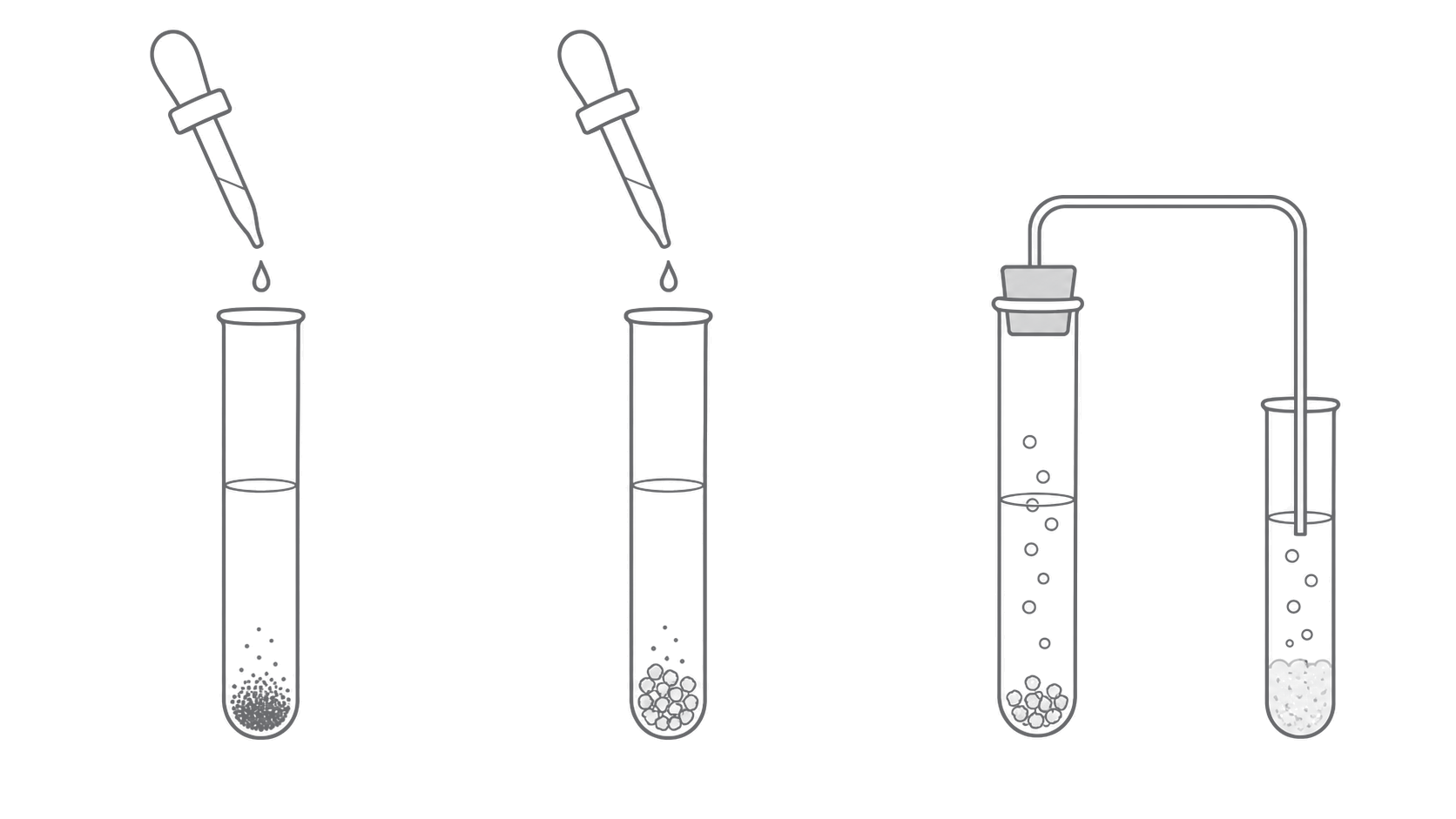
A complete test answer has two parts:
- the reagent or physical test used
- the positive observation that identifies the ion or water sample
For example, "add acidified silver nitrate solution" is only the test. You also need the observation, such as "a white precipitate forms", to identify chloride ions.
Halide ion tests
Chloride, bromide and iodide ions are halide ions. Edexcel names acidified silver nitrate solution as the reagent for these anions.
The usual method is:
- Put a small amount of the unknown aqueous sample in a test tube.
- Acidify the sample, usually with dilute nitric acid.
- Add silver nitrate solution.
- Observe the colour of the precipitate.
Nitric acid is used for acidifying because it does not add chloride, bromide, iodide or sulfate ions that could give a misleading precipitate.
| Anion present | Formula | Positive result with acidified silver nitrate solution | Precipitate formed |
|---|---|---|---|
| chloride | white precipitate | silver chloride, AgCl | |
| bromide | cream precipitate | silver bromide, AgBr | |
| iodide | yellow precipitate | silver iodide, AgI |
The important observation is the colour and the word precipitate. A bare colour such as "cream" is weaker than "a cream precipitate forms" because the test depends on forming an insoluble silver halide.
Ionic equations show why the precipitates form:
You do not need to explain the solubility rules in this lesson. You do need to match each halide ion to the correct precipitate colour.
Sulfate and carbonate tests
Sulfate ions are tested using acidified barium chloride solution. The usual method is to acidify the sample with dilute hydrochloric acid, then add barium chloride solution. A white precipitate shows sulfate ions are present.
Acidifying matters because carbonate ions can also form a white precipitate with barium ions. The acid removes carbonate ions by reacting with them before barium chloride is added.
Carbonate ions are tested by adding hydrochloric acid and identifying the gas evolved. If carbonate ions are present, the acid causes effervescence because carbon dioxide gas is produced.
[DIAGRAM: asset_name: Anion and water tests - diagram 02; asset_slug: c39_anion_and_water_tests__diagram_02; recommended_method: image_gen; description: Monochrome text-free apparatus diagram for the carbonate test, showing acid reacting with a carbonate sample and the gas delivered into limewater, which becomes cloudy.]
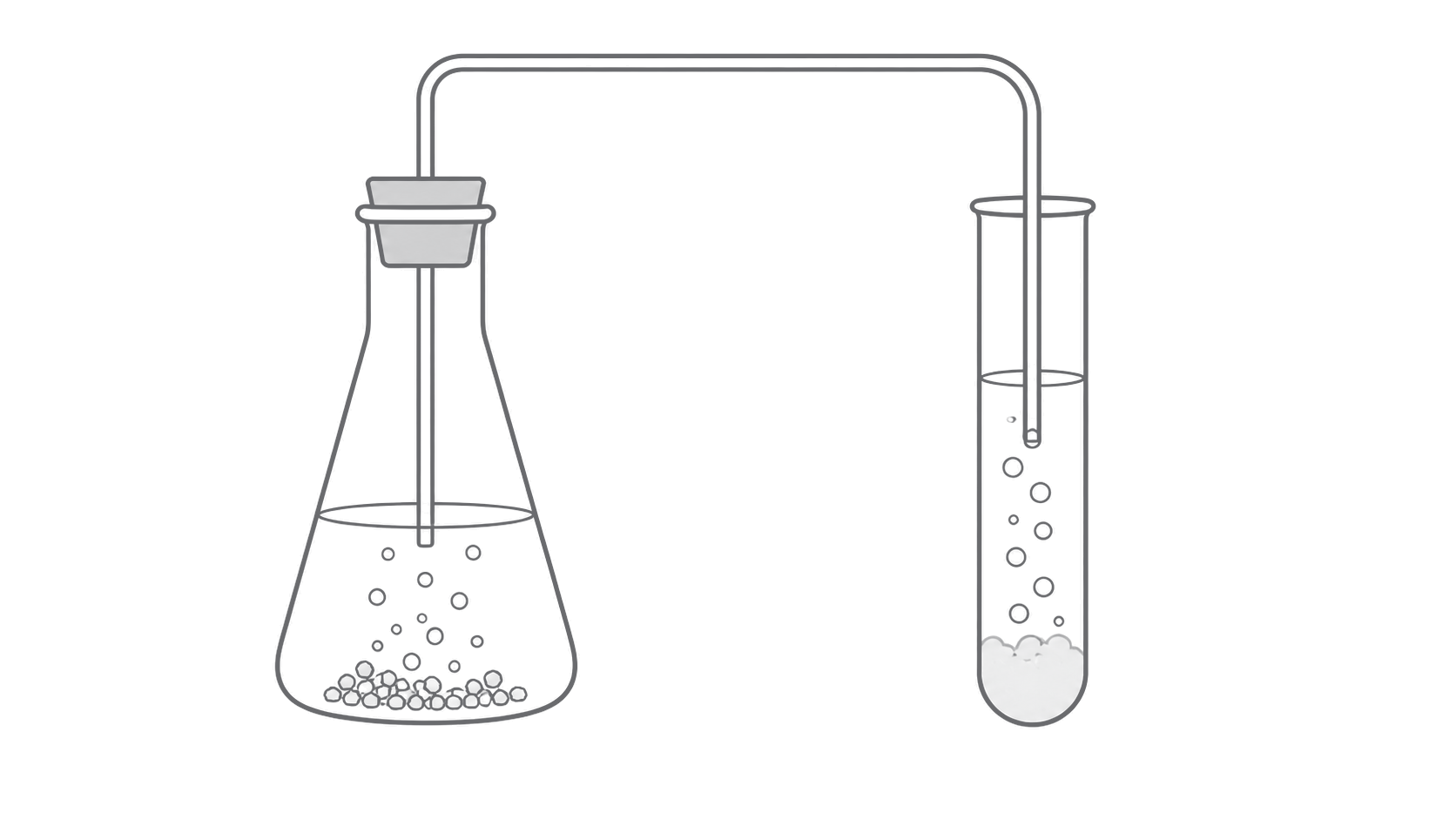
To identify the gas as carbon dioxide, bubble it through limewater. Carbon dioxide turns limewater milky or cloudy.
| Anion present | Formula | Test | Positive result |
|---|---|---|---|
| sulfate | add acidified barium chloride solution | white precipitate | |
| carbonate | add hydrochloric acid and test the gas | effervescence; gas turns limewater cloudy |
Continue this lesson.
You’re previewing NovaLearn without an account. Create a free account to read the rest.
Create free account