2.28-2.30 - Acids, alkalis and indicators
Many acidic and alkaline solutions are colourless, so you often need an indicator to tell what type of solution you have. This lesson focuses on three named indicators, the pH scale from 0 to 14, and how universal indicator gives an approximate pH. Keep the job of each test clear: some indicators only distinguish acid from alkali, while universal indicator is used to estimate a pH value.
What indicators show
An indicator is a substance that changes colour depending on whether a solution is acidic or alkaline. In this part of the specification, you do not need to explain why the colour change happens; you need to describe the colour results and use them correctly.
Indicator
An indicator is a substance used to test a solution because it changes colour in acidic and alkaline conditions.
The solution being tested should be aqueous, meaning the substance is dissolved in water. A few drops of indicator solution can be added to a small sample in a test tube, or indicator paper can be dipped into the sample. You then compare the observed colour with the expected result for that indicator.
The important exam distinction is between identifying the type of solution and measuring approximate pH. Litmus, phenolphthalein and methyl orange can distinguish acidic from alkaline solutions. Universal indicator is used when you need an approximate pH value.
Three named indicators
Edexcel names three indicators that you must know: litmus, phenolphthalein and methyl orange. Each has a different pair of colours in acidic and alkaline solutions.
| Indicator | In acidic solution | In alkaline solution |
|---|---|---|
| Litmus | red | blue |
| Phenolphthalein | colourless | pink |
| Methyl orange | red | yellow |
For litmus, exam answers often describe the paper changing colour: blue litmus turns red in an acid, and red litmus turns blue in an alkali. If the question asks for the final colour in acid or alkali, give the final colour, not the starting colour of the paper.
Phenolphthalein is useful because the alkaline result is very clear: it turns pink in alkaline solution. It is colourless in acidic solution. Do not write "red" or "purple" for phenolphthalein in an alkali.
Methyl orange is red in acidic solution and yellow in alkaline solution. A common mistake is to write "orange" for an alkaline solution. Orange is an intermediate colour around its change point, not the colour to give for a solution that is definitely alkaline.
Classifying with the pH scale
The pH scale used in this specification runs from 0 to 14. A lower pH means more acidic. A higher pH means more alkaline. A solution with pH 7 is neutral.
[DIAGRAM: asset_name: Acids, alkalis and indicators - diagram 01; asset_slug: c30_acids_alkalis_and_indicators__diagram_01; recommended_method: deterministic_drawing; description: Monochrome pH scale from 0 to 14 showing Edexcel classification bands: strongly acidic 0-3, weakly acidic 4-6, neutral 7, weakly alkaline 8-10, strongly alkaline 11-14, with arrows showing more acidic at low pH and more alkaline at high pH.]
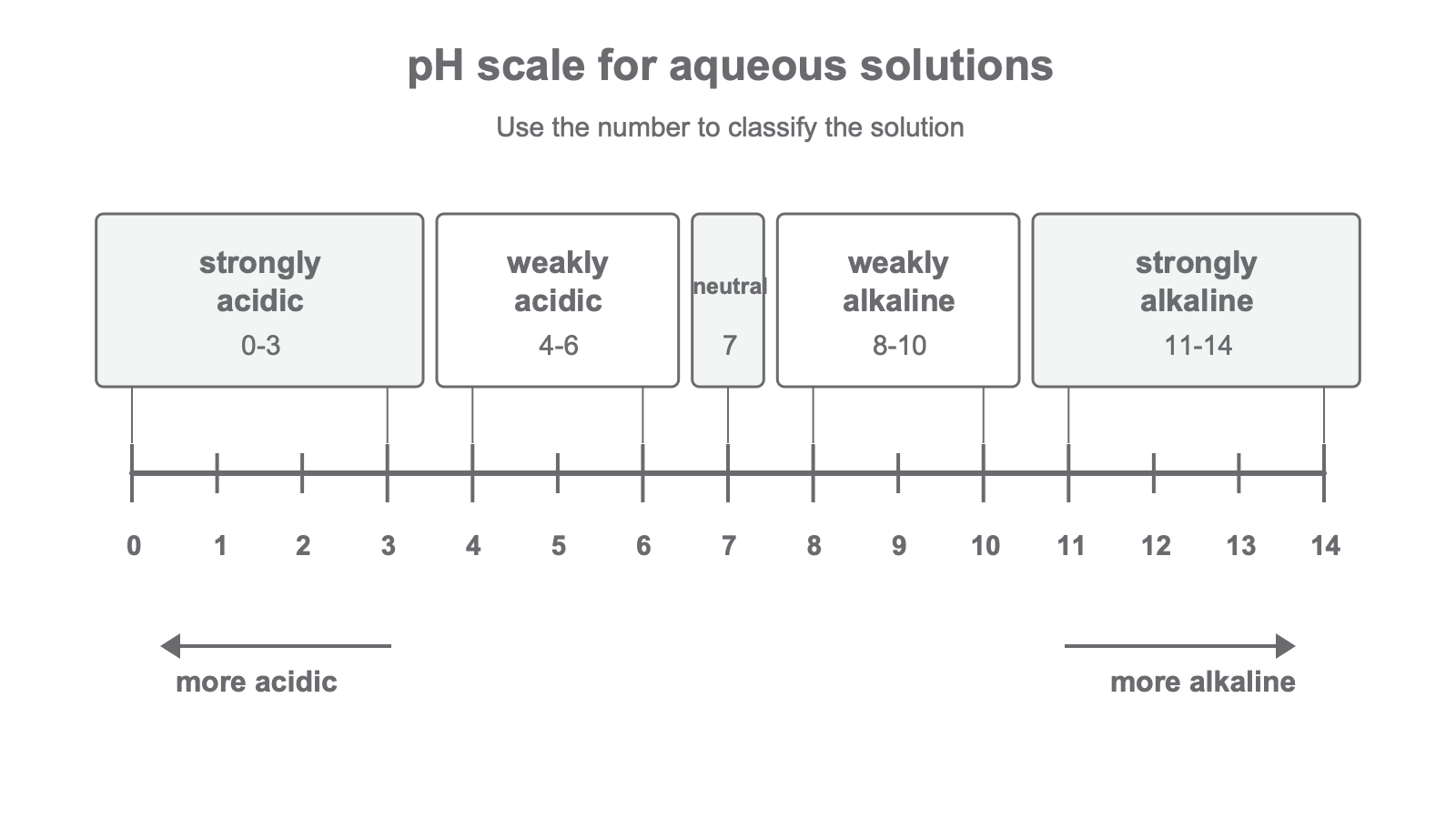
Use the exact bands from the specification:
| pH value | Classification |
|---|---|
| 0-3 | strongly acidic |
| 4-6 | weakly acidic |
| 7 | neutral |
| 8-10 | weakly alkaline |
| 11-14 | strongly alkaline |
The words strongly and weakly in this lesson are used for these pH bands. Do not turn this into a separate explanation of strong and weak acids at particle level; that is beyond this cluster. Here, the skill is to read a pH number and classify the solution accurately.
Continue this lesson.
You’re previewing NovaLearn without an account. Create a free account to read the rest.
Create free account