2.33C - Acid-alkali titration
An acid-alkali titration is a practical method for finding the volume of one solution needed to exactly neutralise a measured volume of another solution. One solution is measured accurately into a conical flask, and the other is added from a burette until an indicator shows the endpoint. Pearson questions usually test the apparatus, the order of the method, how the endpoint is reached, and how repeated titres are judged.
Purpose and apparatus
A titration is used when you need a precise reacting volume, not just an observation that acid and alkali react. In this lesson, the reaction is an acid-alkali neutralisation. The acid may be in the burette and the alkali in the conical flask, or the other way round; the method is the same as long as one solution is measured accurately and the other is added carefully.
Titration
A titration is a practical method in which one solution is added to a measured volume of another solution until the reaction is just complete.
The key pieces of apparatus have different jobs. A volumetric pipette measures one fixed volume accurately, such as 25.0 cm³. A burette delivers variable measured volumes, so it is used for the solution that is added until the endpoint is reached. The conical flask holds the measured solution and allows the mixture to be swirled without spilling.
[DIAGRAM: asset_name: Acid-alkali titration - diagram 01; asset_slug: c32_acid_alkali_titration__diagram_01; recommended_method: image_gen; description: Monochrome labelled titration setup showing a burette clamped above a conical flask on a white tile, plus a pipette and filler and indicator bottle. Labels identify burette, tap, conical flask, white tile, pipette and filler, and indicator.]
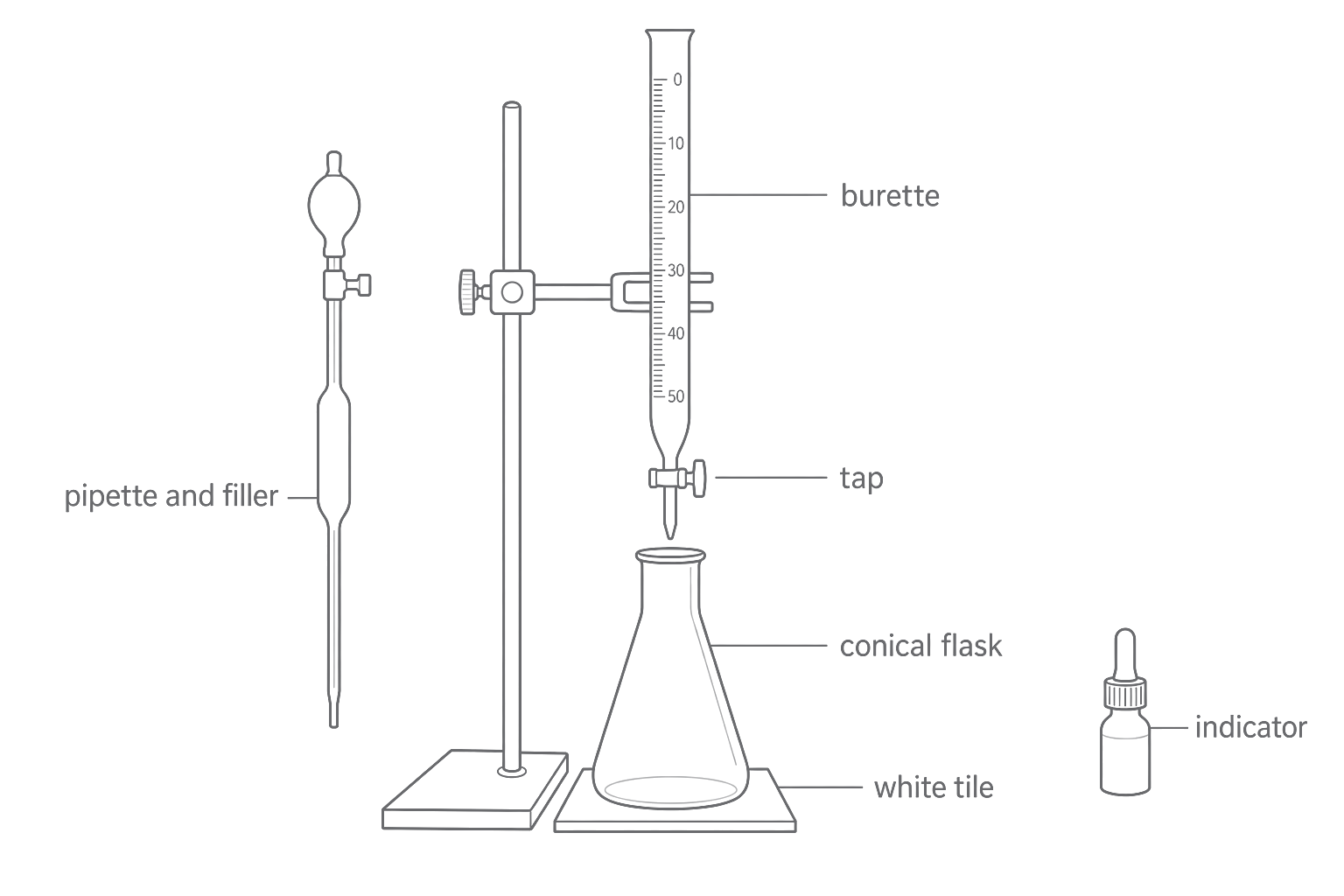
The pipette is used with a pipette filler. Do not describe sucking liquid into a pipette by mouth. The burette has a tap so the solution can be added quickly at first and then drop by drop near the endpoint.
Setting up the titration
The setup must give a known starting volume in the flask and a measurable volume added from the burette.
- Use a pipette and pipette filler to transfer a fixed volume of one solution into a conical flask.
- Add a few drops of a suitable indicator to the conical flask.
- Place the conical flask on a white tile so the colour change is easier to see.
- Fill the burette with the other solution and record the initial burette reading.
- Put the conical flask under the burette, directly below the tap.
A suitable indicator has a clear colour change at the endpoint. Methyl orange, phenolphthalein or litmus solution may be suitable in Pearson acid-alkali titration questions, depending on the acid and alkali used. In the common setup with acid in the burette and alkali in the flask, methyl orange starts yellow. The endpoint is the first permanent change from yellow to orange after swirling; red shows that excess acid has been added and the endpoint has been overshot, while pink is not a methyl-orange colour. If phenolphthalein is used in this setup, it is pink in alkali and becomes colourless when acid neutralises it. Universal indicator is not suitable for a titration because it changes through a range of colours rather than giving a sharp endpoint.
Read the burette scale at eye level. Burettes are usually marked with 0 cm³ near the top and larger numbers lower down, so the reading increases as solution runs out. The volume added in a titration is:
Titre from burette readings
For example, if the initial reading is 0.50 cm³ and the final reading is 21.80 cm³:
The titre is 21.30 cm³.
Finding the endpoint
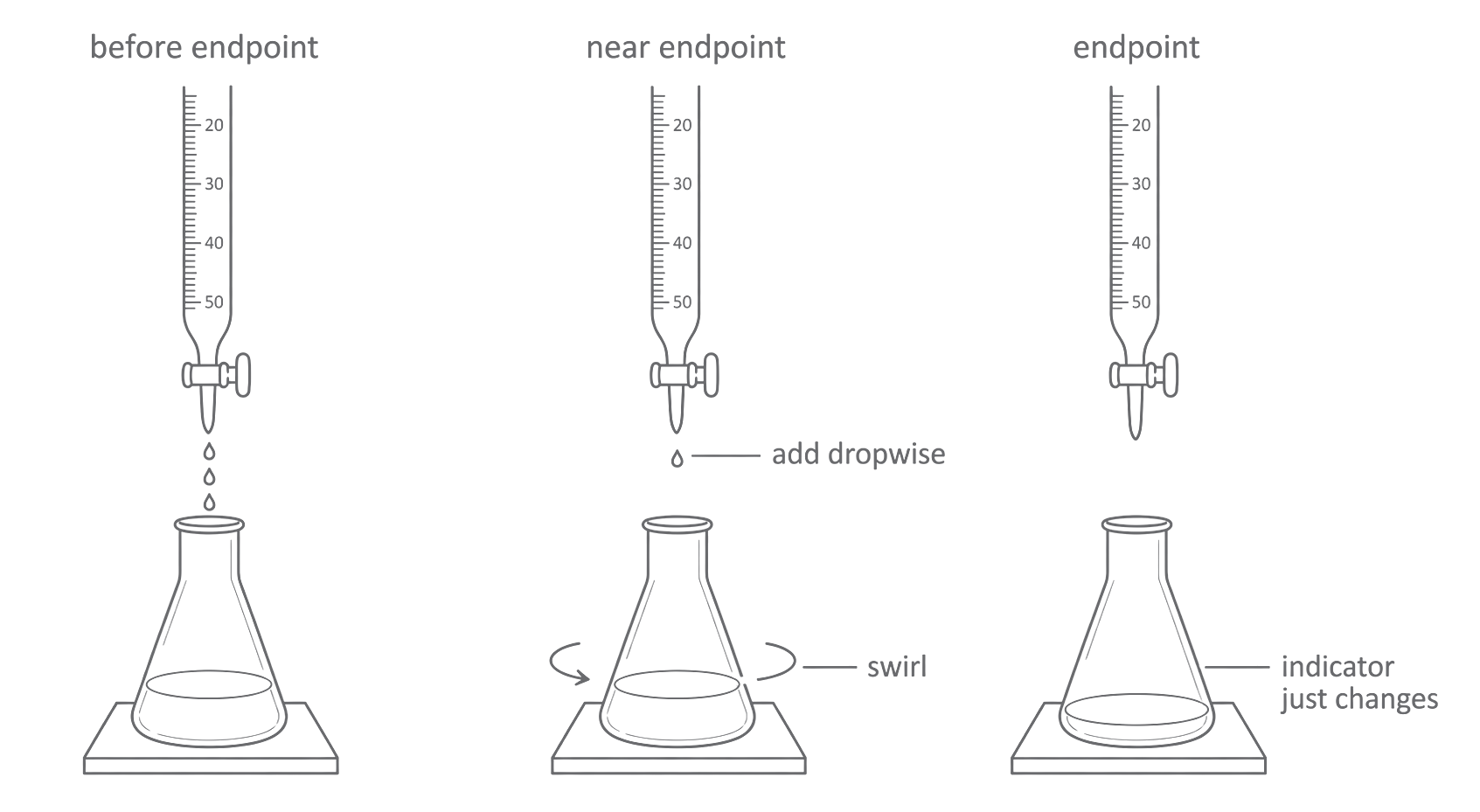
The endpoint is the point where the indicator just changes colour, showing that enough acid and alkali have reacted. In an exam, do not write only "add until neutral"; describe what you do and what you see.
Endpoint
The endpoint is the point in a titration when the indicator just changes colour.
[DIAGRAM: asset_name: Acid-alkali titration - diagram 02; asset_slug: c32_acid_alkali_titration__diagram_02; recommended_method: image_gen; description: Monochrome three-panel schematic showing titration before endpoint, near endpoint and at endpoint. It shows solution added from a burette into a conical flask, dropwise addition near the endpoint, swirling, and the indicator just changing.]
Continue this lesson.
You’re previewing NovaLearn without an account. Create a free account to read the rest.
Create free account