1.49-1.51 - Giant covalent structures
Some covalent substances are made from small molecules. Others are different: their atoms are joined in a huge network of covalent bonds. Giant covalent structures explain why diamond is extremely hard, why graphite can write on paper and conduct electricity, and why C60 fullerene behaves differently from both.
Giant covalent networks
A giant covalent structure is a very large network of atoms joined by covalent bonds. The atoms do not exist as separate small molecules. Instead, the covalent bonding continues throughout the structure.
Giant covalent structure
A giant covalent structure is a large network of atoms joined together by covalent bonds.
This is the key reason for the high melting and boiling points. To melt or boil a giant covalent substance, many strong covalent bonds must be broken. Breaking many strong covalent bonds requires a large amount of thermal energy, so these substances are solids with high melting and boiling points.
Do not explain a giant covalent melting point by saying "weak intermolecular forces are overcome". That explanation belongs to simple molecular substances. In a giant covalent network, the important attractions are the covalent bonds between atoms in the network.
Diamond: strong in three dimensions
Diamond is a form of carbon. Each carbon atom forms four covalent bonds to other carbon atoms. These bonds point in different directions, forming a rigid three-dimensional giant covalent structure.
Because the strong covalent bonds extend in three dimensions, diamond is very hard. Scratching or deforming diamond would require covalent bonds to be broken. Diamond also has a very high melting point for the same reason: many strong covalent bonds must be broken.
Diamond does not conduct electricity. All four outer electrons of each carbon atom are used in covalent bonds, so there are no delocalised electrons that can move through the structure. There are also no mobile ions.
Graphite: strong layers that can slide
Graphite is also made only of carbon atoms, but its structure is different from diamond. Each carbon atom forms three covalent bonds to other carbon atoms. This makes flat layers of hexagonal rings.
[DIAGRAM: asset_name: Giant covalent structures - diagram 01; asset_slug: c18_giant_covalent_structures__diagram_01; recommended_method: image_gen; description: Monochrome side-by-side comparison of diamond and graphite carbon structures. Diamond is shown as a three-dimensional covalent network of carbon atoms with bonds extending through the structure. Graphite is shown as stacked hexagonal carbon layers, with weak separation between layers and mobile electron paths within a layer.]
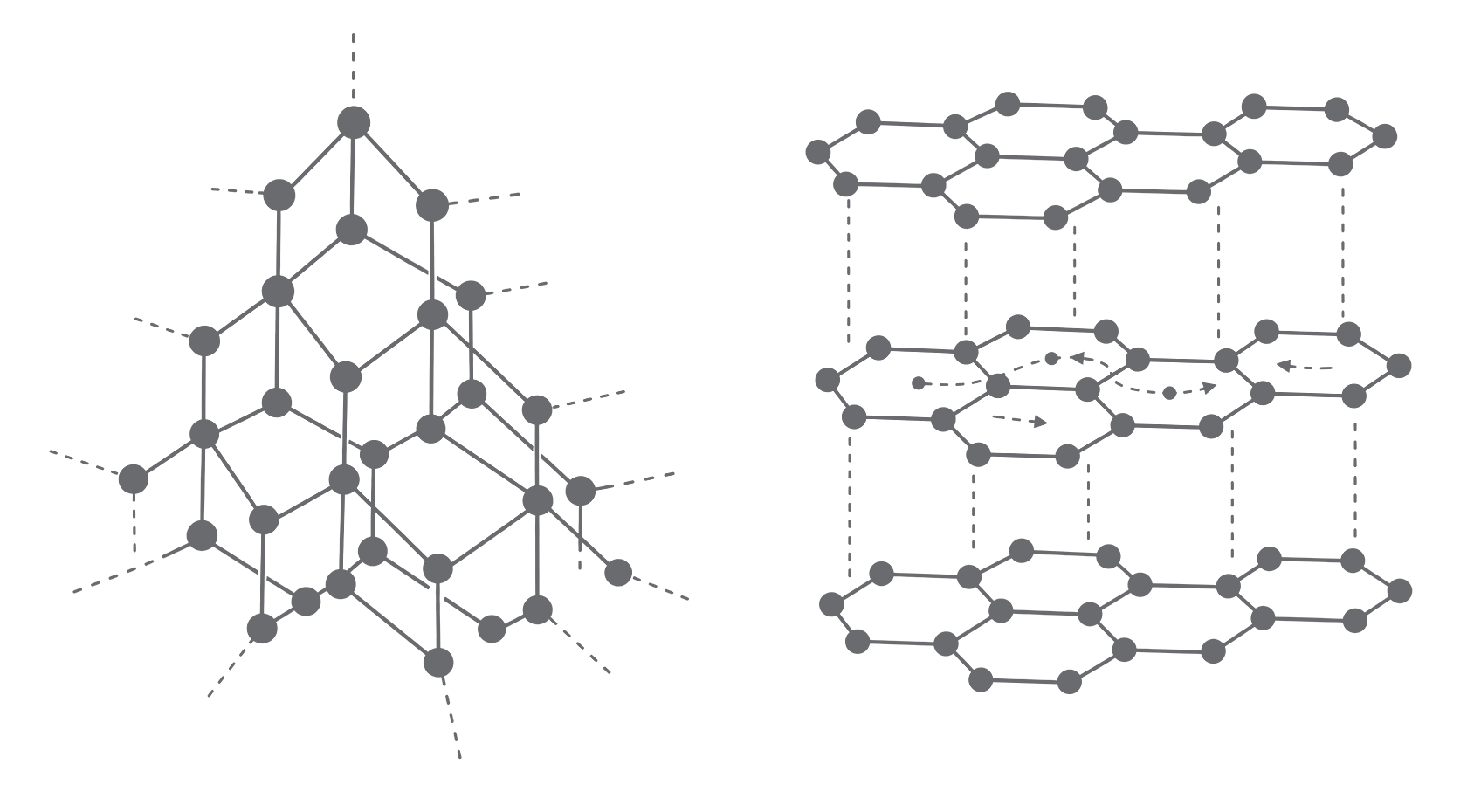
The covalent bonds within each graphite layer are strong. This gives graphite a high melting point, because many strong covalent bonds must be broken to melt the structure.
The forces between graphite layers are weak compared with covalent bonds. The layers can slide over each other, so graphite is soft and slippery. This is why graphite can be used in pencil "lead" and as a lubricant.
Graphite conducts electricity because each carbon atom has one outer electron that is not used in the three covalent bonds. These electrons are delocalised and can move along the layers. Moving delocalised electrons carry charge.
Continue this lesson.
You’re previewing NovaLearn without an account. Create a free account to read the rest.
Create free account