4.34C-4.37C - Carboxylic acids - structures and reactions
Carboxylic acids are organic acids that all contain the same functional group. In this lesson you will learn how to recognise that group, draw and name the first four unbranched-chain carboxylic acids, and describe two important acid reactions. The lesson finishes with vinegar, a familiar aqueous solution containing ethanoic acid.
The carboxyl functional group
A functional group is the atom or group of atoms that gives an organic family its characteristic reactions. Carboxylic acids contain the carboxyl functional group, usually written in a structural formula as -COOH.
Carboxyl functional group
The -COOH group found in carboxylic acids.
In a displayed formula, -COOH must not be treated as a single block of letters. It means that the carbon is double-bonded to one oxygen atom and single-bonded to an O-H group.
[DIAGRAM: asset_name: Carboxylic acids: structures and reactions - diagram 01; asset_slug: c59_carboxylic_acids_structures_and_reactions__diagram_01; recommended_method: image_gen; description: Monochrome displayed carboxyl functional group matching the Pearson orientation, with a chain bond into C from the left, C double-bonded upward to O, and C single-bonded right to O-H.]
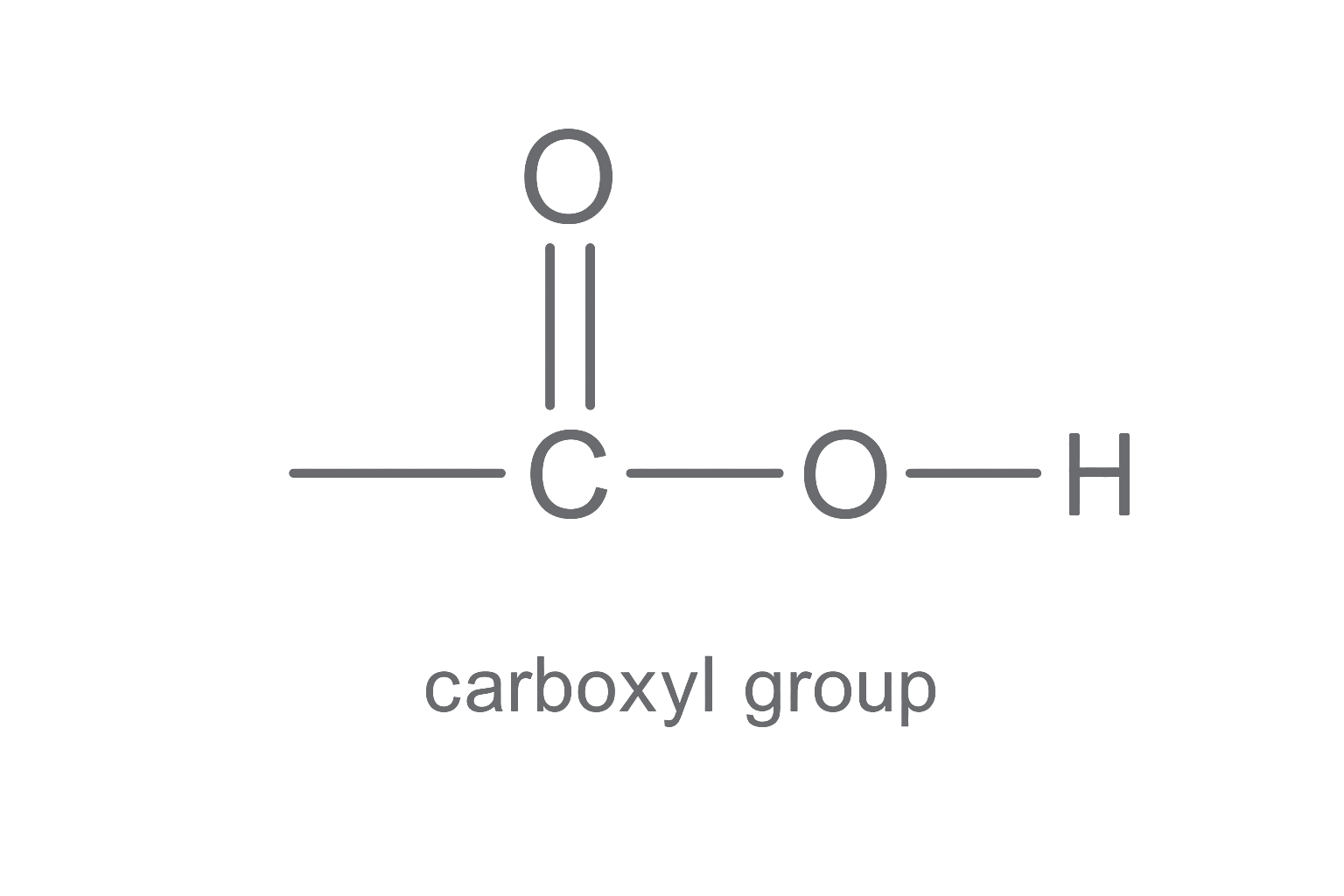
The important exam point is the connectivity. The carbonyl part is C=O, and the hydroxyl part is O-H, but together as one -COOH group they make a carboxylic acid. An alcohol also contains an -OH group, so do not identify a carboxylic acid by saying only "it has OH". Look for the whole -C(=O)OH arrangement.
Carboxylic acid names end in -oic acid. The first four unbranched-chain examples are methanoic acid, ethanoic acid, propanoic acid and butanoic acid.
Drawing the first four acids
For this cluster, the specification only requires unbranched-chain carboxylic acids with up to four carbon atoms in the molecule. The carboxyl carbon counts as one of those carbon atoms.
| Name | Total carbon atoms | Structural formula |
|---|---|---|
| methanoic acid | 1 | HCOOH |
| ethanoic acid | 2 | CH3COOH |
| propanoic acid | 3 | CH3CH2COOH |
| butanoic acid | 4 | CH3CH2CH2COOH |
[DIAGRAM: asset_name: Carboxylic acids: structures and reactions - diagram 02; asset_slug: c59_carboxylic_acids_structures_and_reactions__diagram_02; recommended_method: image_gen; description: Monochrome 2 by 2 chart showing methanoic acid HCOOH, ethanoic acid CH3COOH, propanoic acid CH3CH2COOH and butanoic acid CH3CH2CH2COOH, with full displayed formulae for each and the carboxyl group at the chain end.]
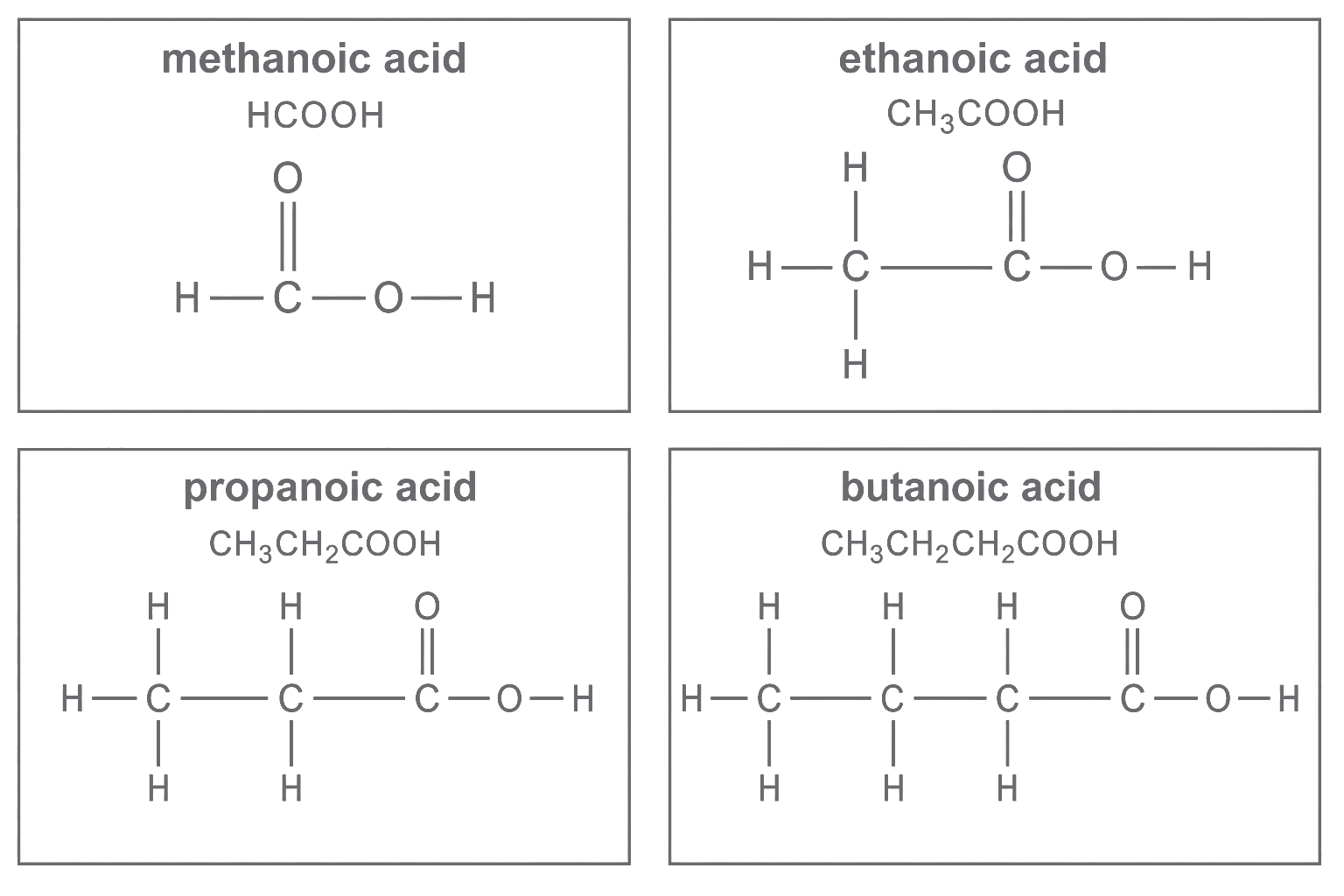
A structural formula groups atoms to show the order of bonding without drawing every bond. For example, CH3CH2COOH shows a three-carbon chain ending in the carboxyl group. A displayed formula shows all the bonds, including every C-H, C-C, C=O, C-O and O-H bond.
To draw one correctly:
- Choose the name from the number of carbon atoms: meth-, eth-, prop- or but-.
- Draw an unbranched chain with that many carbon atoms in total.
- Put the carboxyl carbon at the end of the chain.
- Complete the carboxyl group as
C=OandC-O-H. - Add enough hydrogens so that each carbon has four bonds.
The common mistake is to count only the carbon atoms before COOH. In propanoic acid, CH3CH2COOH, there are three carbon atoms altogether, not two.
From acid names to salts
When a carboxylic acid reacts as an acid, the hydrogen in the -COOH group is replaced by a metal ion. The product is a carboxylate salt.
The salt name comes from the acid name:
| Acid | Salt ending | Example salt name |
|---|---|---|
| methanoic acid | methanoate | sodium methanoate |
| ethanoic acid | ethanoate | magnesium ethanoate |
| propanoic acid | propanoate | calcium propanoate |
| butanoic acid | butanoate | sodium butanoate |
For example, ethanoic acid forms ethanoate salts. The word ethanoate tells you that the carboxylic acid part came from ethanoic acid. The metal name tells you which metal ion replaced the acidic hydrogen.
Continue this lesson.
You’re previewing NovaLearn without an account. Create a free account to read the rest.
Create free account