4.29C-4.31C - Alcohol structures and reactions
Alcohols are organic compounds with the functional group -OH. In this cluster, the important alcohol is ethanol, but you also need to draw and name the first four straight-chain alcohols: methanol, ethanol, propan-1-ol and butan-1-ol. The reaction work stays focused on oxidation of ethanol: by complete combustion, by microbial oxidation in air, and by heating with acidified potassium dichromate(VI).
The -OH functional group
All alcohols contain the -OH functional group. The O and H are bonded together, and the oxygen is also bonded to a carbon atom in the organic molecule.
[DIAGRAM: asset_name: Alcohol structures and reactions - diagram 01; asset_slug: c57_alcohol_structures_and_reactions__diagram_01; recommended_method: image_gen; description: Monochrome generic alcohol structure R-O-H with the O-H end circled and labelled as the -OH functional group, highlighting the separate O-H bond.]
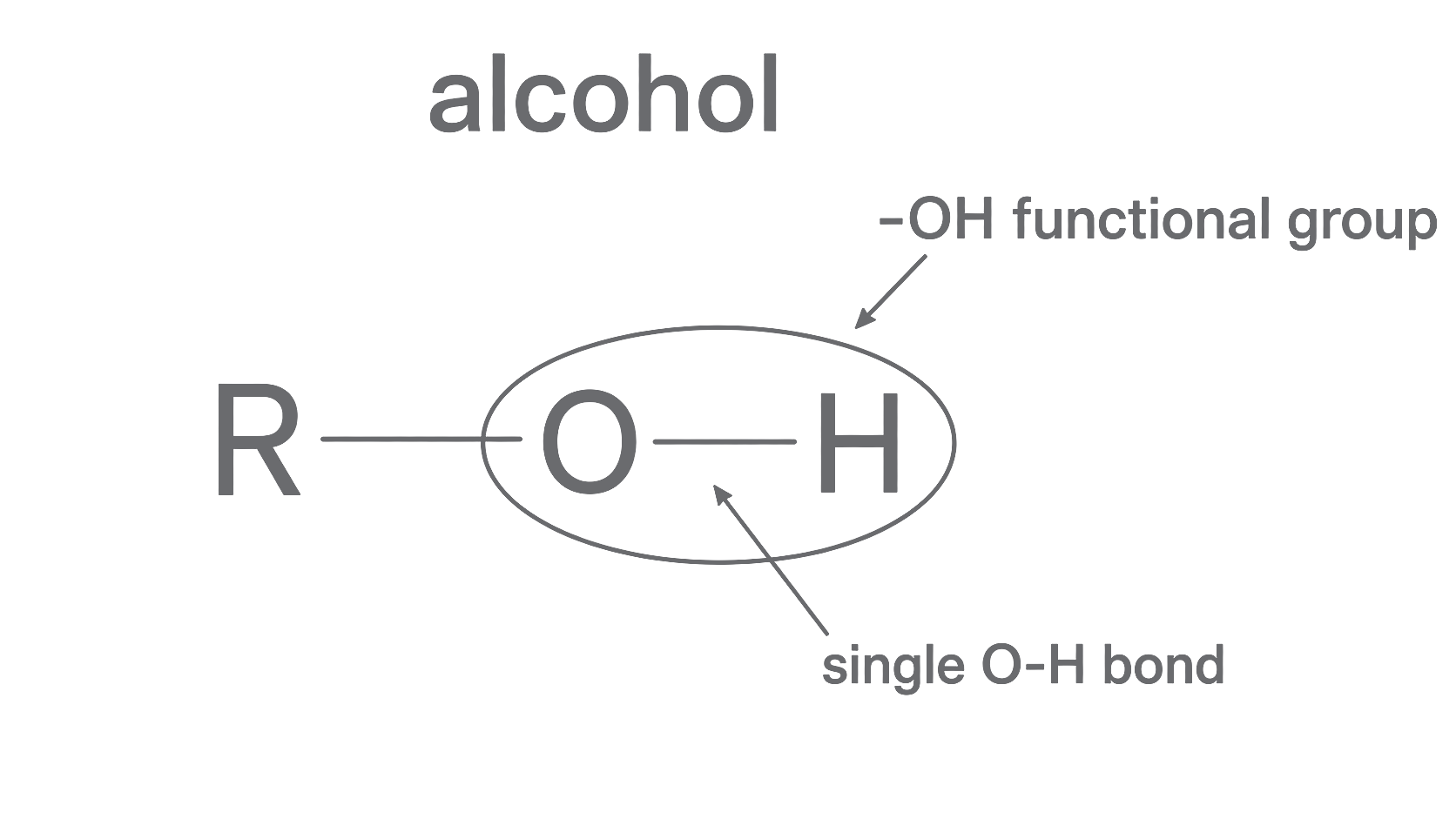
Functional group
A functional group is the atom or group of atoms in an organic compound that gives the compound its characteristic reactions.
For an alcohol, the functional group is written as -OH. Do not confuse this with a hydroxide ion, OH-. In an alcohol, the -OH group is part of a covalent molecule and has no charge.
The -OH group is what makes ethanol an alcohol:
| Compound | Structural formula | Why it is an alcohol |
|---|---|---|
| methanol | CH3OH | contains -OH |
| ethanol | CH3CH2OH | contains -OH |
The first four alcohols
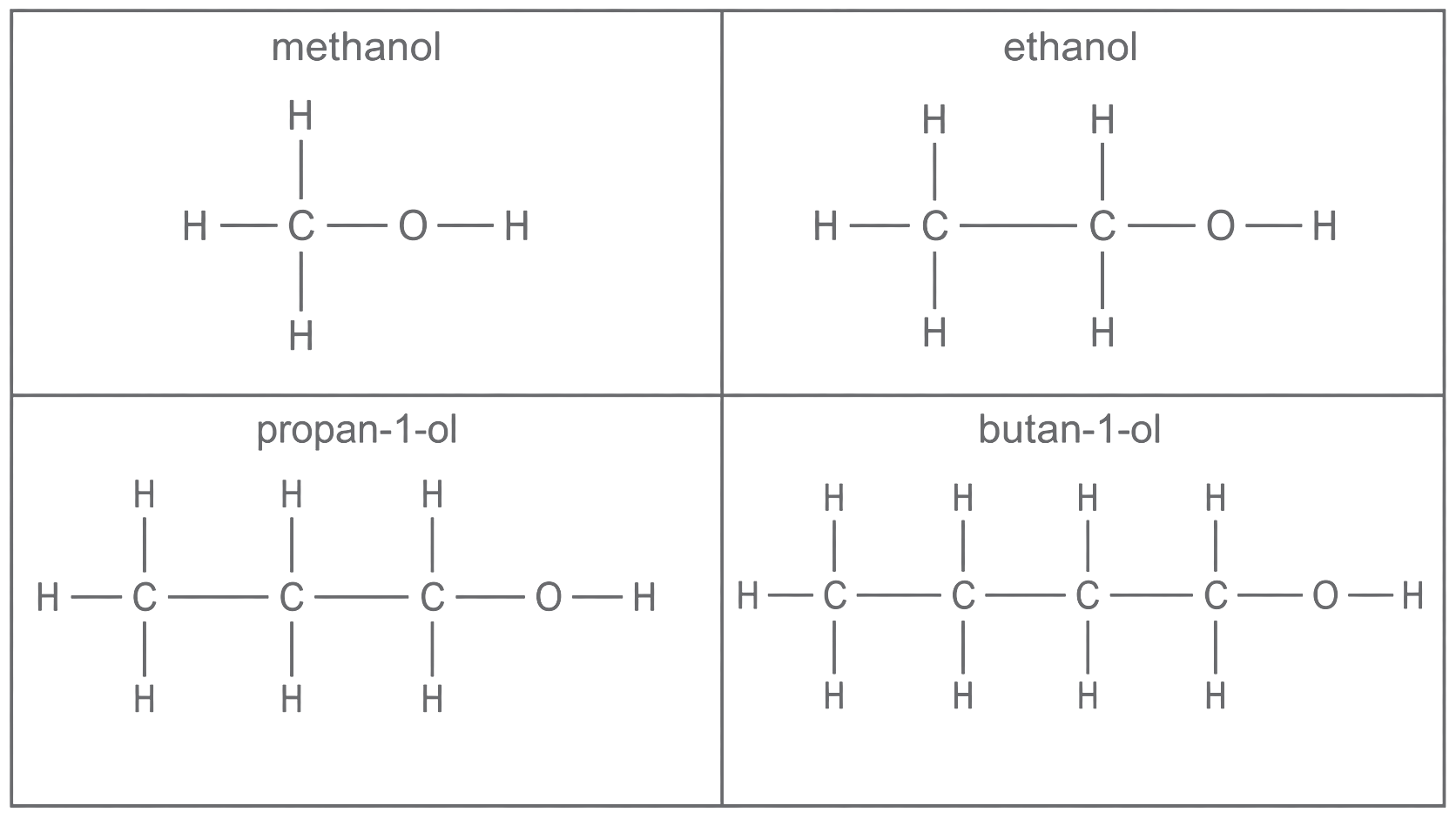
You need to know the structural and displayed formulae of methanol, ethanol, propan-1-ol and butan-1-ol. The specification says that the names propanol and butanol are acceptable, but the structures you draw here must be the straight-chain terminal alcohols: propan-1-ol and butan-1-ol.
[DIAGRAM: asset_name: Alcohol structures and reactions - diagram 02; asset_slug: c57_alcohol_structures_and_reactions__diagram_02; recommended_method: image_gen; description: Monochrome displayed formulae for methanol, ethanol, propan-1-ol and butan-1-ol, showing all C-H, C-C, C-O and O-H single bonds and terminal O-H groups.]
| Name required in this cluster | Molecular formula | Structural formula |
|---|---|---|
| methanol | CH4O | CH3OH |
| ethanol | C2H6O | CH3CH2OH |
| propan-1-ol, or propanol | C3H8O | CH3CH2CH2OH |
| butan-1-ol, or butanol | C4H10O | CH3CH2CH2CH2OH |
The pattern is simple: each next member adds one CH2 unit to the carbon chain, while the terminal -OH group stays at the end. That terminal -OH placement matters because propan-2-ol is not the alcohol named by this cluster.
Structural and displayed formulae
A structural formula shows the order in which atoms or groups are joined, without showing every individual bond. For example, ethanol can be written as CH3CH2OH.
A displayed formula shows every atom and every covalent bond. For an alcohol, that includes the bond between O and H. Pearson mark schemes can reject a displayed formula where the answer only writes "-OH" instead of showing the separate O-H bond, because the question asked for all bonds.
Use this checklist when you draw a displayed formula:
- Draw the correct number of carbon atoms in a straight chain.
- Put the -OH group on the end carbon for propan-1-ol and butan-1-ol.
- Make every carbon have four bonds.
- Make oxygen have two single bonds: one C-O bond and one O-H bond.
- Count the H atoms against the molecular formula.
For propan-1-ol, the structural formula is CH3CH2CH2OH. A displayed formula for it must show three carbon atoms in a row, the oxygen bonded to the last carbon, and the hydrogen bonded to the oxygen.
Continue this lesson.
You’re previewing NovaLearn without an account. Create a free account to read the rest.
Create free account