3.8 - Temperature-change practicals
Temperature-change practicals are about collecting trustworthy temperature data during a chemical or physical change. In this lesson, you will use the right apparatus, choose fair controls, read maximum or minimum temperatures, and explain the main sources of error for dissolving, neutralisation, displacement, and combustion experiments.
What temperature change shows
In these practicals, the thermometer is the evidence. If the temperature of the reaction mixture rises, the surroundings or solution have gained thermal energy. If the temperature falls, the solution has lost thermal energy to the change taking place.
For a temperature-change practical, record the starting temperature and the most important later temperature:
Temperature change
Use the maximum temperature for a temperature rise and the minimum temperature for a temperature fall. A rise can be recorded as a positive change, such as +6.5 °C. A fall can be recorded as a negative change, such as -2.0 °C.
Specification point 3.8 gives four possible types of change:
| Type of change | What is usually measured | Common practical clue |
|---|---|---|
| salts dissolving in water | temperature change of the water/solution | some salts warm the water, others cool it |
| neutralisation reactions | temperature change when acid and alkali mix | temperature usually rises and reaches a maximum near complete neutralisation |
| displacement reactions | temperature change when a more reactive element displaces a less reactive one from solution | temperature may rise, but slower reactions need careful timing |
| combustion reactions | temperature change of water heated by a burning fuel | a flame heats water in a copper can or beaker |
The same temperature data can later be used in wider calorimetry calculations, but this practical skill is first about measuring the temperature change accurately.
Solution calorimetry method
Salts dissolving, neutralisation reactions, and many displacement reactions can be investigated in an insulated cup. The cup reduces heat transfer to or from the surroundings, and the beaker supports the cup so it is less likely to tip over.
[DIAGRAM: asset_name: Temperature-change practicals - diagram 01; asset_slug: c42_temperature_change_practicals__diagram_01; recommended_method: image_gen; description: Monochrome line-art apparatus diagram of solution calorimetry in a polystyrene cup supported by a beaker, with lid, thermometer, reacting solution, measured reactant being added, and gentle stirring.]
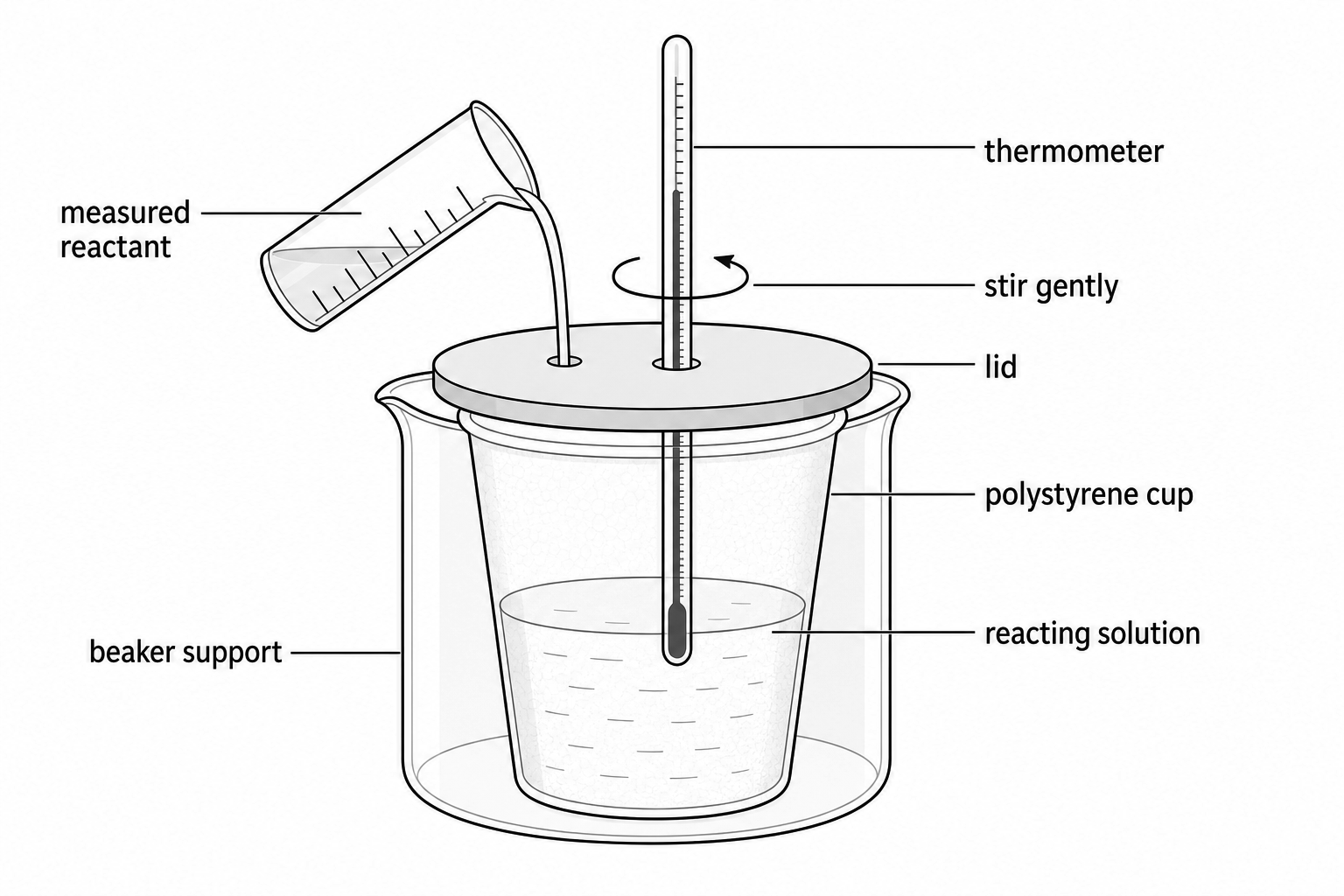
A general method is:
- Measure a fixed volume or mass of the starting liquid into a polystyrene cup.
- Place the cup in a beaker for support and fit a lid if available.
- Measure and record the steady starting temperature.
- Add the measured reactant, such as a salt, an acid/alkali, or a metal powder.
- Stir gently and record the temperature at regular intervals, or record the highest or lowest temperature reached.
- Repeat if a comparison is being made.
For salts dissolving, add a known mass of salt to a known mass or volume of water. For neutralisation, mix known volumes and concentrations of acid and alkali. For displacement, add a known mass or excess amount of the solid to a known volume and concentration of solution.
Useful controls include the volume of solution, concentration of solution, mass of solid, starting temperature, apparatus, insulation, stirring method, and timing. Wear eye protection, avoid splashing acids and alkalis, and handle solids such as copper(II) sulfate according to the teacher's safety instructions.
Neutralisation curve interpretation
Neutralisation temperature-change experiments often add small portions of alkali to a fixed volume of acid, or acid to a fixed volume of alkali. After each portion is added, the mixture is stirred and the highest temperature is recorded.
[DIAGRAM: asset_name: Temperature-change practicals - diagram 02; asset_slug: c42_temperature_change_practicals__diagram_02; recommended_method: deterministic_drawing; description: Monochrome plotted graph of temperature change against volume of alkali added, showing points rising to a maximum at complete neutralisation and then decreasing as extra cool alkali is added.]
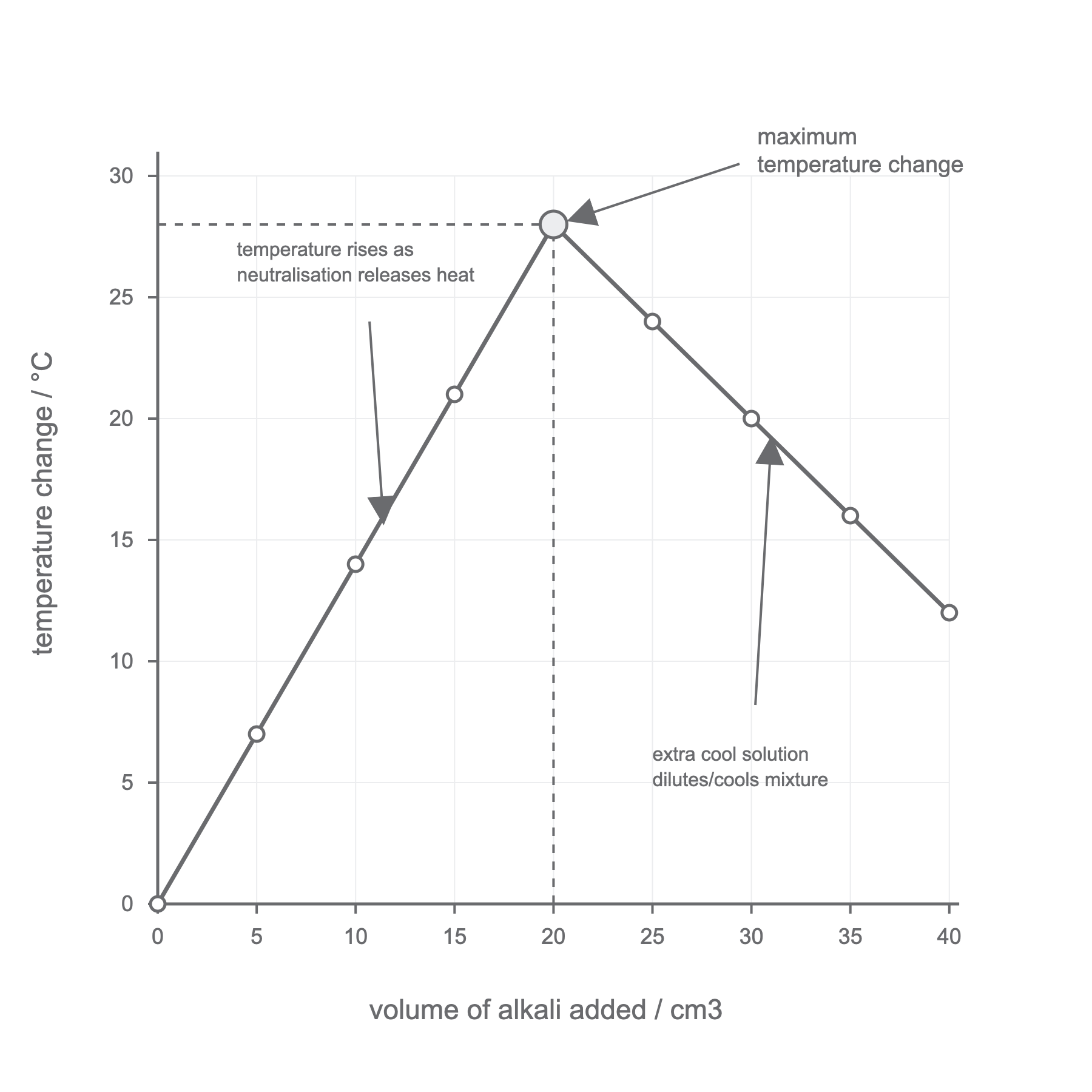
At first, each added portion reacts with acid already in the cup. The temperature rises because neutralisation releases heat to the solution. The maximum temperature change is reached when the acid has just been neutralised.
After this point, extra alkali does not react with acid because the acid has already been used up. The added solution may be cooler than the mixture, so the temperature change falls. In exam answers, explain both sections of the graph:
- before the maximum: more neutralisation occurs, so the temperature rises
- at the maximum: complete neutralisation has occurred
- after the maximum: there is no further neutralisation, and extra cooler solution lowers the temperature
The most reliable maximum may be found from the point where two best-fit lines cross, not just from one raw temperature reading.
Continue this lesson.
You’re previewing NovaLearn without an account. Create a free account to read the rest.
Create free account