1.44-1.46 - Covalent bonding and dot-and-cross diagrams
Covalent bonding happens when atoms share electrons. In this lesson, you will learn exactly what a covalent bond is, how Pearson describes the electrostatic attraction in the bond, and how to represent the bonding using dot-and-cross diagrams for the molecules named in the specification.
What a covalent bond is
Atoms form covalent bonds by sharing electrons. One covalent bond is one shared pair of electrons between two atoms.
Covalent bond
A covalent bond is formed when atoms share a pair of electrons. The bond is the electrostatic attraction between the shared pair of electrons and the nuclei of the bonded atoms.
The word nuclei matters. A shared pair is attracted to both positive nuclei, so an exam answer that only says "electrons are shared between atoms" is too vague for the electrostatic attraction point.
[DIAGRAM: asset_name: Covalent bonding and dot-and-cross diagrams - diagram 01; asset_slug: c16_covalent_bonding_and_dot_and_cross_diagrams__diagram_01; recommended_method: image_gen; description: Monochrome concept diagram showing two overlapping atoms, a shared pair of electrons, and attraction from both nuclei to the shared pair.]
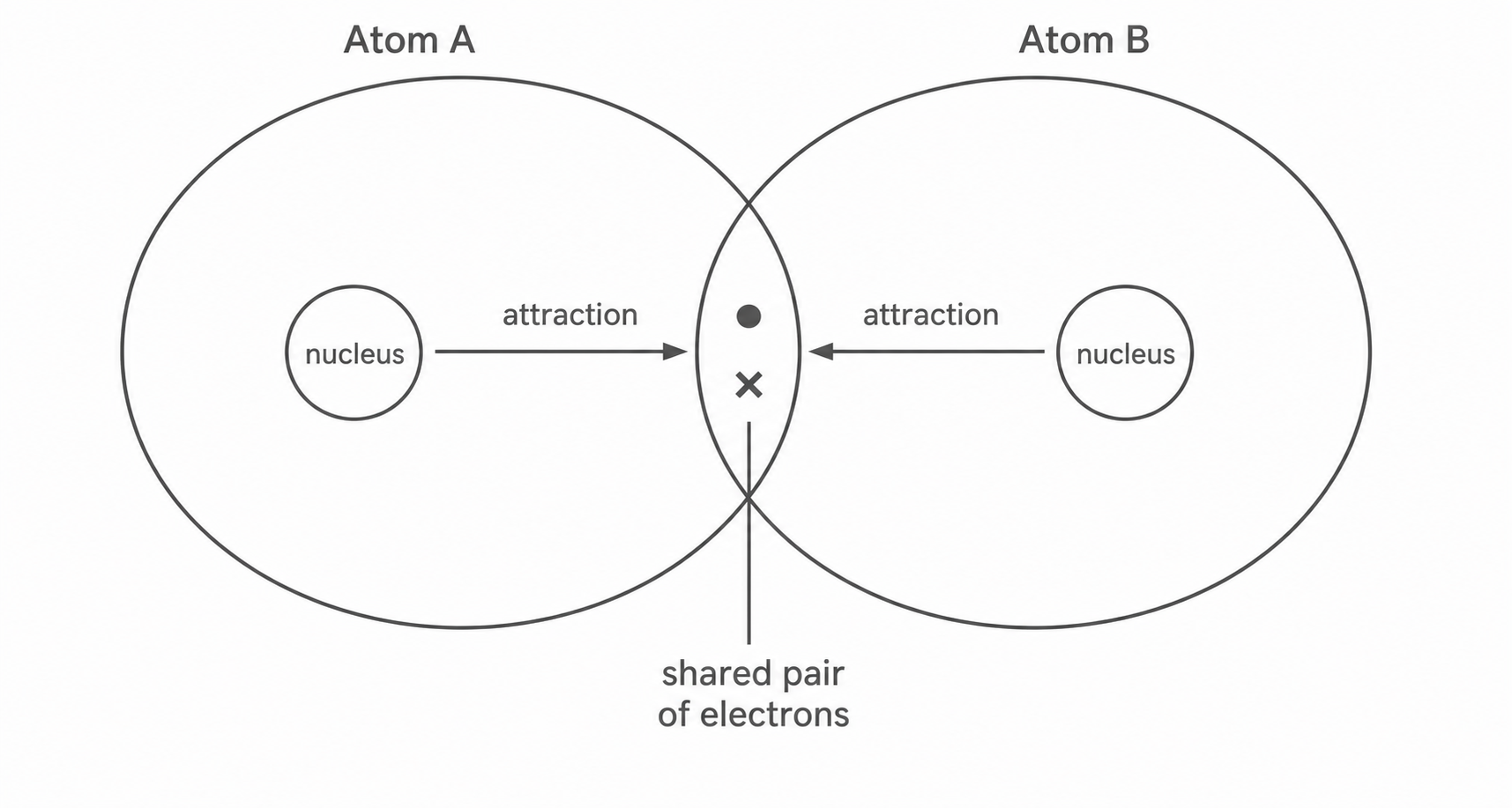
A covalent bond is different from ionic bonding. In covalent bonding, atoms share a pair of electrons. In ionic bonding, electrons are transferred and ions form. Dot-and-cross diagrams for covalent molecules therefore show shared pairs, not charges on ions.
Dot-and-cross rules
A dot-and-cross diagram is a way of showing which outer-shell electrons are involved in bonding. One atom's electrons are drawn as dots and the other atom's electrons are drawn as crosses. The dot and cross do not mean different charges; they only show which atom the electron came from.
Use this routine:
- Count the outer-shell electrons for each atom.
- Put one electron from each atom into a shared pair to make each single covalent bond.
- Use two shared pairs for a double bond and three shared pairs for a triple bond.
- Add remaining outer-shell electrons as lone pairs on the correct atom.
- Check that hydrogen has two electrons in its outer shell and period 2 atoms such as carbon, nitrogen and oxygen usually have eight.
A shared pair is a bonding pair. A lone pair is an outer-shell pair that is not shared. In Edexcel dot-and-cross questions, only the outer-shell electrons normally need to be shown unless the question says otherwise.
Worked example: hydrogen chloride, HCl. Hydrogen has one outer electron and chlorine has seven. They share one pair, so hydrogen has two electrons in its first shell and chlorine has eight outer electrons. Chlorine still has three lone pairs.
Diatomic molecules
A diatomic molecule contains two atoms. The specification expects you to represent hydrogen, oxygen, nitrogen, halogens and hydrogen halides.
[DIAGRAM: asset_name: Covalent bonding and dot-and-cross diagrams - diagram 02; asset_slug: c16_covalent_bonding_and_dot_and_cross_diagrams__diagram_02; recommended_method: image_gen; description: Monochrome dot-and-cross gallery for H2, O2 and N2 showing one, two and three shared pairs respectively, with correct lone pairs.]
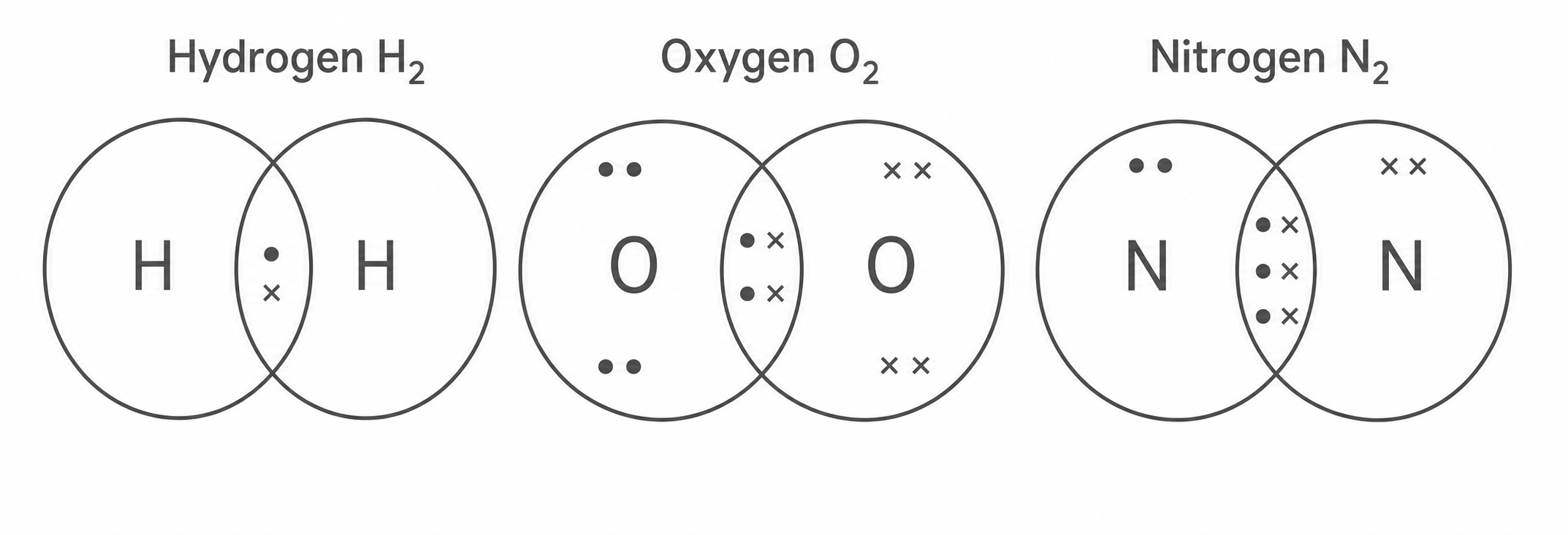
Hydrogen, H2, has one single covalent bond. Each hydrogen atom contributes one electron to the shared pair.
Oxygen, O2, has a double covalent bond. Each oxygen atom has six outer electrons, so the two atoms share two pairs and each oxygen keeps two lone pairs.
Nitrogen, N2, has a triple covalent bond. Each nitrogen atom has five outer electrons, so the two atoms share three pairs and each nitrogen keeps one lone pair.
Continue this lesson.
You’re previewing NovaLearn without an account. Create a free account to read the rest.
Create free account