2.37-2.38 - Acid reactions and bases
Acids make salts in several predictable ways. This lesson keeps the patterns separate: acids can react with metals, bases and metal carbonates, but the products are not always the same. The acid helps decide the salt ending, while the metal or ammonium part supplies the first part of the salt name.
Three product patterns
The specification names three acids here: hydrochloric acid, sulfuric acid and nitric acid. It also names three types of reactant with acids: metals, bases and metal carbonates. Each reaction forms a salt, but the other products depend on which type of reactant is used.
Salt
A salt is an ionic compound formed when the hydrogen in an acid is replaced by a metal ion or by an ammonium ion.
[DIAGRAM: asset_name: Acid reactions and bases - diagram 01; asset_slug: c34_acid_reactions_and_bases__diagram_01; recommended_method: image_gen; description: Monochrome three-panel summary of acid reaction patterns: metal plus acid gives salt and hydrogen with fizzing, metal oxide or hydroxide plus acid gives salt and water with no gas, and metal carbonate plus acid gives salt, water and carbon dioxide with fizzing.]
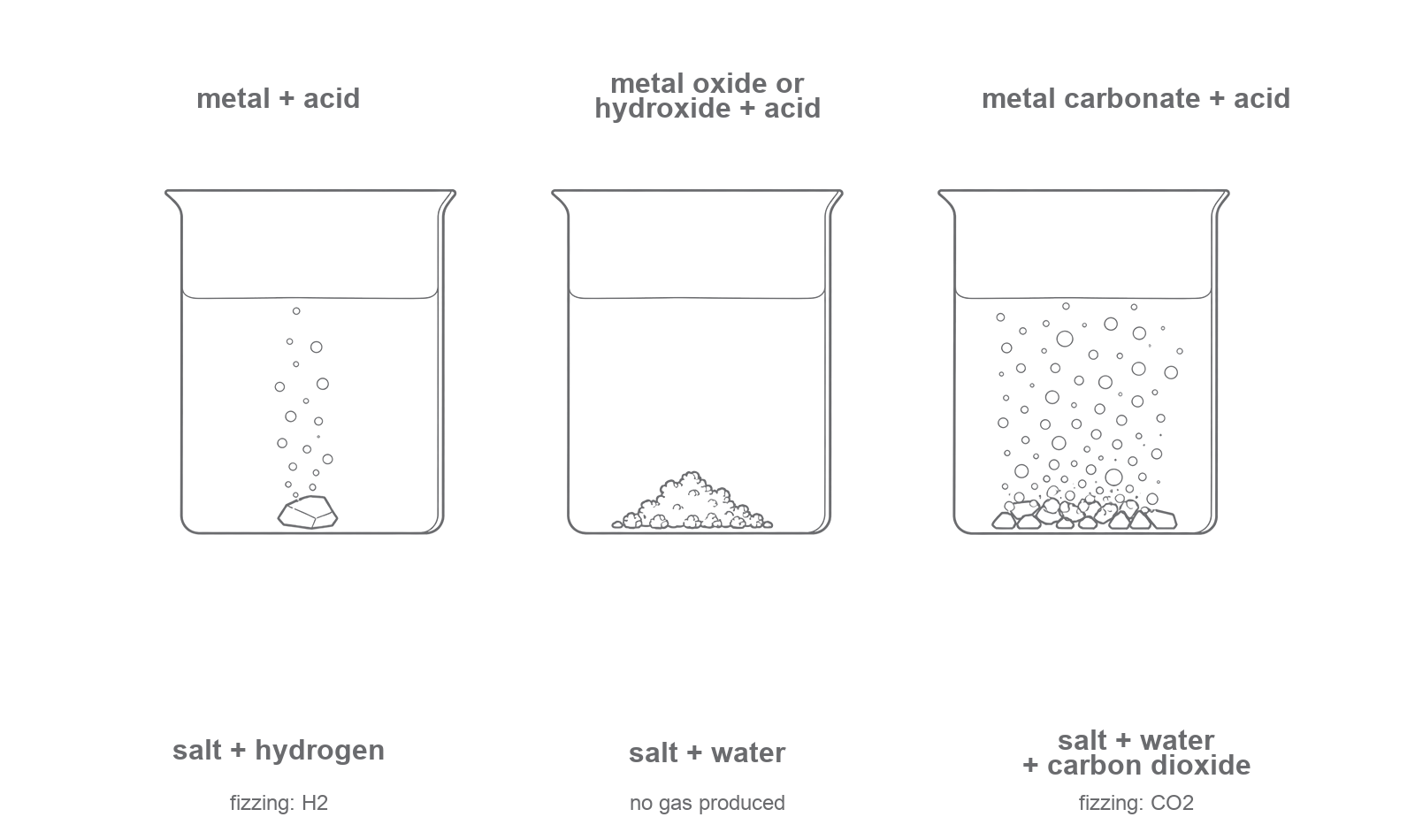
The three core word equations are:
Acid with metal
In this pattern, the gas made is hydrogen.
Acid with metal oxide or metal hydroxide
This base reaction has water as the extra product and no gas.
Acid with metal carbonate
The fizzing matters. If a metal reacts with a suitable dilute acid, the bubbles are hydrogen. If a metal carbonate reacts with an acid, the bubbles are carbon dioxide. Acid reactions with metal oxides and metal hydroxides usually do not produce a gas; the solid base may disappear as it reacts.
Nitric acid has one special boundary in this specification: reactions between nitric acid and metals are excluded. You still need nitric acid with bases and metal carbonates, because those reactions form nitrates.
Ammonia is also a base, but it forms ammonium salts rather than following the metal oxide or metal hydroxide pattern exactly. That case is handled separately below.
Naming the salt
A salt name has two useful parts:
- The first part comes from the metal ion or from ammonium.
- The ending comes from the acid used.
[DIAGRAM: asset_name: Acid reactions and bases - diagram 02; asset_slug: c34_acid_reactions_and_bases__diagram_02; recommended_method: image_gen; description: Monochrome salt-naming flowchart showing that hydrochloric acid gives chlorides, sulfuric acid gives sulfates, nitric acid gives nitrates, and the metal/base/carbonate/ammonia reactant supplies the first part of the salt name.]
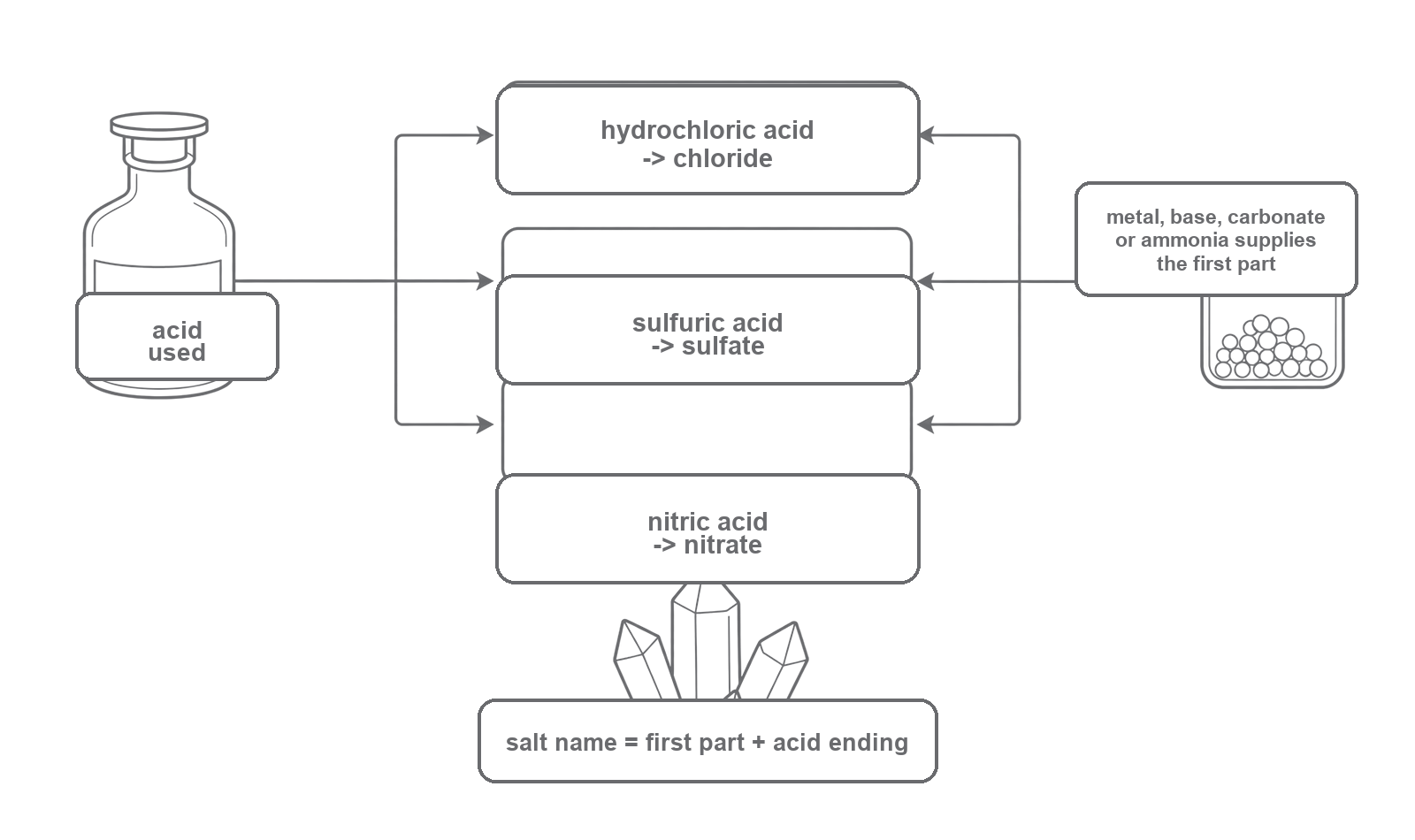
Learn these acid endings:
| Acid used | Salt ending |
|---|---|
| hydrochloric acid | chloride |
| sulfuric acid | sulfate |
| nitric acid | nitrate |
Then add the first part from the other reactant:
| Reaction mixture | Salt formed |
|---|---|
| magnesium + hydrochloric acid | magnesium chloride |
| copper(II) oxide + sulfuric acid | copper(II) sulfate |
| potassium hydroxide + nitric acid | potassium nitrate |
| calcium carbonate + nitric acid | calcium nitrate |
| ammonia + hydrochloric acid | ammonium chloride |
Do not call every salt a chloride just because an acid is present. The acid name decides the ending: hydrochloric acid gives chlorides, sulfuric acid gives sulfates, and nitric acid gives nitrates.
The metal name should stay precise. If the reactant is copper(II) oxide, the salt is copper(II) sulfate with sulfuric acid or copper(II) nitrate with nitric acid. The roman numeral is part of the ion name.
Acids with metals
Reactive metals such as magnesium and zinc react with dilute hydrochloric acid or dilute sulfuric acid to make a salt and hydrogen. The reaction is often seen as fizzing or effervescence, and the metal may get smaller as it reacts.
For hydrochloric acid:
For sulfuric acid:
Continue this lesson.
You’re previewing NovaLearn without an account. Create a free account to read the rest.
Create free account