1.47-1.48 - Simple molecular substances
Simple molecular substances are made from separate molecules. The covalent bonds inside each molecule are strong, but the forces between neighbouring molecules are much weaker. That difference explains why many simple molecular substances are gases or liquids, and why the ones that are solids usually melt and boil at relatively low temperatures.
Inside molecules and between molecules
A simple molecular substance contains separate molecules. Each molecule is a fixed group of atoms joined by covalent bonds. The molecules are not joined together into a giant lattice.
Simple molecular substance
A simple molecular substance is a substance made from separate molecules, with covalent bonds inside each molecule.
There are two different attractions to keep apart in your mind:
| Attraction | Where it acts | Relative strength |
|---|---|---|
| Covalent bond | Between atoms inside one molecule | Strong |
| Intermolecular force | Between separate molecules | Weak compared with covalent bonds |
[DIAGRAM: asset_name: Simple molecular substances - diagram 01; asset_slug: c17_simple_molecular_substances__diagram_01; recommended_method: image_gen; description: A NovaLearn monochrome diagram of three separate simple molecules, showing strong covalent bonds inside each molecule and weak intermolecular forces between neighbouring molecules.]
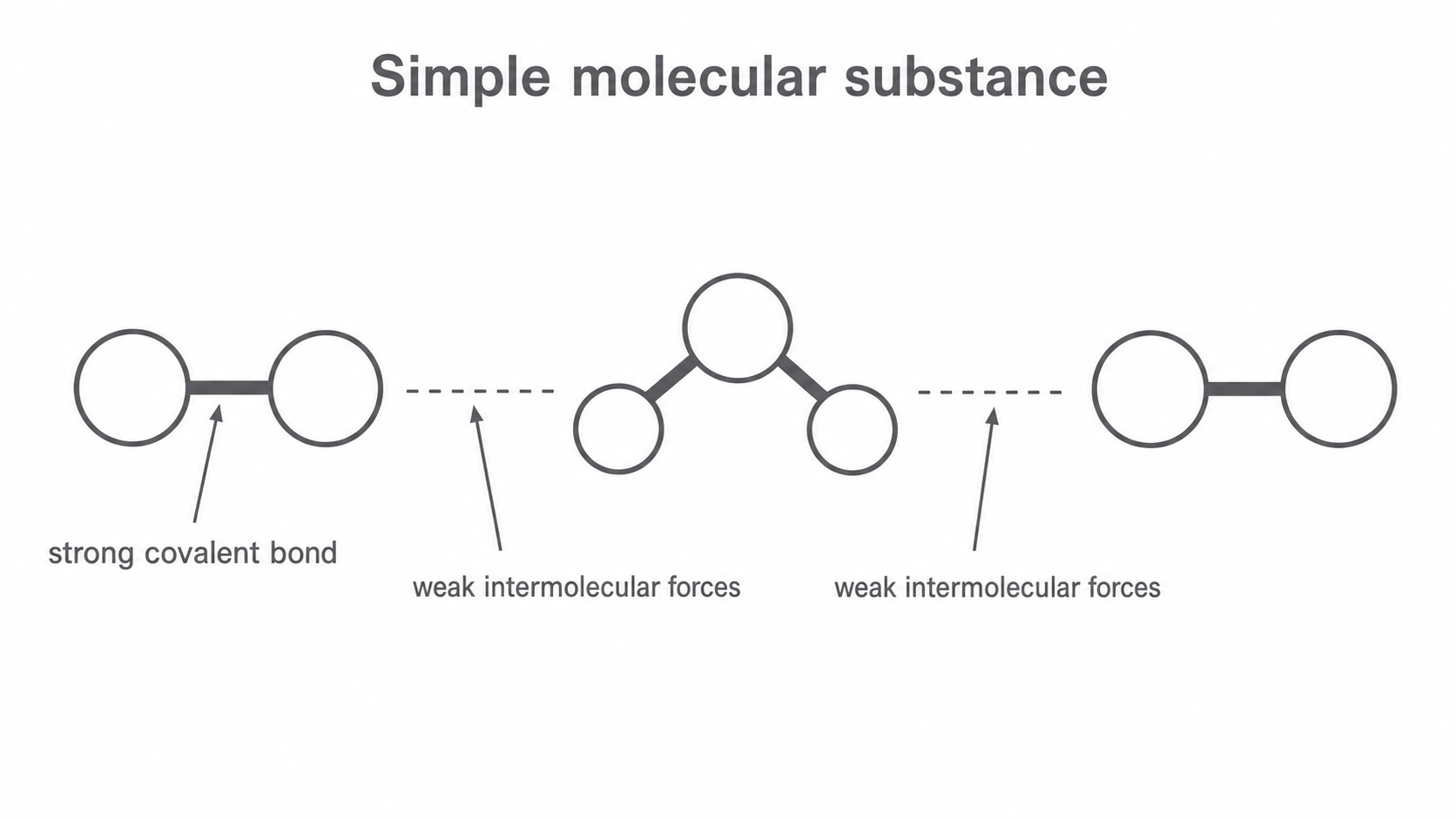
Intermolecular forces of attraction
Intermolecular forces of attraction are forces between molecules. In this lesson, the term is used as an umbrella term for all forces between molecules.
The word intermolecular means "between molecules". It does not mean between atoms inside one molecule. That is why an answer such as "weak covalent bonds between molecules" loses the chemistry: the covalent bonds are within molecules, while the weak forces are between molecules.
Low melting and boiling points
When a substance melts or boils, its particles gain enough energy to move more freely. In a simple molecular substance, the particles are molecules. Melting or boiling therefore requires the molecules to separate from one another or move past one another.
The important point is that only the weak intermolecular forces need to be overcome. Because these forces are weak, not much energy is needed. This gives simple molecular substances low melting and boiling points.
This is why many simple molecular substances are gases or liquids at room temperature. Oxygen, nitrogen, and chlorine are gases because their boiling points are below room temperature. Bromine is a liquid at room temperature. Iodine is a solid at room temperature, but it still has a much lower melting point than a giant structure such as diamond or sodium chloride.
Simple molecular substances have low melting and boiling points because weak intermolecular forces between molecules need little energy to overcome.
In an explanation, make the link complete: weak forces between molecules lead to little energy needed, which leads to a low melting or boiling point.
What changes during melting and boiling
A simple molecular substance does not turn into separate atoms when it melts or boils. The molecules stay as molecules. For example, when liquid bromine evaporates, bromine molecules move further apart; the atoms inside each bromine molecule are still joined by covalent bonds.
Continue this lesson.
You’re previewing NovaLearn without an account. Create a free account to read the rest.
Create free account