2.5-2.8C - Group 7 halogens
Group 7 contains the halogens: a family of reactive non-metals with similar chemical behaviour. In this lesson, the named halogens are chlorine, bromine and iodine. You need to know their colours and states, use trends to make predictions, and explain how displacement reactions show their reactivity order.
The halogen family
The halogens are in Group 7 of the periodic table. The Edexcel Group 7 examples are chlorine, bromine and iodine. Each element exists as simple diatomic molecules, so chlorine is Cl2, bromine is Br2 and iodine is I2.
Halogen
A halogen is an element in Group 7 of the periodic table.
At room temperature, the colours and physical states you should know are:
| Halogen | Formula | Colour | Physical state at room temperature |
|---|---|---|---|
| chlorine | Cl2 | green or yellow-green | gas |
| bromine | Br2 | red-brown | liquid |
| iodine | I2 | grey-black or black | solid |
Down Group 7, the halogens become darker in colour. Their melting points and boiling points increase, which is why chlorine is a gas, bromine is a liquid and iodine is a solid at room temperature.
[DIAGRAM: asset_name: Group 7 halogens - diagram 01; asset_slug: c23_group_7_halogens__diagram_01; recommended_method: deterministic_drawing; description: A monochrome line graph comparing melting and boiling points of chlorine, bromine and iodine, with a 20 deg C room-temperature reference line and state labels.]
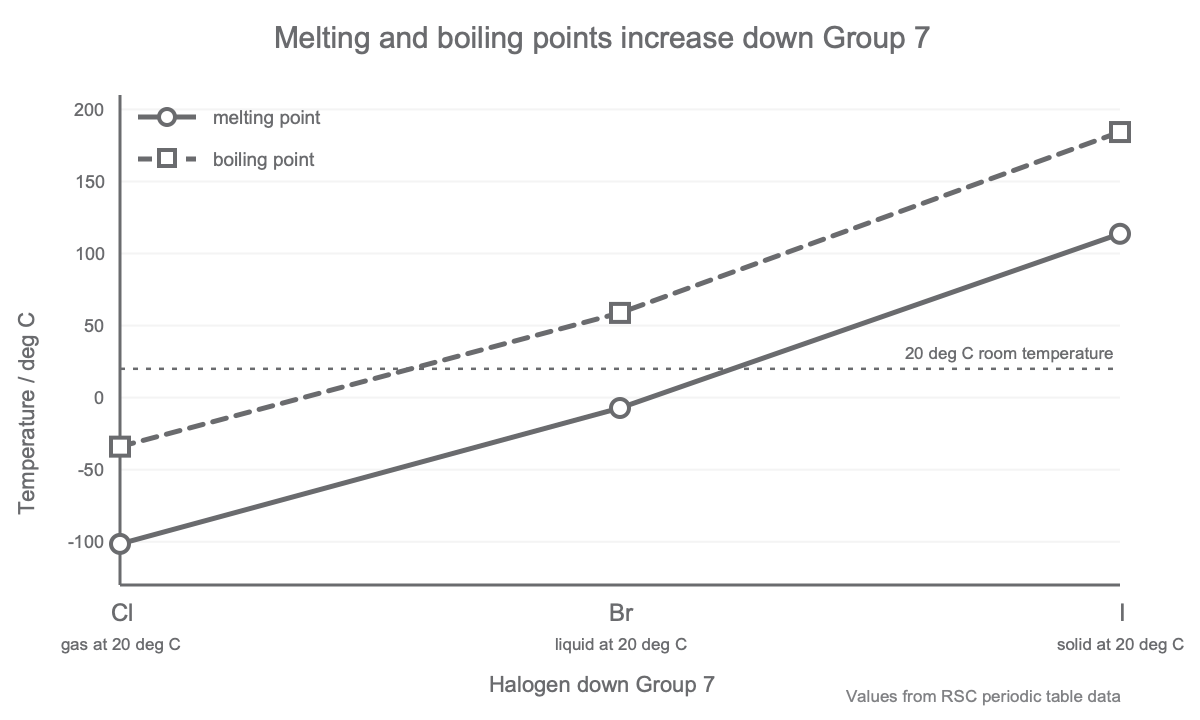
For chlorine, bromine and iodine, the physical trend down Group 7 is darker colour and higher melting and boiling points.
Use the table facts first, then use the trend to check that the states make sense.
Predicting properties
A trend lets you make a sensible prediction for a halogen you have not been given directly. First decide whether the element is above or below the halogens you know, then extend the pattern.
If a halogen is above chlorine, it should have lower melting and boiling points than chlorine and should be a gas at room temperature. Fluorine fits this pattern: it is above chlorine, very pale, gaseous, and more reactive than chlorine.
If a halogen is below iodine, it should have higher melting and boiling points than iodine, so it is predicted to be a dark solid at room temperature. Astatine is below iodine; for IGCSE trend predictions, treat it as a dark solid and less reactive than iodine. It is radioactive and only exists in tiny amounts, so exam questions usually ask for prediction rather than practical observations of astatine.
Reactivity has the opposite trend from melting and boiling points:
| Trend down Group 7 | What happens |
|---|---|
| colour | gets darker |
| melting point | increases |
| boiling point | increases |
| physical state at room temperature | gas to liquid to solid |
| reactivity | decreases |
Displacement reactions
Halogens react by gaining one electron to form halide ions. The names are easy to mix up: chlorine is the element, but chloride is the ion. Bromine forms bromide ions, and iodine forms iodide ions.
Halide Ion
A halide ion is a negative ion formed from a Group 7 atom, such as Cl-, Br- or I-.
A more reactive halogen displaces a less reactive halogen from a solution containing its halide ions. In this reaction, "displaces" means "takes its place": the added halogen becomes a halide ion, and the ion of the less reactive halogen becomes the halogen element.
[DIAGRAM: asset_name: Group 7 halogens - diagram 02; asset_slug: c23_group_7_halogens__diagram_02; recommended_method: image_gen; description: A monochrome reactivity ladder showing chlorine above bromine above iodine, with one reaction example for a higher halogen displacing a lower halogen from halide ions and one no-reaction example for a lower halogen added to a higher halide ion.]
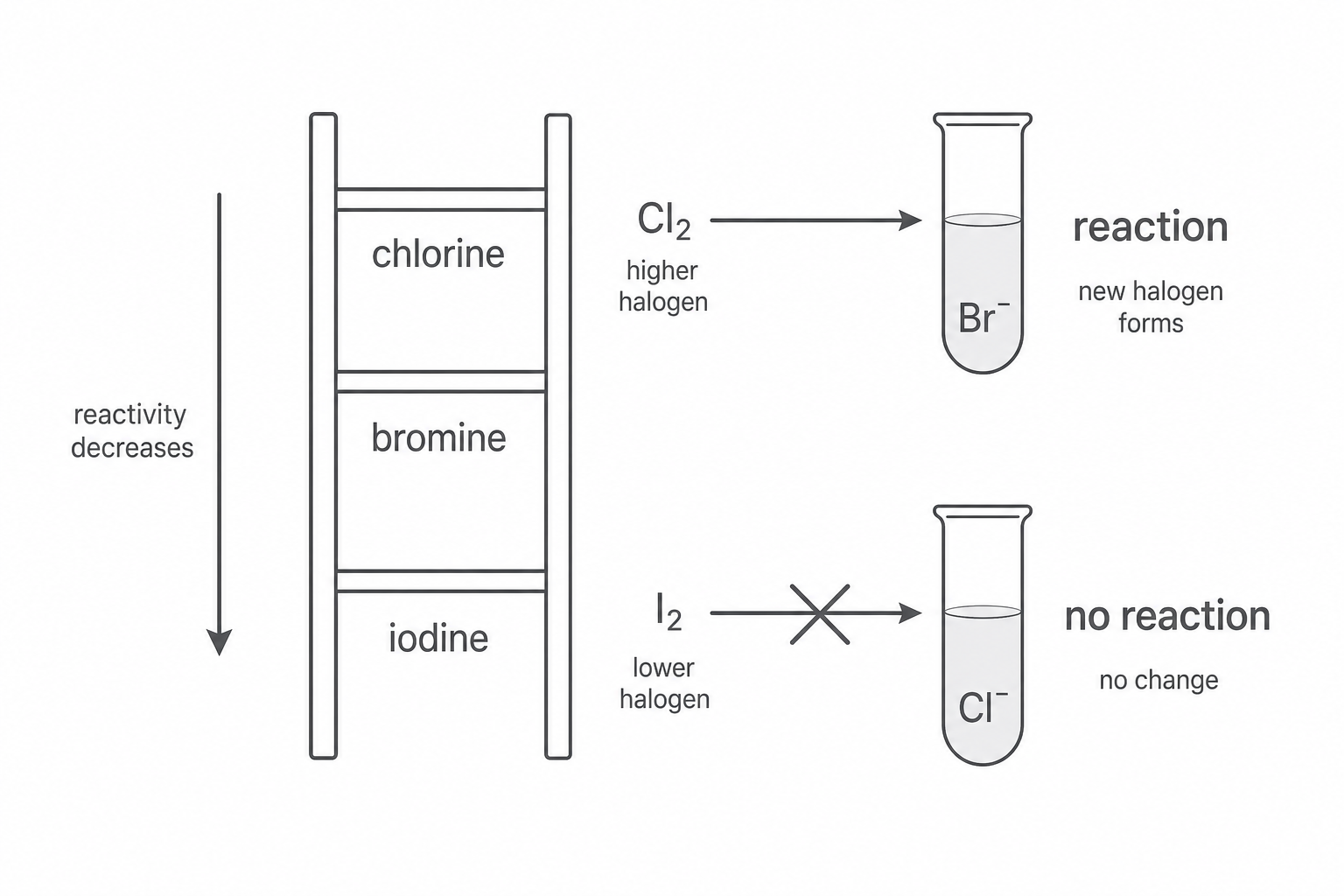
The reactivity order is:
chlorine > bromine > iodine
So chlorine can displace bromine from bromide ions and iodine from iodide ions:
chlorine + potassium bromide -> potassium chloride + bromine
Cl2 + 2KBr -> 2KCl + Br2
Cl2 + 2Br- -> 2Cl- + Br2
Bromine can displace iodine from iodide ions:
bromine + potassium iodide -> potassium bromide + iodine
Br2 + 2KI -> 2KBr + I2
Br2 + 2I- -> 2Br- + I2
Iodine is less reactive than chlorine and bromine, so iodine does not displace chlorine from chloride ions or bromine from bromide ions.
Continue this lesson.
You’re previewing NovaLearn without an account. Create a free account to read the rest.
Create free account