4.11-4.13 - Complete and incomplete combustion
Hydrocarbon fuels are useful because burning them transfers energy to the surroundings as heat. The products formed depend on how much oxygen is available. In this lesson, the key comparison is complete combustion in plenty of oxygen versus incomplete combustion when the oxygen supply is limited.
Fuels and burning
A fuel is useful only if it releases energy when it burns. In this topic, "burning" means combustion: a reaction with oxygen in the air.
Fuel
A fuel is a substance that, when burned, releases heat energy.
Most fuels in this part of the course are hydrocarbons. A hydrocarbon contains hydrogen and carbon only. When a hydrocarbon burns, its carbon atoms and hydrogen atoms react with oxygen from the air.
Do not write "fuel turns into energy". Energy is released, but the atoms still end up in chemical products. A better exam pattern is:
hydrocarbon fuel + oxygen -> combustion products + heat energy
The exact chemical products depend on the oxygen supply. Plenty of oxygen gives complete combustion. Too little oxygen gives incomplete combustion.
Complete combustion
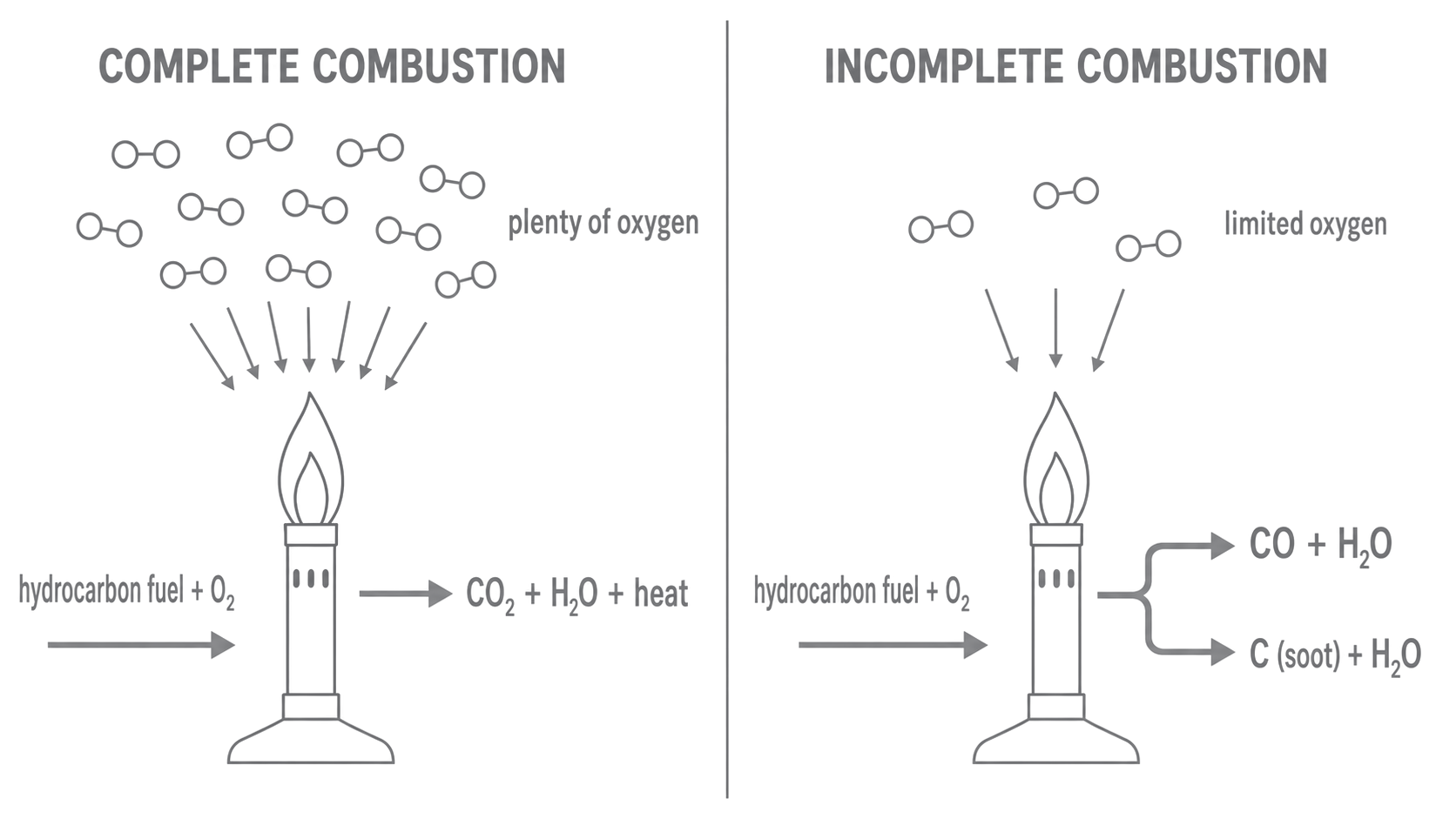
Complete combustion happens when a hydrocarbon burns in plenty of oxygen. The carbon in the hydrocarbon forms carbon dioxide, and the hydrogen in the hydrocarbon forms water.
Complete Combustion
Complete combustion of a hydrocarbon happens when there is enough oxygen for the carbon to form carbon dioxide and the hydrogen to form water.
The word equation is:
hydrocarbon + oxygen -> carbon dioxide + water
For methane:
For propane:
Notice the pattern: all the carbon atoms in the fuel appear in CO2, and all the hydrogen atoms in the fuel appear in H2O. Heat energy is released, but heat is not a chemical product with a formula.
[DIAGRAM: asset_name: Complete and incomplete combustion - diagram 01; asset_slug: c51_complete_and_incomplete_combustion__diagram_01; recommended_method: image_gen; description: Monochrome two-column comparison of complete and incomplete hydrocarbon combustion. Complete combustion shows plenty of oxygen producing carbon dioxide, water and heat. Incomplete combustion shows limited oxygen producing carbon monoxide and/or carbon soot plus water. White background with #6A6B6E linework and text.]
Incomplete combustion
Incomplete combustion happens when there is not enough oxygen for every carbon atom in the hydrocarbon to become carbon dioxide. The hydrogen still usually forms water, but some carbon forms carbon monoxide or solid carbon instead of carbon dioxide.
Incomplete Combustion
Incomplete combustion is combustion with a limited oxygen supply, producing carbon monoxide and/or carbon as possible products.
The possible products of incomplete combustion of hydrocarbons are:
| Product | Formula | Why it forms |
|---|---|---|
| water | H2O | hydrogen from the hydrocarbon reacts with oxygen |
| carbon monoxide | CO | carbon reacts with some oxygen, but not enough to make only CO2 |
| carbon | C | some carbon does not get enough oxygen and remains as soot |
| carbon dioxide | CO2 | may still form in a real flame where some fuel burns completely |
For methane making carbon monoxide:
For methane making solid carbon:
Carbon, C, is the black solid seen as soot. It is a sign that the fuel has not burned completely. A yellow, smoky flame is often associated with more incomplete combustion than a clean, non-smoky flame.
Continue this lesson.
You’re previewing NovaLearn without an account. Create a free account to read the rest.
Create free account