4.19-4.22 - Alkanes
Alkanes are the simplest family of hydrocarbons in this organic chemistry section. You need to recognise their general formula, explain why they are saturated, draw their structural and displayed formulae, and describe their substitution reactions with halogens in ultraviolet radiation. Keep the boundary tight: the alkene bromine-water test is not part of this lesson.
Alkanes and the general formula
An alkane is a hydrocarbon. That means each molecule contains carbon and hydrogen atoms only.
Hydrocarbon
A hydrocarbon is a compound that contains hydrogen and carbon only.
The general formula for alkanes is:
Alkanes
The letter n means the number of carbon atoms in one molecule. Once you know n, you can calculate the number of hydrogen atoms.
For example, propane has three carbon atoms, so n = 3:
So the molecular formula of propane is C3H8.
Number of carbon atoms, n | Alkane molecular formula |
|---|---|
| 1 | CH4 |
| 2 | C2H6 |
| 3 | C3H8 |
| 4 | C4H10 |
| 5 | C5H12 |
The formula test is useful in multiple-choice and short-answer questions. A compound with formula C4H10 fits the alkane formula because 2n + 2 = 10 when n = 4. A compound with formula C4H8 does not fit the alkane formula.
Saturated hydrocarbons
Alkanes are classified as saturated hydrocarbons. The word has two parts in a Pearson-style explanation.
First, they are hydrocarbons because they contain carbon and hydrogen only. Second, they are saturated because their carbon atoms are joined by single covalent bonds only. They do not contain a carbon-carbon double bond.
Saturated Hydrocarbon
A saturated hydrocarbon contains carbon and hydrogen only, and has only single bonds between carbon atoms.
For alkanes, "saturated" also means that no extra atoms can be added across a carbon-carbon double bond, because there is no carbon-carbon double bond to open up. Do not write only "it has single bonds" if the question asks why an alkane is a saturated hydrocarbon; include the hydrocarbon part as well.
| Exam phrase | What it should mean |
|---|---|
| hydrocarbon | contains hydrogen and carbon only |
| saturated | only single carbon-carbon bonds / no carbon-carbon double bonds |
| maximum number of hydrogens | follows from the single-bond carbon chain |
| not saturated in the alkene contrast | has a carbon-carbon double bond somewhere in the molecule |
Names and formulae
You need to name the unbranched-chain alkanes up to five carbon atoms. The prefix tells you the number of carbon atoms, and the ending -ane tells you it is an alkane.
| Carbon atoms | Name | Molecular formula | Structural formula |
|---|---|---|---|
| 1 | methane | CH4 | CH4 |
| 2 | ethane | C2H6 | CH3CH3 |
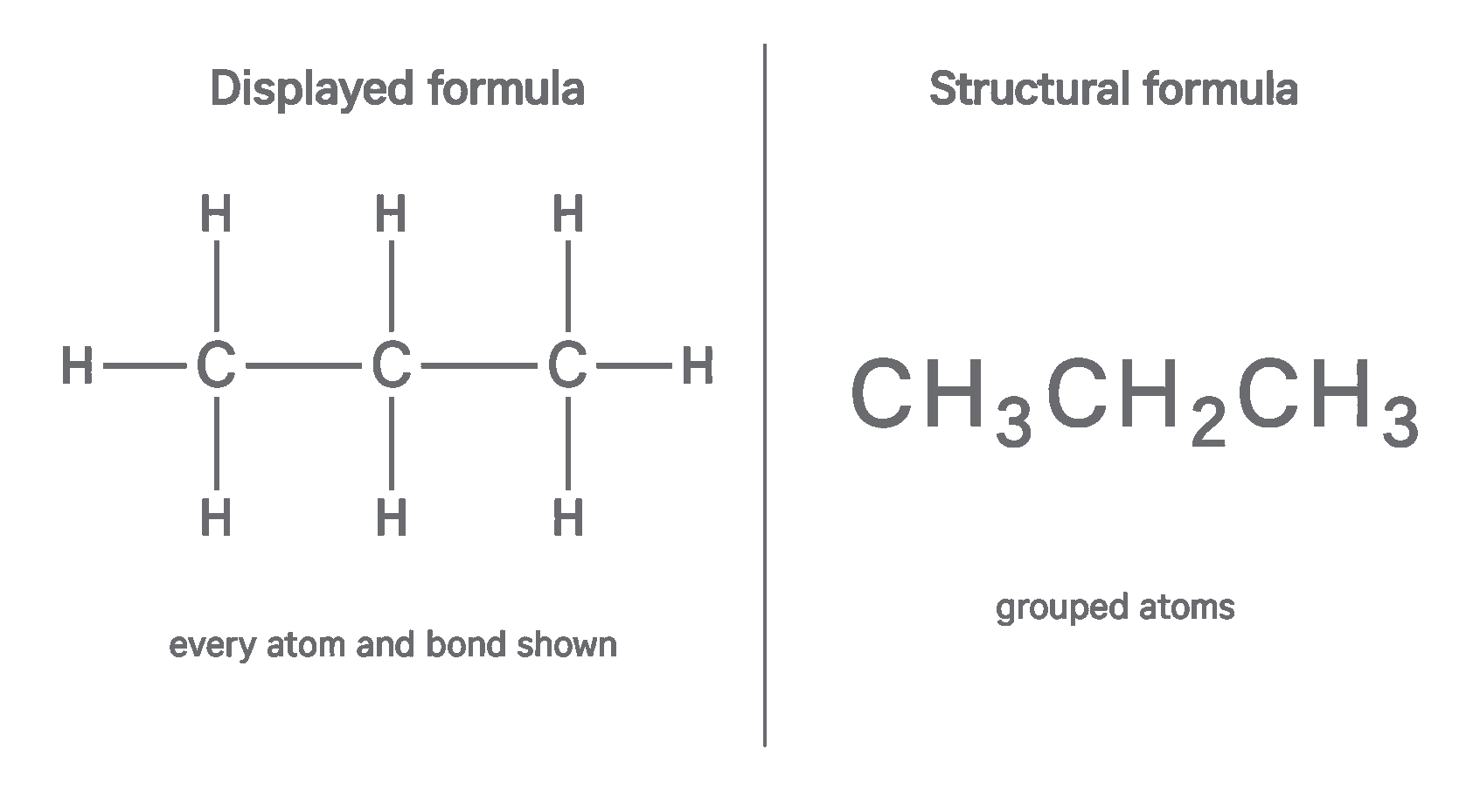
| 3 | propane | C3H8 | CH3CH2CH3 |
| 4 | butane | C4H10 | CH3CH2CH2CH3 |
| 5 | pentane | C5H12 | CH3CH2CH2CH2CH3 |
A molecular formula gives the number of each type of atom in the molecule. A structural formula shows how the atoms are grouped and connected. A displayed formula goes further: it shows every atom and every covalent bond.
[DIAGRAM: asset_name: Alkanes - diagram 01; asset_slug: c54_alkanes__diagram_01; recommended_method: image_gen; description: Monochrome comparison of propane as a displayed formula and as the structural formula CH3CH2CH3, with callouts that the displayed formula shows every atom and every bond while the structural formula groups atoms along the carbon chain.]
Continue this lesson.
You’re previewing NovaLearn without an account. Create a free account to read the rest.
Create free account