2.15-2.17, 2.21 - Reactivity series and acid-metal reactions
Metals do not all react with the same eagerness. Some react quickly with water, some react only with dilute acids, and some barely react in these tests at all. The reactivity series is a way to put these observations into an order that lets you predict acid reactions and displacement reactions.
Ordering metals by reactivity
A metal is described as more reactive if it takes part in these reactions more readily. In this lesson, the evidence comes from reactions with water, reactions with dilute hydrochloric or sulfuric acid, and displacement reactions.
Reactivity series
A list of metals arranged from the most reactive at the top to the least reactive at the bottom.
You need to know this order:
| More reactive at the top | Metal |
|---|---|
| 1 | potassium |
| 2 | sodium |
| 3 | lithium |
| 4 | calcium |
| 5 | magnesium |
| 6 | aluminium |
| 7 | zinc |
| 8 | iron |
| 9 | copper |
| 10 | silver |
| 11 | gold |
The top metals react most readily. Potassium, sodium, lithium and calcium react with cold water; the more reactive examples in this group react more vigorously. Magnesium, aluminium, zinc and iron are lower down; they are usually compared using dilute acids because their reactions with cold water are much less useful as a simple test. Copper, silver and gold are near the bottom and do not react with cold water or dilute hydrochloric/sulfuric acid.
Aluminium needs one careful thought: it is above zinc in the reactivity series, but a thin aluminium oxide layer can make a piece of aluminium look less reactive in simple classroom observations.
Reactions with water and dilute acids
For the most reactive metals in this list, cold water is enough to produce hydrogen. Potassium, sodium and lithium form metal hydroxides; calcium also forms calcium hydroxide and hydrogen. Calcium hydroxide is only slightly soluble, so the simple equation below does not rely on an aqueous state symbol for it.
Metal with water
For example:
Metals such as magnesium, zinc and iron are more safely and usefully compared using dilute hydrochloric acid or dilute sulfuric acid.
Metal with dilute acid
The acid decides the type of salt:
| Acid | Salt type formed | Example |
|---|---|---|
| dilute hydrochloric acid | chloride | magnesium chloride |
| dilute sulfuric acid | sulfate | zinc sulfate |
Useful symbol equations include:
The usual observations are fizzing or effervescence, the metal getting smaller, and sometimes the mixture warming up. The gas is hydrogen, which gives a squeaky pop with a lighted splint.
Potassium, sodium and lithium are not sensible metals for an acid comparison because they are too reactive. Copper, silver and gold are too unreactive to give visible reactions with these dilute acids.
Investigating acid-metal reactions
The specification practical investigates reactions between dilute hydrochloric and sulfuric acids and metals such as magnesium, zinc and iron. A good method lets you compare the metals fairly, so a faster reaction really means a more reactive metal rather than just a different set-up.
[DIAGRAM: asset_name: Reactivity series and acid-metal reactions - diagram 01; asset_slug: c26_reactivity_series_and_acid_metal_reactions__diagram_01; recommended_method: image_gen; description: Monochrome apparatus schematic showing a conical flask containing dilute acid and metal pieces, sealed with a bung, with the delivery tube opening into the flask headspace above the liquid and leading to a gas syringe collecting hydrogen.]
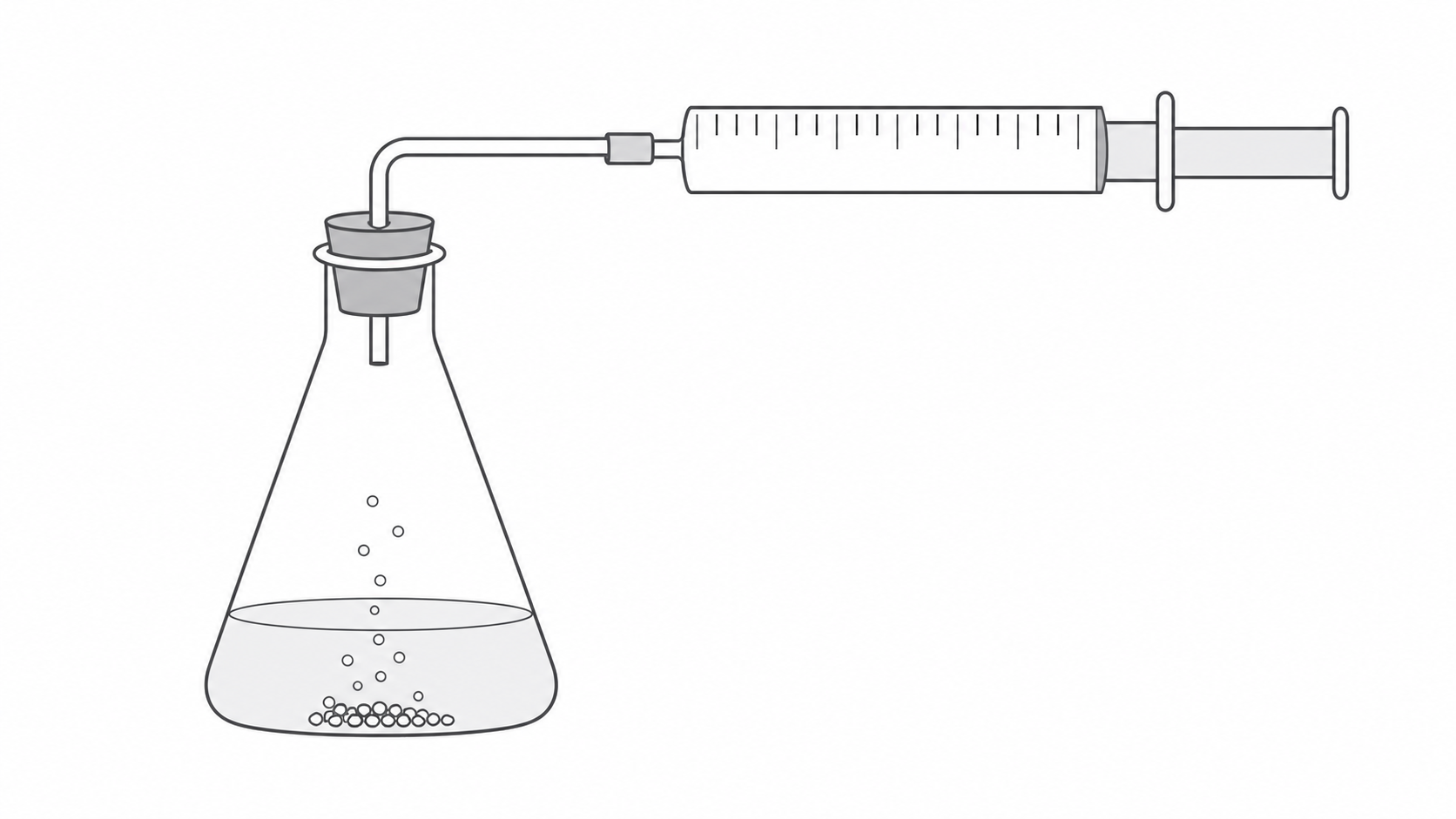
One suitable method is:
- Measure the same volume and concentration of dilute acid into a conical flask.
- Add a measured amount of one metal, using pieces with comparable surface area or the same particle size where possible.
- Fit the bung and gas syringe quickly, then start the timer.
- Record the volume of hydrogen at regular time intervals.
- Repeat with the other metals, keeping the set-up the same.
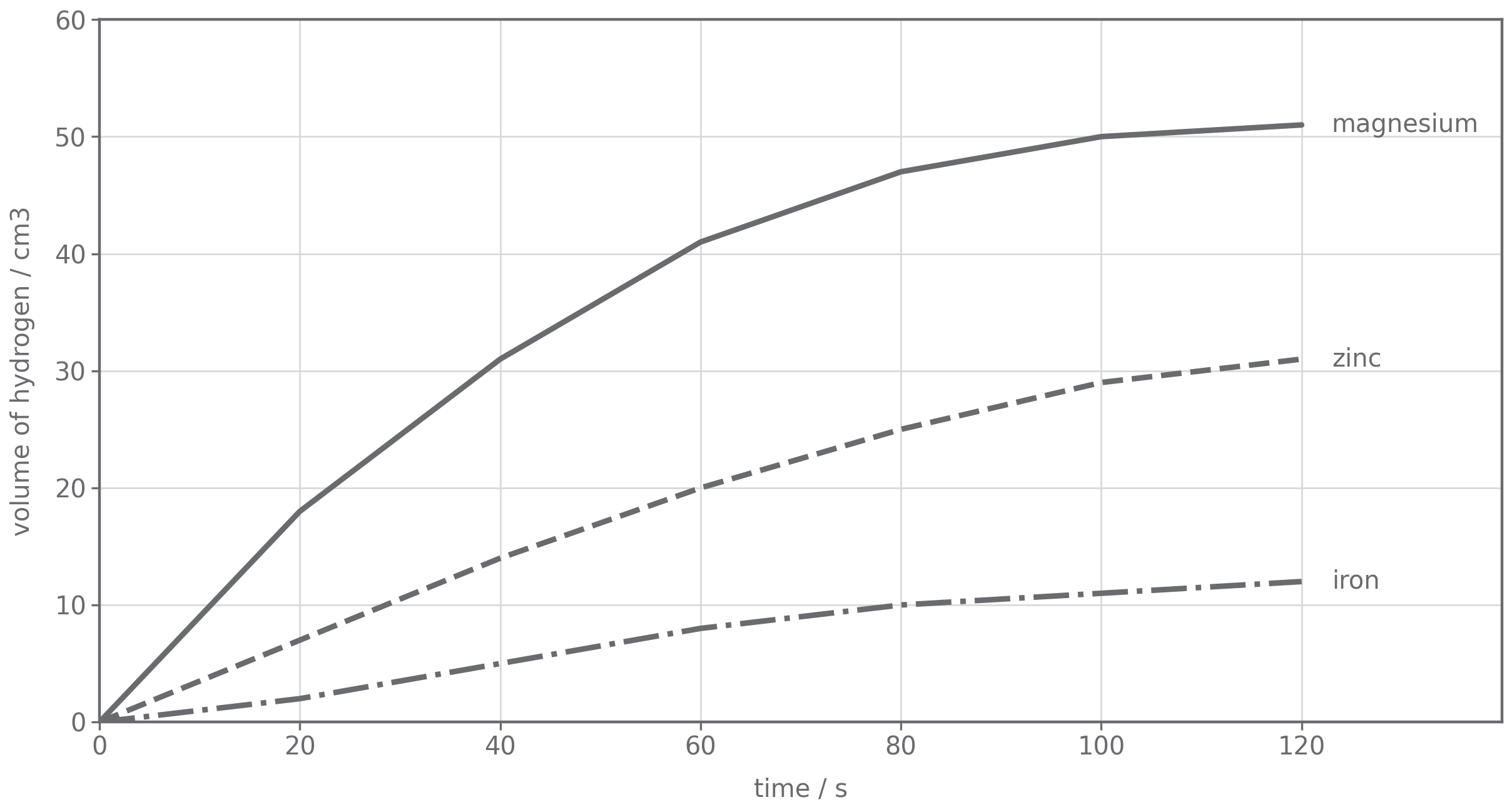
The independent variable is the metal used. The dependent variable should be a rate measure, such as the initial gradient of a gas-volume graph, the time taken to collect a fixed small volume of hydrogen, or the volume collected in the same short early time while the acid is in excess. Important control variables include acid volume, acid concentration, temperature, amount or mass of metal, surface area or particle size of metal, and how clean the metal surface is.
[DIAGRAM: asset_name: Reactivity series and acid-metal reactions - diagram 03; asset_slug: c26_reactivity_series_and_acid_metal_reactions__diagram_03; recommended_method: matplotlib; description: Monochrome line graph of volume of hydrogen in cm3 against time in seconds for magnesium, zinc and iron reacting with dilute acid; magnesium has the steepest curve, zinc is intermediate and iron is slowest.]
Continue this lesson.
You’re previewing NovaLearn without an account. Create a free account to read the rest.
Create free account