4.17-4.18 - Cracking and demand for fractions
Fractional distillation separates crude oil into fractions, but it does not automatically give refiners the amounts people want. Catalytic cracking is the chemical process that turns some surplus long-chain alkanes into shorter-chain alkanes and alkenes. In this lesson, you will learn the required conditions, how cracking equations work, and how to explain the supply-demand reason for cracking in Pearson mark-scheme style.
Why cracking is needed
Crude oil contains many different hydrocarbons. After fractional distillation, some fractions contain long-chain molecules and some contain shorter-chain molecules.
The problem is a balance problem. There is usually a greater demand for shorter-chain fractions, especially fuels such as gasoline or petrol, than the amount obtained directly from crude oil. There is less demand for some larger fractions, so cracking is used to convert some of those larger molecules into smaller, more useful products.
[DIAGRAM: asset_name: Cracking and demand for fractions - diagram 01; asset_slug: c53_cracking_and_demand_for_fractions__diagram_01; recommended_method: image_gen; description: Monochrome supply-demand concept diagram on a white background. Show surplus long-chain fractions on the left, shortage or high demand for short-chain fractions on the right, and an arrow labelled cracking linking surplus large molecules to more useful short-chain products. Use #6A6B6E linework and minimal labels.]
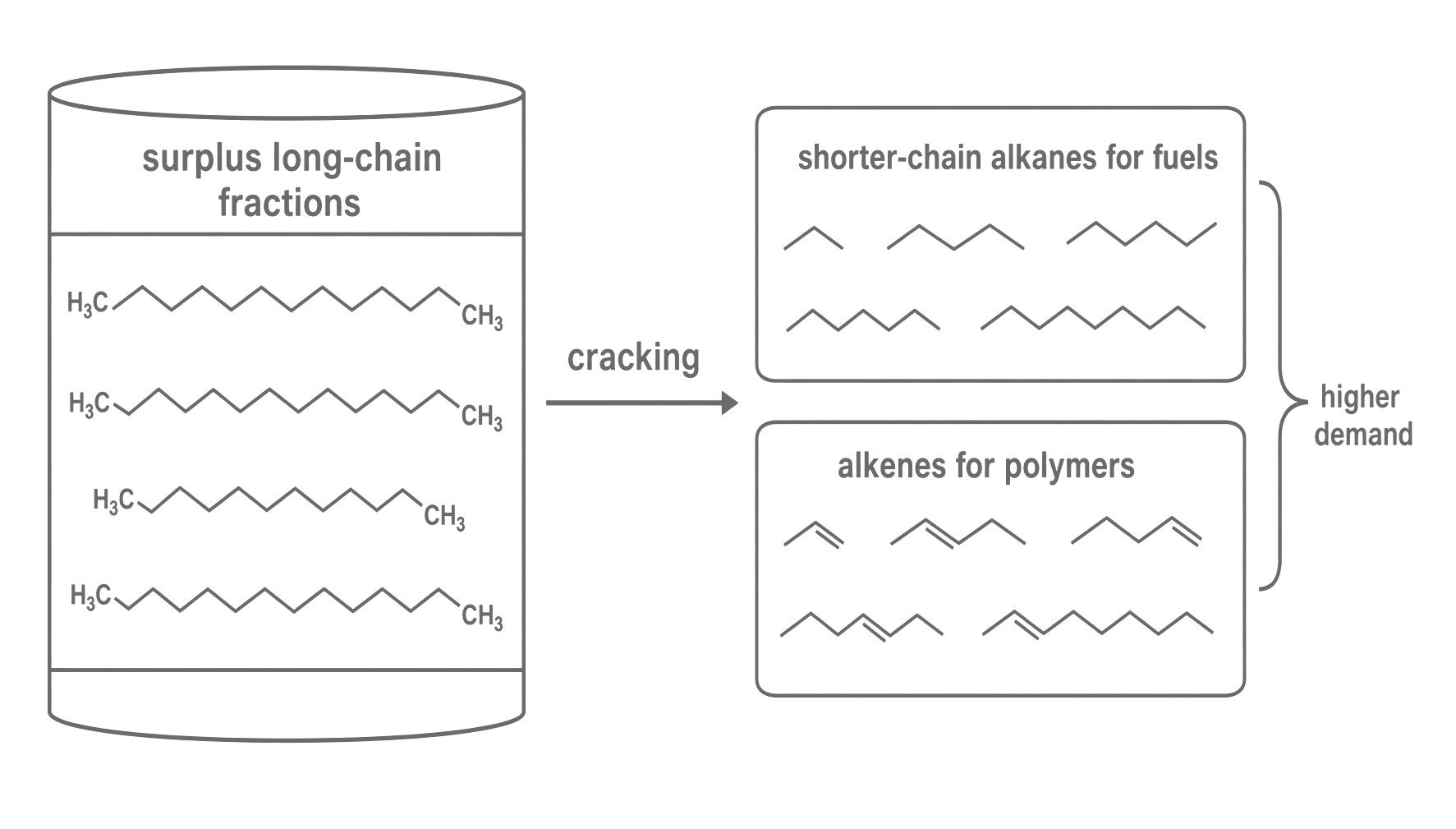
Do not write only "cracking meets demand" in an exam answer. That idea is true, but Pearson answers normally need the chemistry of the products as well: cracking makes shorter-chain alkanes for fuels and alkenes for making polymers.
What catalytic cracking does
Cracking breaks large hydrocarbon molecules into smaller hydrocarbon molecules. In this specification, the starting molecules are long-chain alkanes. The products include shorter-chain alkanes and alkenes.
Catalytic cracking
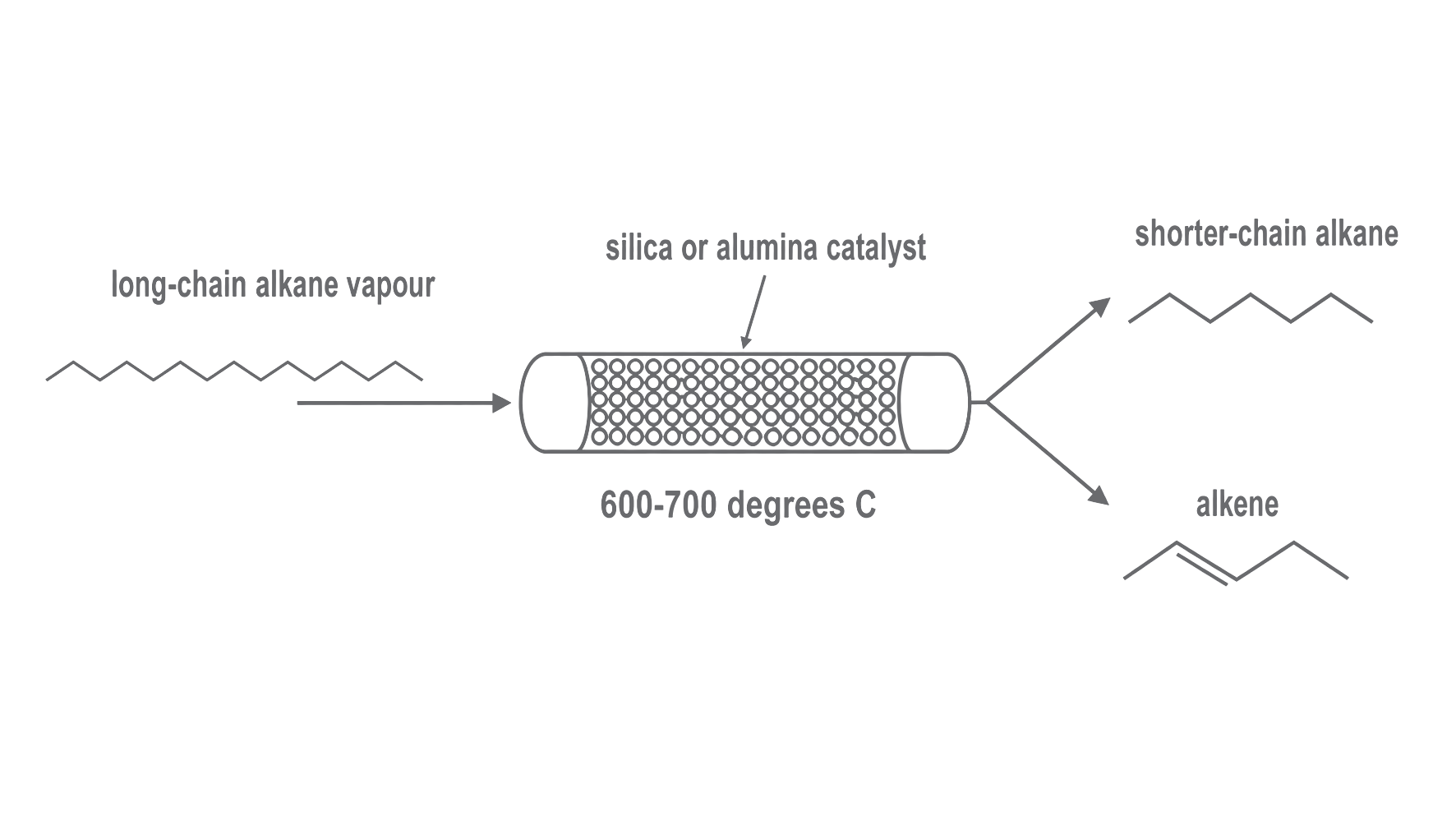
Catalytic cracking is the conversion of long-chain alkanes into alkenes and shorter-chain alkanes using a catalyst and a high temperature.
The catalyst does not appear in the chemical equation because it is not used up. Its job is to help the reaction happen at the required temperature.
The required conditions are:
- a catalyst of silica or alumina
- a temperature in the range
- long-chain alkane vapour passed over the hot catalyst
[DIAGRAM: asset_name: Cracking and demand for fractions - diagram 02; asset_slug: c53_cracking_and_demand_for_fractions__diagram_02; recommended_method: image_gen; description: Monochrome process diagram showing long-chain alkane vapour entering a hot catalyst bed labelled silica or alumina, temperature 600-700 degrees C, and products leaving as shorter-chain alkane plus alkene. Use white background, #6A6B6E linework, simple arrows, and readable labels.]
Silica may also be described as silicon dioxide, . Alumina may also be described as aluminium oxide, . In this lesson, use the names silica and alumina because they match the specification wording.
Continue this lesson.
You’re previewing NovaLearn without an account. Create a free account to read the rest.
Create free account