4.4-4.6 - Organic naming, formulae and reaction types
Organic chemistry uses a compact language: the name tells you the carbon chain and functional group, while the formula tells you which atoms are present and how they are connected. In this lesson you will learn how to name compounds up to six carbon atoms, how to write possible structural and displayed formulae from a molecular formula, and how to classify organic reactions as substitution, addition or combustion. The focus is exam recognition and accurate formula writing, not reaction mechanisms.
Building IUPAC names
For this course, an organic name usually starts by counting the carbon atoms in the main chain. The first six carbon-count roots are:
- 1 carbon:
meth- - 2 carbons:
eth- - 3 carbons:
prop- - 4 carbons:
but- - 5 carbons:
pent- - 6 carbons:
hex-
Then add the part of the name that shows the type of compound. A molecule with only carbon-carbon single bonds is usually an alkane and ends in -ane, such as propane. A molecule with a carbon-carbon double bond is an alkene and ends in -ene, such as propene. Other families in the specification use endings or name parts such as -ol for alcohols, -oic acid for carboxylic acids, and two-part ester names such as ethyl ethanoate.
[DIAGRAM: asset_name: Organic naming, formulae and reaction types - diagram 01; asset_slug: c49_organic_naming_formulae_and_reaction_types__diagram_01; recommended_method: image_gen; description: Monochrome naming map showing the carbon-count roots meth-, eth-, prop-, but-, pent- and hex-, the endings -ane and -ene, and the use of position numbers in but-1-ene and but-2-ene without cis/trans or E/Z notation.]
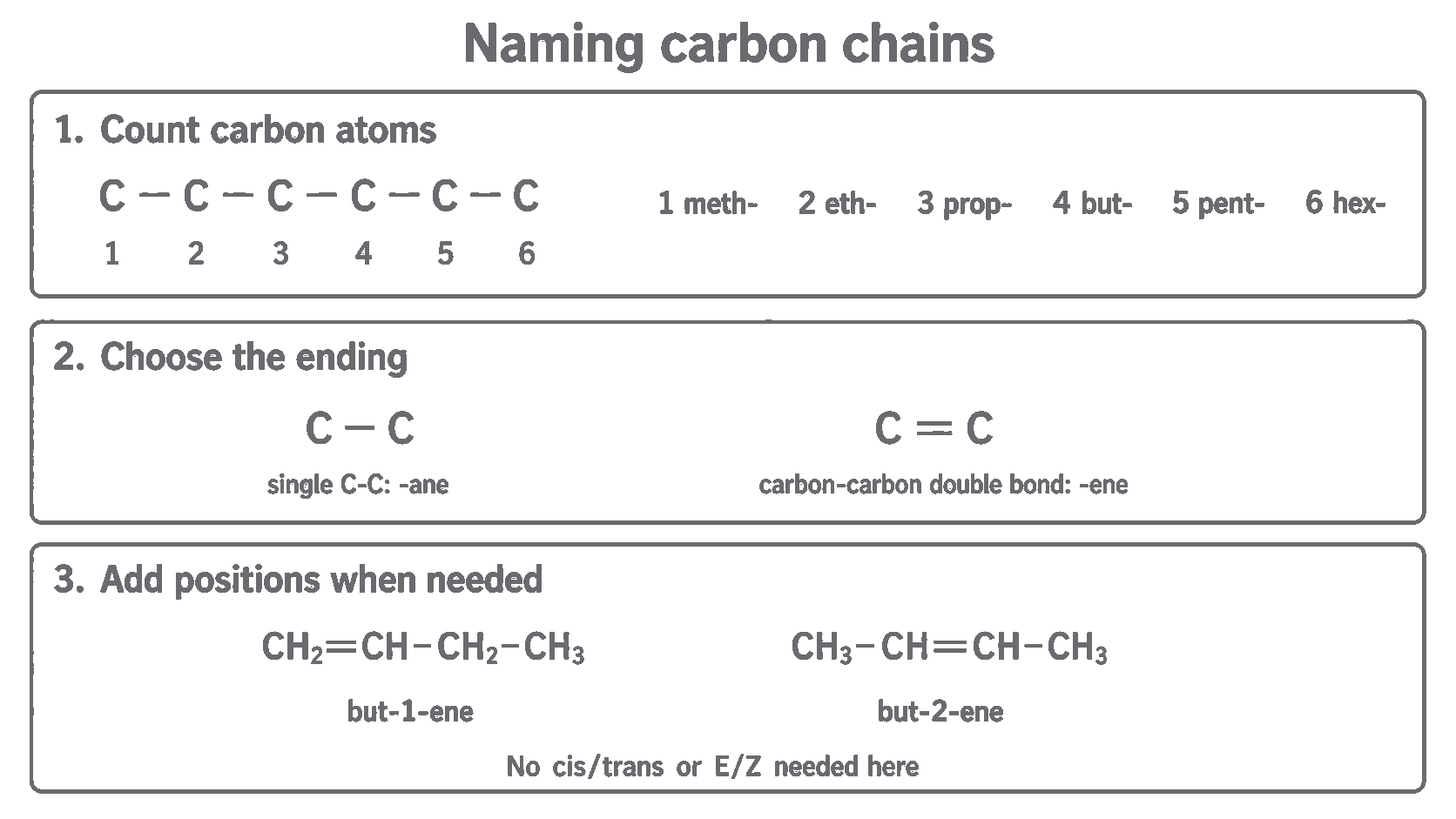
Use numbers when the position of a double bond or functional group could be unclear. For example, but-1-ene and but-2-ene both have four carbon atoms and one carbon-carbon double bond, but the double bond is in a different position. You do not need cis/trans or E/Z notation here.
For a simple branch, choose the longest carbon chain as the parent and name the branch. A one-carbon branch is methyl-, so methylpropane has a three-carbon parent chain with a one-carbon branch.
Formula types
A molecular formula gives the number of atoms of each element in one molecule. For example, C4H10 says there are four carbon atoms and ten hydrogen atoms, but it does not say which atoms are bonded to which.
A structural formula shows the arrangement of atoms in a condensed way. For example, CH3CH2CH2CH3 shows a four-carbon chain, while CH3CH(CH3)CH3 shows a branched structure.
A displayed formula shows every atom and every covalent bond. This is stricter than a structural formula: every C-H bond and every C-C bond must be visible. If an exam asks for a displayed formula, a condensed formula such as CH3CH2CH3 is not enough.
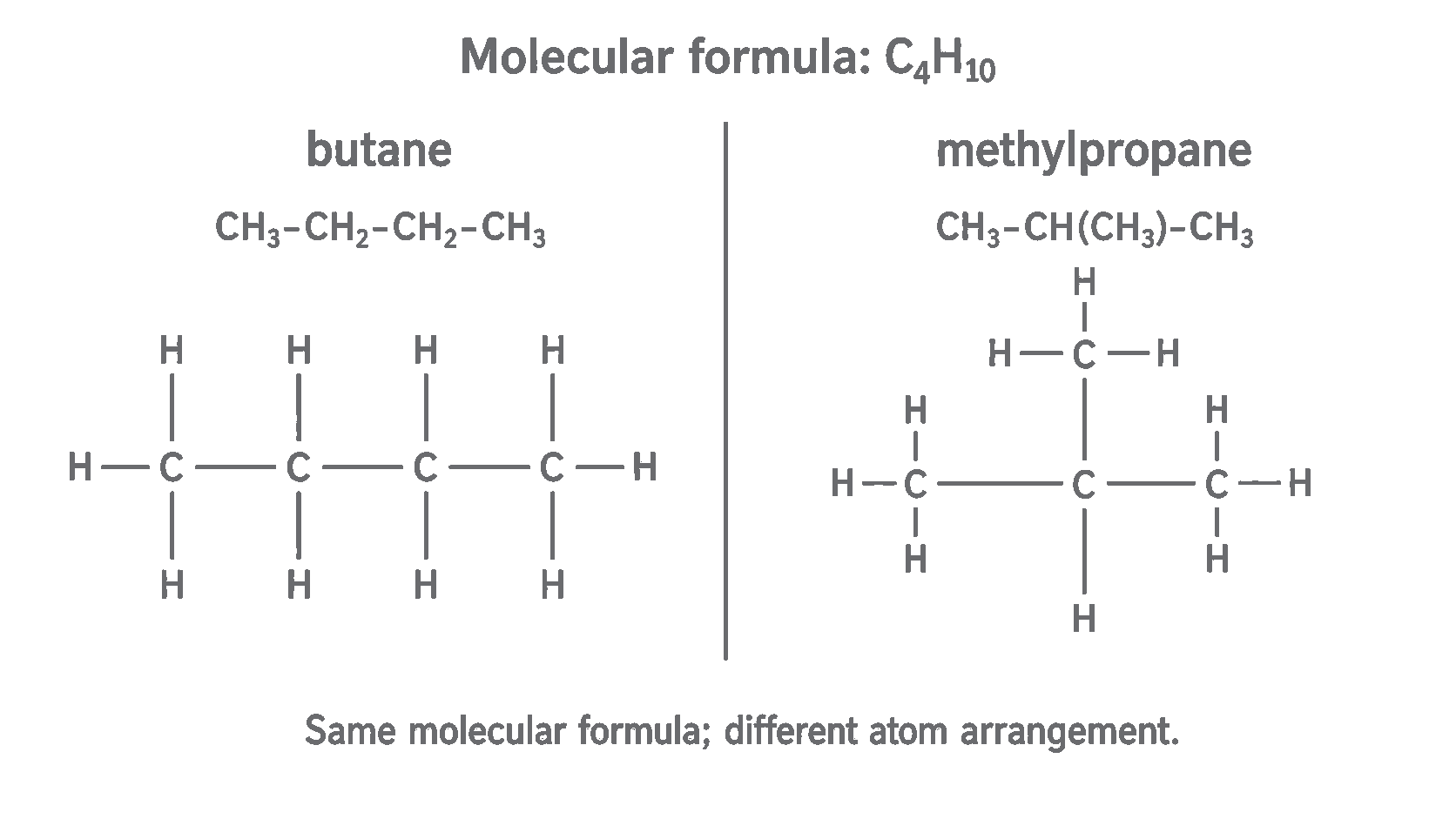
[DIAGRAM: asset_name: Organic naming, formulae and reaction types - diagram 02; asset_slug: c49_organic_naming_formulae_and_reaction_types__diagram_02; recommended_method: image_gen; description: Monochrome comparison of C4H10 as butane and methylpropane, showing each structural formula and a fully displayed formula with all C-H and C-C bonds visible.]
Isomers
Isomers are compounds with the same molecular formula but different structural or displayed formulae.
Butane and methylpropane are isomers because they both have the molecular formula C4H10, but their atoms are arranged differently. A bent drawing of the same four-carbon chain is not a new isomer; the connectivity must change.
Writing possible structures
When you are given a molecular formula, your job is to write formulae that use exactly those atoms and obey normal bonding. At this level, carbon forms four covalent bonds and hydrogen forms one covalent bond.
A reliable method is:
- Place the carbon atoms in a possible chain or branch.
- Add any required double bond or functional group if the formula or name requires it.
- Add hydrogen atoms until every carbon has four bonds.
- Count every atom and check it matches the molecular formula.
- Convert between displayed and structural formulae if the question asks for both.
Continue this lesson.
You’re previewing NovaLearn without an account. Create a free account to read the rest.
Create free account