2.22C-2.24C - Metal extraction and ores
Most metals in everyday objects did not start as shiny pieces of metal in the ground. They usually started as compounds mixed with rock, and chemists choose an extraction method by thinking about how reactive the metal is. In this lesson, the key decision is simple but powerful: compare the metal with carbon in the reactivity series, then use the information in the question to judge the process.
Ores and native metals
A metal is often found in the Earth's crust as a compound, not as the pure element. The useful metal compound may be mixed with sand, clay, other minerals, and waste rock.
Ore
An ore is a naturally occurring rock or mineral from which a metal can be extracted.
"Extracted" means separated from the ore and turned into the metal. For many metals, extraction is a chemical change because the metal ions in a compound must be converted into metal atoms.
Some metals are so unreactive that they do not easily form compounds. Gold is the classic example: it may be found as the uncombined element. Silver and copper can also occur uncombined, although they are also found in ores.
Do not over-read this idea. "Unreactive metals are often found uncombined" does not mean every sample of copper, silver, or gold is pure metal in the ground. It means unreactive metals are much more likely than reactive metals to be found as elements rather than only as compounds.
Most metals are extracted from ores; the least reactive metals may be found as uncombined elements.
Use that distinction before you choose an extraction method: first ask whether the metal is already uncombined, then ask how reactive it is.
Reactivity controls the method
The extraction method depends on the metal's position in the reactivity series. A more reactive metal forms more stable compounds, so it is harder to separate from its ore.
Carbon is used as a comparison point in this lesson. Metals below carbon in the reactivity series can often be extracted from their oxides by heating with carbon or carbon monoxide. In that kind of extraction, oxygen is removed from the metal compound and the metal is formed.
Metals above carbon are too reactive for carbon extraction. Carbon cannot remove the oxygen from their compounds effectively, so these metals need electrolysis. In this extraction context, electrolysis uses electricity to break down a molten ionic compound and produce the metal.
[DIAGRAM: asset_name: Metal extraction and ores - diagram 01; asset_slug: c28_metal_extraction_and_ores__diagram_01; recommended_method: image_gen; description: Monochrome decision map showing position in the reactivity series, the carbon boundary, electrolysis for metals above carbon including aluminium, carbon extraction for iron below carbon, unreactive metals often uncombined, and a simple ore in Earth's crust to extraction method to metal flow.]
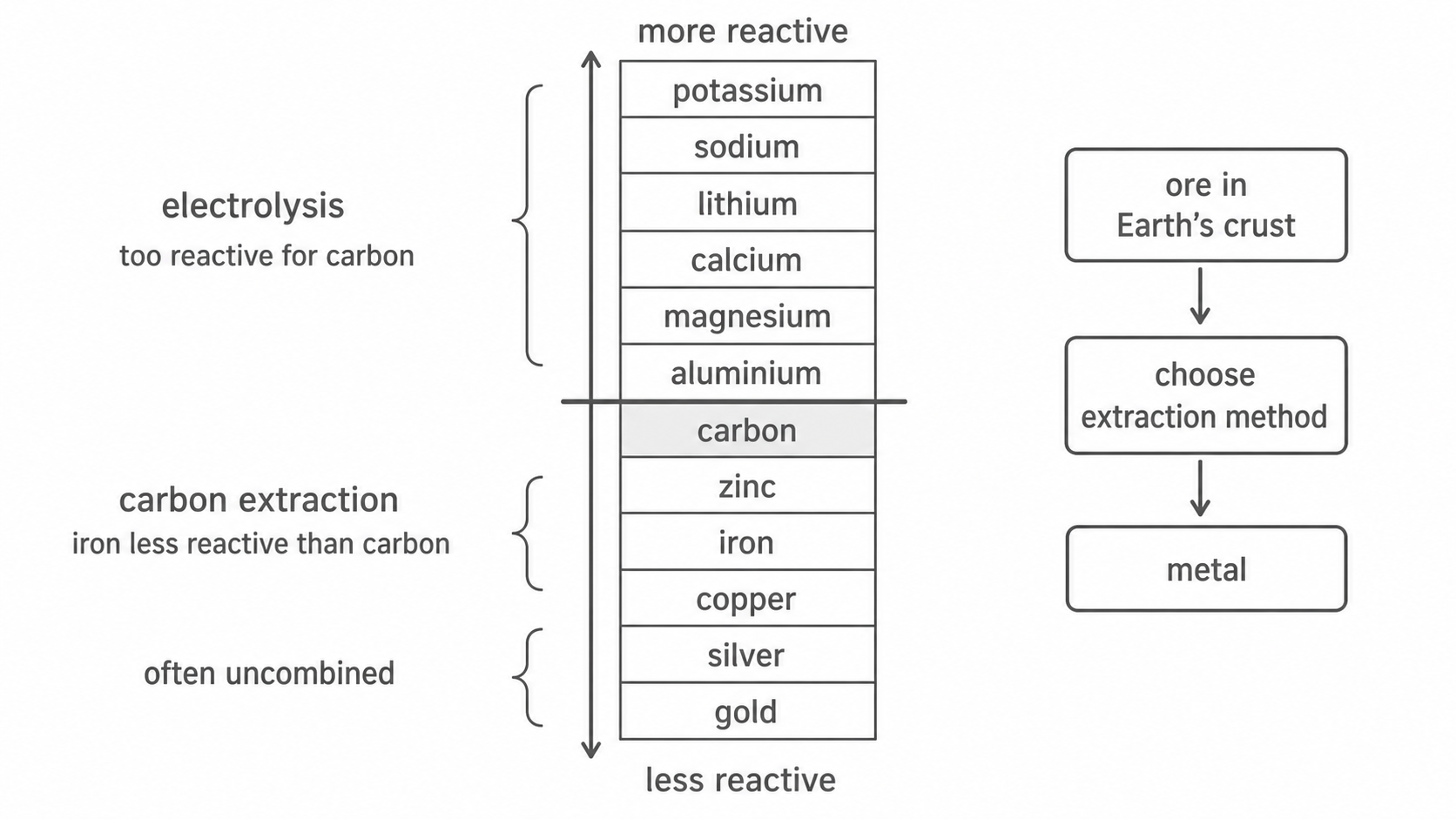
This is the decision pattern you should keep using:
| Position in reactivity series | Usual extraction idea at this level | Example from this lesson |
|---|---|---|
| Above carbon | Electrolysis | aluminium |
| Below carbon | Extraction using carbon or carbon monoxide | iron |
| Very unreactive | Often found uncombined | gold |
Carbon extraction for iron
Iron is below carbon in the reactivity series. That means carbon is more reactive than iron, so carbon can remove oxygen from iron compounds.
For this specification point, you do not need to memorise blast furnace stages, temperatures, limestone reactions, or a set of industrial equations. The required explanation is the reactivity-series link:
- Iron is less reactive than carbon.
- Therefore carbon can be used to extract iron from iron oxide.
- The iron compound loses oxygen, forming iron.
In Pearson-style questions, the comparison matters. "Use carbon" is not enough for a full explanation unless you link it to iron being less reactive than carbon, or carbon being more reactive than iron.
Continue this lesson.
You’re previewing NovaLearn without an account. Create a free account to read the rest.
Create free account