4.9.2.1,4.9.2.2 - Greenhouse gases and human activities
The greenhouse effect helps keep Earth warm enough for life, but human activities can increase the gases responsible for it. This lesson explains radiation and warming, identifies carbon dioxide and methane sources, and teaches how to judge climate evidence, models and reports.
The greenhouse effect
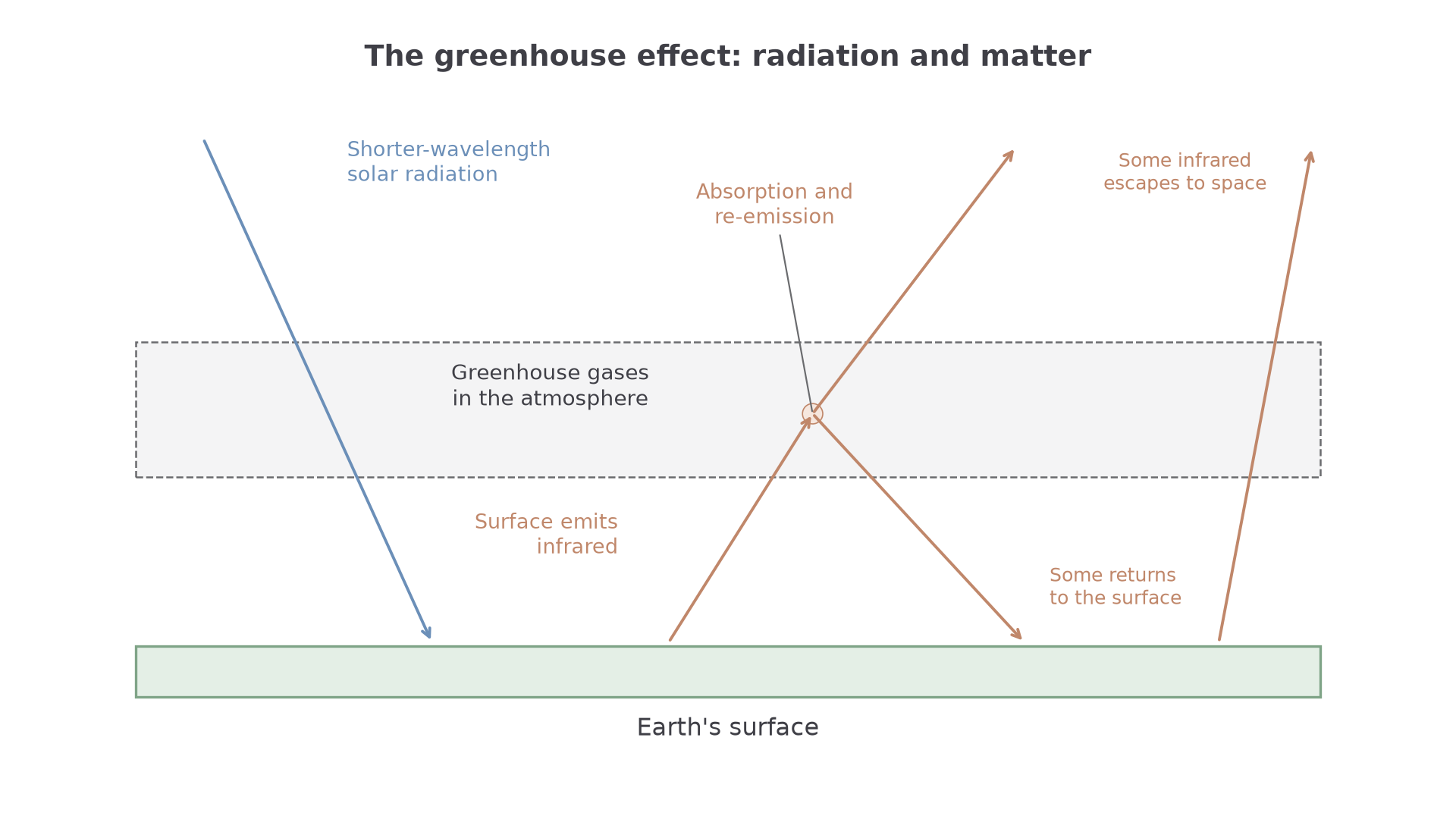
Greenhouse gases absorb some of the long-wavelength radiation emitted by Earth and re-emit energy, slowing its escape to space.
Energy from the Sun reaches Earth mainly as shorter-wavelength radiation. Much of this passes through the atmosphere and is absorbed by the surface, warming land and oceans. The warm surface then emits longer-wavelength infrared radiation. Water vapour, carbon dioxide and methane absorb some of this outgoing radiation and emit infrared radiation in different directions, including back towards the surface.
Greenhouse gas
A gas that absorbs and emits some of the outgoing long-wavelength infrared radiation, contributing to warming of Earth's surface and lower atmosphere.
Energy still escapes to space. The greenhouse effect is not a sealed lid that stops all radiation or a system in which energy is produced from nothing. It changes the transfer of energy: at a given surface temperature, more greenhouse gas can reduce the rate at which energy escapes. The surface and lower atmosphere warm until energy entering and leaving are balanced again under the changed conditions.
The natural greenhouse effect maintains temperatures high enough to support life. Water vapour, carbon dioxide and methane are examples of greenhouse gases; the most abundant atmospheric gases, nitrogen and oxygen, are not the main greenhouse gases. Their abundance alone does not determine their ability to absorb infrared radiation.
An enhanced greenhouse effect occurs when increased greenhouse-gas concentrations strengthen this warming influence. Distinguish the wavelength steps: incoming shorter-wavelength solar radiation is absorbed by the surface, and outgoing longer-wavelength infrared is absorbed by greenhouse gases. Saying only “the Sun's heat is trapped” hides the mechanism. The effect also differs from damage to the ozone layer, which concerns protection from ultraviolet radiation.
[DIAGRAM: asset_name: Greenhouse radiation transfers; asset_slug: 8462_c61_greenhouse; caption: Shorter-wavelength solar radiation warms the surface; greenhouse gases absorb and re-emit some outgoing infrared radiation.; description: A standard radiation schematic shows an incoming solar arrow reaching Earth's surface, outgoing infrared from the surface, some infrared escaping to space, and absorption and re-emission by atmospheric greenhouse gases both towards space and back towards the surface. Arrows begin at the emitting surface or gas region and do not imply that all radiation is retained.]
Human sources of carbon dioxide
Human activities increase atmospheric carbon dioxide when they release stored carbon or reduce its removal by photosynthesis.
Burning fossil fuels is one important activity. Coal, oil and natural gas contain carbon that was stored underground over very long timescales. Combustion in electricity generation, heating and transport converts that carbon mainly into carbon dioxide when oxygen is plentiful. For methane, the main component of natural gas:
This introduces carbon from a long-term geological store into the active atmosphere–ocean–living-system cycle. Calling the fuel “natural” does not mean its burning has no atmospheric effect.
Deforestation is a second activity. Removing trees reduces the uptake of carbon dioxide by photosynthesis. If the cut vegetation is burned or decomposes, its stored carbon can also be released as carbon dioxide. These are linked but distinct effects: reduced removal and additional release. If new growth replaces the removed vegetation, its uptake must also be considered rather than assumed.
Manufacturing cement is another source, because heating limestone releases carbon dioxide as well as using fuels. Naming the process explains a source more clearly than saying only “factories”.
Natural processes such as respiration and volcanic activity also release carbon dioxide. Recognising them does not remove the human contribution. To explain a change in atmospheric amount, consider both sources and removal processes, rather than the existence of any source on its own.
Continue this lesson.
You’re previewing NovaLearn without an account. Create a free account to read the rest.
Create free account