4.3.1.1,4.3.1.2,4.3.1.3 - Conservation of mass and formula calculations
Learn why chemical equations must conserve atoms, how formulae give relative formula masses and percentage composition, and why a balance can appear to show a mass change when a gas enters or leaves a reaction. These ideas connect the particle model to quantities that can be measured in a laboratory.
Balancing atoms and conserving mass
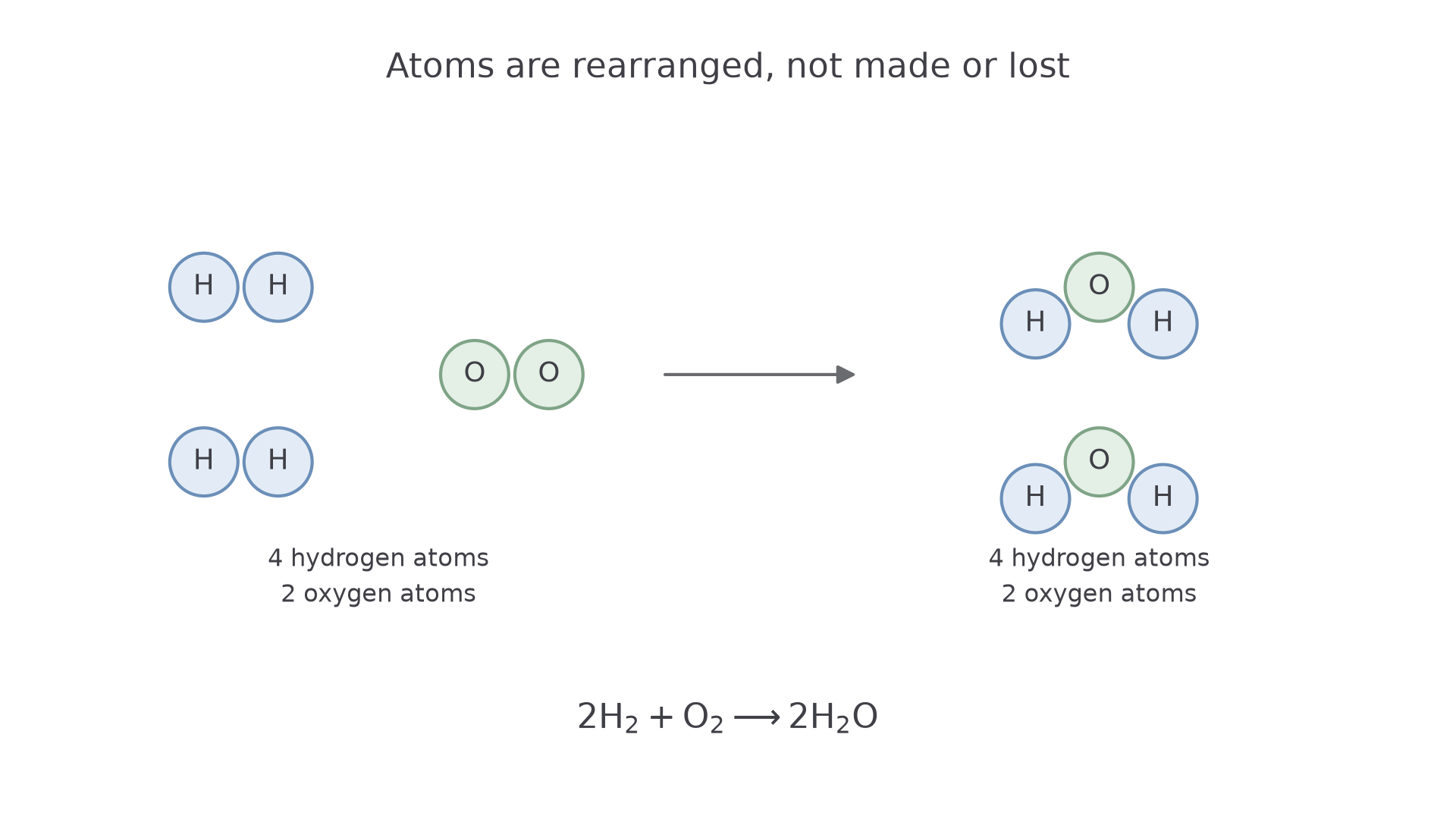
A chemical reaction rearranges existing atoms into new substances; it does not make or destroy atoms.
The law of conservation of mass states that the total mass of the products equals the total mass of the reactants. Each atom still contributes its mass after it has been rearranged. To make a fair comparison, include every substance that enters or leaves, including gases.
A symbol equation must therefore contain the same number of atoms of each element on both sides. Consider hydrogen reacting with oxygen to form water. The formula of water is , so each molecule contains two hydrogen atoms and one oxygen atom. Oxygen gas is . The balanced equation is:
There are four hydrogen atoms and two oxygen atoms on each side. The coefficient 2 in front of a formula multiplies the entire formula: means two water molecules, containing four hydrogen atoms and two oxygen atoms altogether. The subscript 2 within is part of the identity of water. Changing it would change the substance; is hydrogen peroxide, not another way to balance water.
[DIAGRAM: asset_name: Atoms before and after water formation; asset_slug: 8462_c18_conserved_atoms; caption: Two hydrogen molecules and one oxygen molecule rearrange into two water molecules, conserving four hydrogen atoms and two oxygen atoms.; description: Exact particle-count diagram with four blue hydrogen atoms and two sage oxygen atoms on each side of a reaction arrow. The left shows two hydrogen pairs and one oxygen pair; the right shows two groups each containing one oxygen and two hydrogen atoms. Atom sizes are schematic.]
To balance an equation, first write correct formulae. Count each element, change whole-number coefficients, and recount. For magnesium burning, the successive equations are:
Use the simplest whole-number coefficients. The water example and magnesium example both change the number of formula units, while keeping each substance's formula fixed.
Relative formula mass
A formula tells us how many of each type of atom to include when calculating a compound's relative formula mass.
Relative atomic mass, , compares an element's average atomic mass with the standard carbon-based mass scale. Relative formula mass, , is the sum of the relative atomic masses of all the atoms in the formula. Both are relative numbers and have no unit. A formula mass is useful for ionic compounds as well as molecular compounds: a giant ionic lattice does not contain separate molecules, but its formula gives the ratio of ions to count.
For , using and ,
Brackets multiply all the atoms inside them. For , using , and ,
The 2 doubles both oxygen and hydrogen, giving one calcium, two oxygen and two hydrogen atoms. Reading the formula correctly matters more than memorising an individual answer.
Conservation also appears in formula-mass totals. In , use and . The reactant total in the displayed quantities is ; the product total is . Count coefficients as well as subscripts. Adding just one magnesium and one magnesium oxide formula would compare different quantities and would not give equal totals.
Percentage by mass of an element
The percentage by mass of an element is its contribution to the compound's formula mass expressed as a percentage of the total.
For calcium carbonate, , take , and :
This means 48 g of oxygen is chemically combined within each 100 g of pure calcium carbonate. It does not mean the material contains free oxygen gas.
Count every atom of the selected element in the numerator. For , using and :
Hydrogen supplies two out of the three atoms, but its atoms are much lighter than oxygen atoms. A percentage of atoms is therefore different from a percentage by mass.
A useful check is that an element's mass percentage lies between 0% and 100%, and the percentages of all elements sum to 100% apart from rounding. For water, oxygen contributes ; together the two percentages give 100.0%.
Gases and apparent mass changes
The mass recorded by a balance changes if matter moves across the boundary of the apparatus being weighed.
When magnesium burns in air, , oxygen atoms from outside the apparatus combine with the magnesium. The final magnesium oxide has greater mass than the original magnesium because it includes this oxygen. Illustrative experiment: 2.40 g of magnesium produces 4.00 g of oxide:
Thermal decomposition gives the opposite apparent change:
If a crucible is open, carbon dioxide particles leave and mix with the atmosphere. The solid left behind weighs less, although the mass of magnesium oxide plus the escaped carbon dioxide equals the starting magnesium carbonate mass. The carbon and some oxygen atoms have left the weighed system; they have not vanished.
Illustrative decomposition: 12.6 g magnesium carbonate leaves 6.00 g magnesium oxide, with no solid lost. The mass account gives:
The balance measures only the retained solid; including the escaped gas restores the complete mass account.
For a mass-change investigation, record the mass of a dry crucible and its contents before and after heating, using the same balance. Wear eye protection, handle a hot crucible with tongs, and let it cool before weighing. Reheat, cool and reweigh until the mass is constant to check that the intended change is complete. When burning a metal, a lid can reduce solid loss while being lifted carefully to admit oxygen. Escaping smoke or lost powder would create a second explanation for a mass change. Compare substances and apparatus consistently, rather than weighing one crucible at the start and a different one at the end.
A closed system that retains all gases shows conservation directly, but never seal a vessel that is being heated or generating gas without suitably designed safe apparatus: pressure could rise dangerously. A school investigation must use its approved method.