4.2.2.6,4.2.3.1,4.2.3.2 - Giant covalent structures, diamond and graphite
Learn how an extended network of covalent bonds differs from a substance made of separate molecules. You will compare silicon dioxide, diamond and graphite, then use carbon's bonding, layers and delocalised electrons to explain hardness, high melting points and electrical conduction.
Giant networks and silicon dioxide
In a giant covalent structure, atoms are linked by strong covalent bonds through an extended network rather than collected into separate small molecules.
The network continues throughout a crystal. To melt such a substance, many strong covalent bonds must be overcome. This requires a large amount of energy, so giant covalent substances are solids with very high melting points. Compare this with a small molecular substance, where melting overcomes weak attractions between molecules while the molecules' internal covalent bonds survive.
Silicon dioxide, also called silica, has a giant covalent structure. Its formula, , gives the silicon-to-oxygen ratio of ; it does not mean the solid is made of separate three-atom molecules. In a useful network representation, each silicon is bonded to four oxygen atoms and each oxygen links two silicon atoms. Sharing these linking oxygens through the network gives the overall ratio: four oxygen connections from a silicon, with each oxygen shared between two silicon centres, corresponds to two oxygens per silicon.
[DIAGRAM: asset_name: A fragment of a silicon dioxide network; asset_slug: 8462_c15_silica_network; caption: Oxygen atoms link silicon centres in a network that continues beyond the fragment.; description: A projected network fragment has one central blue silicon atom bonded to four sage oxygen atoms, with each oxygen bonded onward to another silicon centre. Short bonds at the outer silicon centres indicate continuation. A key states that silicon has four bonds and oxygen has two within the full network. The flat projection is not a literal planar structure, and the cropped fragment is not used as a counting unit.]
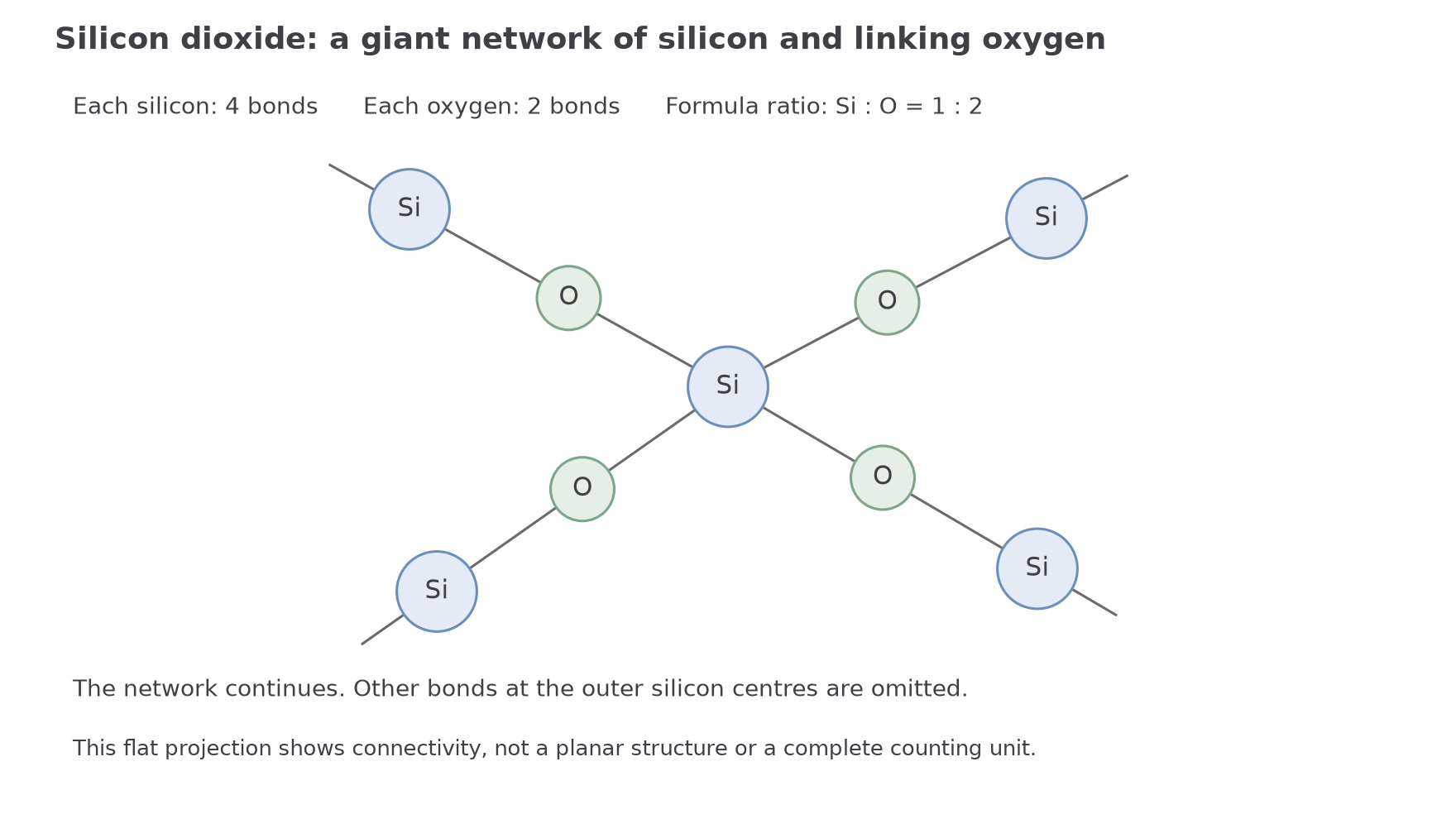
Recognise a giant covalent structure from bonds that continue across a network, with no repeated boundary around individual small molecules. A finite drawing must stop somewhere, so continuation marks or the description are important. Counting all spheres in an arbitrary cut fragment can give a misleading formula because atoms at the edge have connections outside the drawing.
Diamond and graphite are also giant covalent structures, but both consist only of carbon. These different structural forms of the same element are called allotropes. Their different properties show why identifying the element alone is insufficient: the bonding and arrangement also determine how a material behaves.
Diamond's structure and properties
In diamond, every carbon atom forms four covalent bonds to four other carbon atoms in a rigid three-dimensional network.
Carbon has four outer electrons. All four are involved in covalent bonding in diamond. The four bonds around each carbon point in different directions through space; the network is not a pile of separate flat rings or separate molecules.
[DIAGRAM: asset_name: Diamond and graphite bonding compared; asset_slug: 8462_c15_diamond_graphite; caption: Four-bond three-dimensional diamond contrasts with three-bond hexagonal graphite layers.; description: A diamond panel shows a central carbon and four carbon neighbours in a projected tetrahedral arrangement, with bonds extending outward to indicate a continuing three-dimensional network. A graphite panel shows two projected layers of joined hexagonal rings, with strong solid bonds within each layer and dashed weak attractions between layers. Labels state four bonds per carbon in diamond and three within each graphite layer; graphite has no covalent bonds between the layers.]
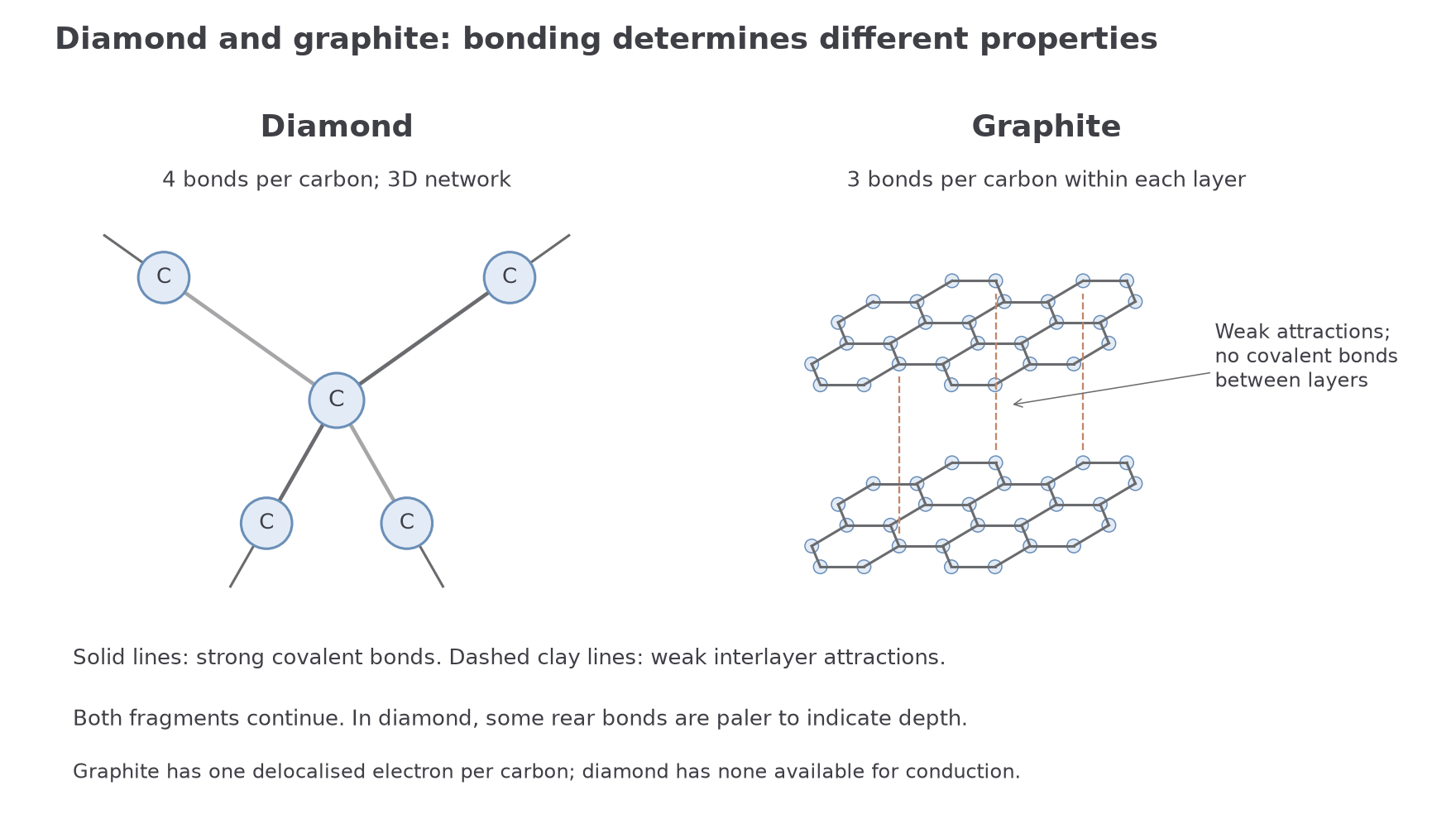
Diamond is very hard because its atoms are held in a rigid network by strong covalent bonds in all directions. Moving one region relative to another requires disrupting that bonding; there are no layers able to slide easily past one another. This makes diamond useful where resistance to scratching or wear is required, such as cutting tools.
Diamond has a very high melting point because overcoming many strong covalent bonds requires a great deal of energy. A diagram containing only five carbon atoms represents a fragment; it must not be used to argue that only four bonds hold an entire diamond together.
Diamond does not conduct electricity because its outer electrons are used in local covalent bonds and there are no delocalised electrons or mobile ions to carry charge through the structure. “It contains carbon” cannot explain conduction: graphite also contains carbon but has a different bonding arrangement.
Graphite's hexagonal layers
In graphite, each carbon atom forms three covalent bonds with three other carbon atoms, producing layers of hexagonal rings.
The carbon–carbon bonds within a layer are strong. Each sheet extends over many connected rings; one hexagon is not a separate graphite molecule. There are no covalent bonds between the layers. Instead, much weaker attractions hold neighbouring layers together.
When a sideways force acts, layers can slide over one another because relatively little energy is needed to overcome the weak attractions between them. This gives graphite its soft, slippery character and supports its use as a lubricant. Graphite can also leave layers on a surface, as happens in pencil writing. The explanation concerns movement between layers, not weak covalent bonds within the rings.
Graphite still has a very high melting point. Allowing intact layers to slide is different from melting the giant covalent structure. Melting requires the strong carbon–carbon bonding within the network to be overcome, which requires much energy. Thus softness does not imply a low melting point.
A flat hexagonal diagram is useful for showing three neighbours around each interior carbon. A diagram of several layers adds the missing third dimension and helps explain sliding. Neither shows all the atoms in a sample, and a boundary carbon in a cropped picture may have bonds continuing beyond the edge.
Delocalisation and electrical conduction
Graphite's fourth outer electron is delocalised, giving it a route to conduct electricity that diamond lacks.
Each carbon uses three of its four outer electrons in bonds to its three neighbours. One electron from each carbon is delocalised and can move along the layer. These mobile negative charges carry current, so graphite conducts electricity. Its conductivity is strongest along the layers; the structure does not imply identical movement in every direction.
Graphite resembles a metal in possessing delocalised electrons, but its principal structure is giant covalent, not metallic. Positive metal centres in a shared electron system are a different model from carbon atoms covalently joined in hexagonal sheets. Mobile electrons can occur in more than one type of structure.
| Feature | Diamond | Graphite |
|---|---|---|
| Bonds from each carbon | Four | Three |
| Arrangement | Three-dimensional network | Hexagonal layers |
| Sliding layers | None | Weakly attracted layers can slide |
| Mobile electrons | None available for conduction | One delocalised electron per carbon |
| Main consequences | Very hard, high melting point, non-conductor | Soft and slippery, high melting point, conductor |
The table connects each property to a cause. If asked to compare, state both sides of the same feature: “diamond has four bonds per carbon whereas graphite has three” is more informative than an unrelated list of facts about each material.