4.1.2.4,4.1.2.5 - Group 0 and Group 1
Compare the stable electron arrangements of Group 0 with the reactive metals of Group 1. Explain noble-gas boiling-point trends, alkali-metal reactions and the increasing ease of losing an outer electron down Group 1.
Full outer shells in Group 0
The Group 0 elements are called noble gases and have stable, full outer electron shells.
Helium has arrangement 2: its first and only shell is full with two electrons. Neon is 2,8 and argon is 2,8,8, with eight electrons in each outer shell. Thus “all noble gases have eight outer electrons” misses helium, while “Group 0 has zero electrons” misreads the group label.
Their full-shell arrangements make noble gases unreactive under ordinary conditions. They do not easily gain, lose or share electrons, so they do not easily form chemical bonds or molecules. Noble gases are monatomic: their gas particles are individual atoms, such as , rather than pairs like .
Monatomic
Existing as individual atoms rather than molecules containing two or more bonded atoms.
“Stable” should be connected to the arrangement of electrons. Simply saying “argon does not react because it is stable” repeats the observation without its explanation. Argon has a full outer shell, so ordinary reactions involving electron transfer or sharing are not favourable. Unreactive does not mean that noble-gas atoms have no forces between them or cannot change state.
Boiling points down Group 0
Noble gases can be chemically unreactive while still showing a regular physical boiling-point trend.
Going down Group 0, relative atomic mass increases and boiling point increases. The particles remain individual atoms. Boiling separates atoms from each other in a liquid; it does not break them into protons and electrons or make a new compound.
Weak attractive forces act between noble-gas atoms. For the larger atoms farther down the group, these attractions are stronger, so more energy is needed to separate them. Their boiling temperatures are therefore higher. This is an explanation of a physical change, distinct from the full-shell explanation of low chemical reactivity.
If a question gives a trend, use it to make a bounded prediction. From helium to neon to argon, a rising boiling point supports predicting that krypton, below argon, boils at a higher temperature than argon. Without numerical data or a specified model, it does not justify inventing an exact krypton boiling point or assuming an equal increase at every step.
Illustrative trend data: three successive unnamed Group 0 elements have boiling points −240, −210 and −180 °C. The temperatures rise down the group: −180 °C is higher than −210 °C because it is less negative. Comparing the size of negative numbers correctly preserves the direction of the physical trend.
Alkali-metal reactions with oxygen, chlorine and water
Lithium, sodium and potassium have one outer-shell electron and show similar reactions because they readily lose it to form ions with charge +1.
These first three alkali metals are soft metals with relatively low densities and low melting points compared with most other metals. A freshly cut surface is shiny, but it tarnishes as it reacts with air. They are usually stored under oil to reduce contact with air and moisture. Their reactions, especially potassium's, require controlled teacher demonstrations and suitable protection; the descriptions here are not instructions for unsupervised experiments.
Oxygen and chlorine
All three react with oxygen to form metal oxides. Fresh lithium tarnishes more slowly; sodium tarnishes faster and potassium very quickly. When heated in oxygen, lithium burns with a crimson-red flame, sodium with a yellow flame and potassium with a lilac flame. For lithium, a balanced oxide equation is . Sodium and potassium can form other oxygen compounds depending on conditions, so use the formula of the specified product rather than copying lithium oxide's formula pattern.
With chlorine, each forms its metal chloride, a white solid: lithium chloride , sodium chloride or potassium chloride . These are ionic compounds. Lithium reacts vigorously when heated; sodium and potassium are progressively more vigorous under comparable conditions. A sodium equation is . Notice the chlorine molecule but the single-chlorine ratio in .
Water
With water, all three produce hydrogen gas and a solution of the metal hydroxide. The dissolved hydroxide makes the solution alkaline, explaining the name alkali metals. For sodium:
Lithium floats and fizzes as hydrogen forms, usually without melting. Sodium reacts more vigorously, moves over the surface and often melts into a ball because the heat released raises the metal above its relatively low melting point. Potassium reacts still more vigorously and often ignites with a lilac flame. Observations depend on piece size and conditions; compare similar-sized pieces under the same conditions when judging reactivity.
The equivalent word equations are lithium + water → lithium hydroxide + hydrogen and potassium + water → potassium hydroxide + hydrogen. Oxygen, chlorine and water are different reactants, so do not mix their product names: water gives a hydroxide and hydrogen, whereas chlorine gives a chloride.
Why Group 1 reactivity increases downwards
An alkali metal becomes more reactive down the group because its outer electron is lost more easily.
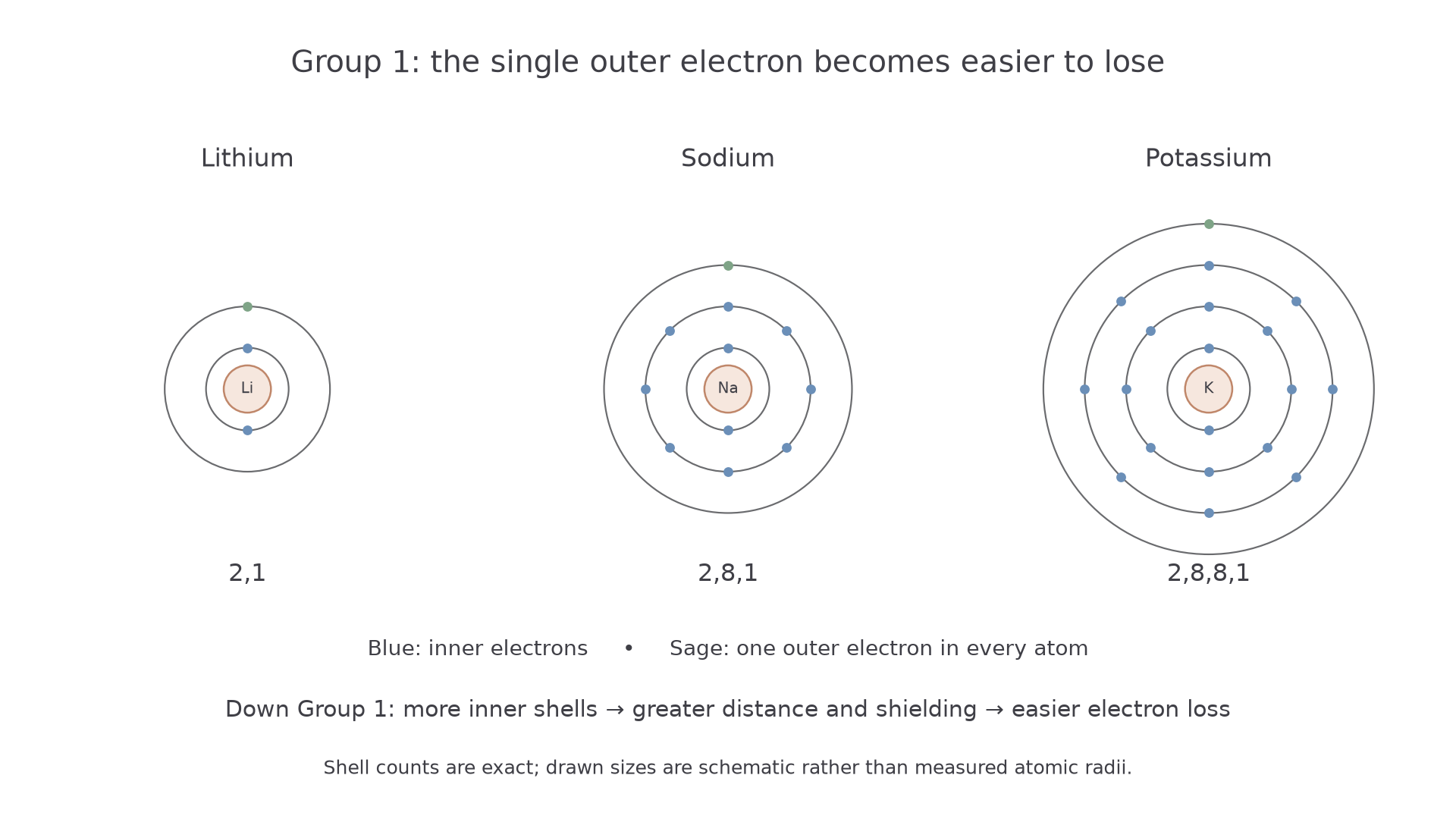
Lithium is 2,1, sodium is 2,8,1 and potassium is 2,8,8,1. All have one outer electron, explaining their common ion charge and reaction types. Going down the group adds occupied inner shells. The outer electron is farther from the positive nucleus and more shielded by inner electrons. Shielding means that inner electrons reduce the attraction experienced by the outer electron.
Although nuclear charge also increases down the group, the greater distance and shielding result in a weaker effective attraction for the outer electron. Less energy is needed to remove it, so it is transferred more readily during reactions. This accounts for the increasing reactivity from lithium to sodium to potassium. “It has more electrons” alone does not identify the electron being removed or explain how its attraction changes.
[DIAGRAM: asset_name: The outer electron in lithium, sodium and potassium; asset_slug: 8462_c07_outer_electron; caption: Additional inner shells place the single outer electron farther from the nucleus and increase shielding down Group 1.; description: Schematic counted shell diagrams for Li 2,1, Na 2,8,1 and K 2,8,8,1 highlight one outer electron in each, with increasing shell count and an annotated trend towards easier electron loss. Diagram sizes illustrate the explanation rather than measured atomic radii.]
The same reasoning supports predictions for a Group 1 element below potassium: it should lose its outer electron more readily and react more vigorously under comparable conditions. It does not make a prediction of an exact reaction rate, which also depends on temperature, surface area and the experiment's conditions. Other measured trends, such as melting points, must be identified separately rather than automatically assumed to follow reactivity.