4.4.3.1,4.4.3.2 - Electrolysis of molten compounds
Learn why an ionic compound conducts when its ions can move and how electric current drives electrolysis (4.4.3.1). Then predict the elements obtained from a molten binary ionic compound at each electrode (4.4.3.2). The key is to follow ion charge and distinguish movement through the liquid from the chemical changes at its boundaries.
Electrolytes and mobile ions
An ionic substance can carry electric current only when its charged particles are free to move.
In a solid ionic compound, oppositely charged ions occupy fixed positions in a giant lattice. They have charge but cannot travel through the solid, so the solid does not conduct electricity. Melting disrupts the fixed arrangement while retaining the ions. The liquid ions can move and carry charge. Dissolving a soluble ionic compound in water also releases mobile ions into the solution.
Electrolyte
A liquid or solution containing mobile ions that can conduct electricity and undergo chemical change when electric current passes through it.
For example, solid lead bromide does not conduct, but molten lead bromide contains mobile lead ions, , and bromide ions, , and conducts. It contains no water. This matters because the products of aqueous electrolysis may differ from those of the molten compound.
Melting itself is a physical change. Before current passes, the substance is still lead bromide, with the same kinds of ions. Electrolysis is a subsequent chemical change in which elements are formed. An ordinary molecular liquid is not automatically an electrolyte: liquid state gives particles mobility, but conducting also requires suitable charged particles.
Electrodes and ion discharge
During electrolysis, opposite ion and electrode charges determine the direction in which ions move.
Electrolysis is the decomposition of an electrolyte by passing an electric current through it. Connect two electrodes to a direct-current power supply and place them in the electrolyte without allowing them to touch. The cathode is the negative electrode; the anode is the positive electrode. Positive ions move towards the negative cathode, and negative ions move towards the positive anode.
At the electrode surfaces, ions undergo a chemical change called discharge. Positive metal ions are converted to metal atoms at the cathode. Negative non-metal ions form non-metal atoms at the anode, which may pair to make molecules such as bromine. Inside the electrolyte, mobile ions carry charge; conduction through a metal wire involves electrons instead.
[DIAGRAM: asset_name: Ion movement in molten lead bromide; asset_slug: 8462_c33_molten_electrolysis; caption: Lead ions move to the negative cathode and bromide ions to the positive anode, forming lead and bromine.; description: A vessel of molten lead bromide contains labelled lead ions moving left to the negative cathode and bromide ions moving right to the positive anode. Separate wires connect each electrode to the corresponding terminal of a direct-current supply, and products are labelled at each electrode.]
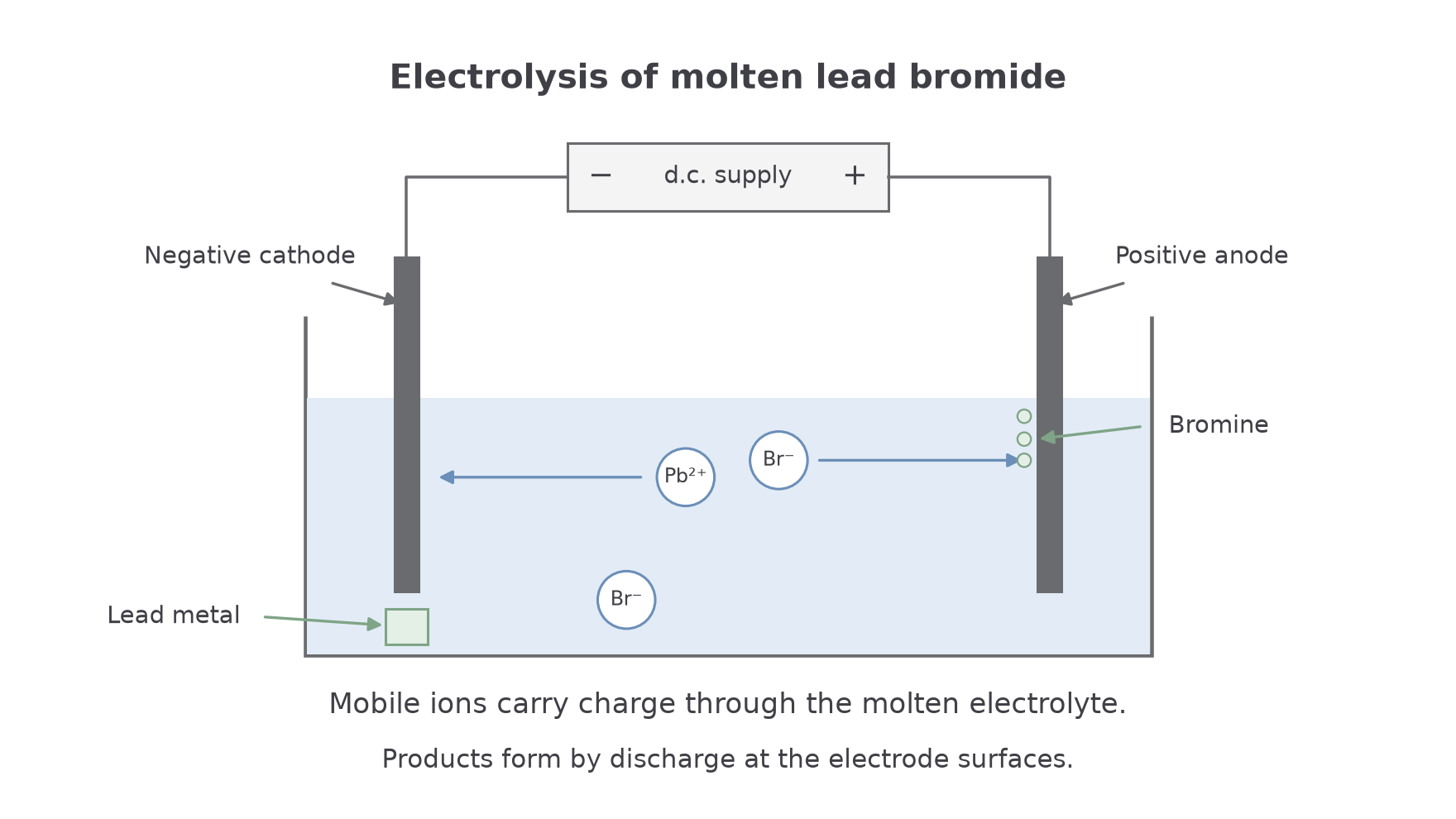
Use inert electrodes when predicting products from the electrolyte alone. Inert means the electrode material does not take part in the intended reaction, so it does not introduce an extra competing product. Electrolysis of molten lead bromide is a conceptual example; lead compounds and bromine are hazardous. Anhydrous zinc chloride is a safer alternative for teacher-controlled molten-compound work.
Electron transfer at molten electrodes (Higher)
Discharge changes an ion into an element by transferring electrons at an electrode surface.
In molten lead bromide, lead ions gain electrons from the cathode:
Each ion's charge is , so two electrons produce a neutral lead atom. This is reduction. Bromide ions lose electrons at the anode; two bromine atoms join as a diatomic molecule:
This is oxidation. The bromine atom count is two on each side and the total charge is on both sides. Electrons are supplied to the cathode and removed from the anode through the wires, while ions carry charge through the liquid. Electrons do not travel freely through the electrolyte between electrodes. Equal numbers of electrons are gained and lost overall, so they cancel when the electrode equations are added.
Continue this lesson.
You’re previewing NovaLearn without an account. Create a free account to read the rest.
Create free account