4.2.3.3 - Graphene, fullerenes and nanotubes
Learn how a single carbon sheet, a hollow carbon cage and a carbon tube differ in shape and bonding. You will recognise graphene and fullerenes from representations and connect their strength, electron behaviour and dimensions to possible uses in electronics, composites and nanotechnology.
A single layer of graphene
Graphene is a single layer of graphite: one atom thick, with carbon atoms covalently bonded in a network of hexagonal rings.
Each carbon has three neighbouring carbon atoms and forms three strong covalent bonds. The network continues across the sheet rather than ending at each hexagon. One carbon belongs to several adjoining rings, so counting six atoms separately for every visible ring would count shared atoms more than once.
One outer electron from each carbon is delocalised. It is not confined to a single bond and can move through the sheet. These features make graphene a giant covalent carbon structure, rather than a small molecule or a metal.
[DIAGRAM: asset_name: Graphene sheet and a carbon nanotube; asset_slug: 8462_c16_sheet_and_tube; caption: A planar hexagonal network contrasts with a long hollow cylindrical carbon network.; description: A graphene panel shows an exact patch of linked hexagonal carbon rings with continuation beyond the patch and labels for three bonds per interior carbon. A nanotube panel wraps a hexagonal network around a cylinder with a clearly marked hollow cross-section. A length arrow runs along the tube axis and a diameter arrow crosses its end. The tube length is much larger than the diameter; the drawing is a representation, not a measured scale.]
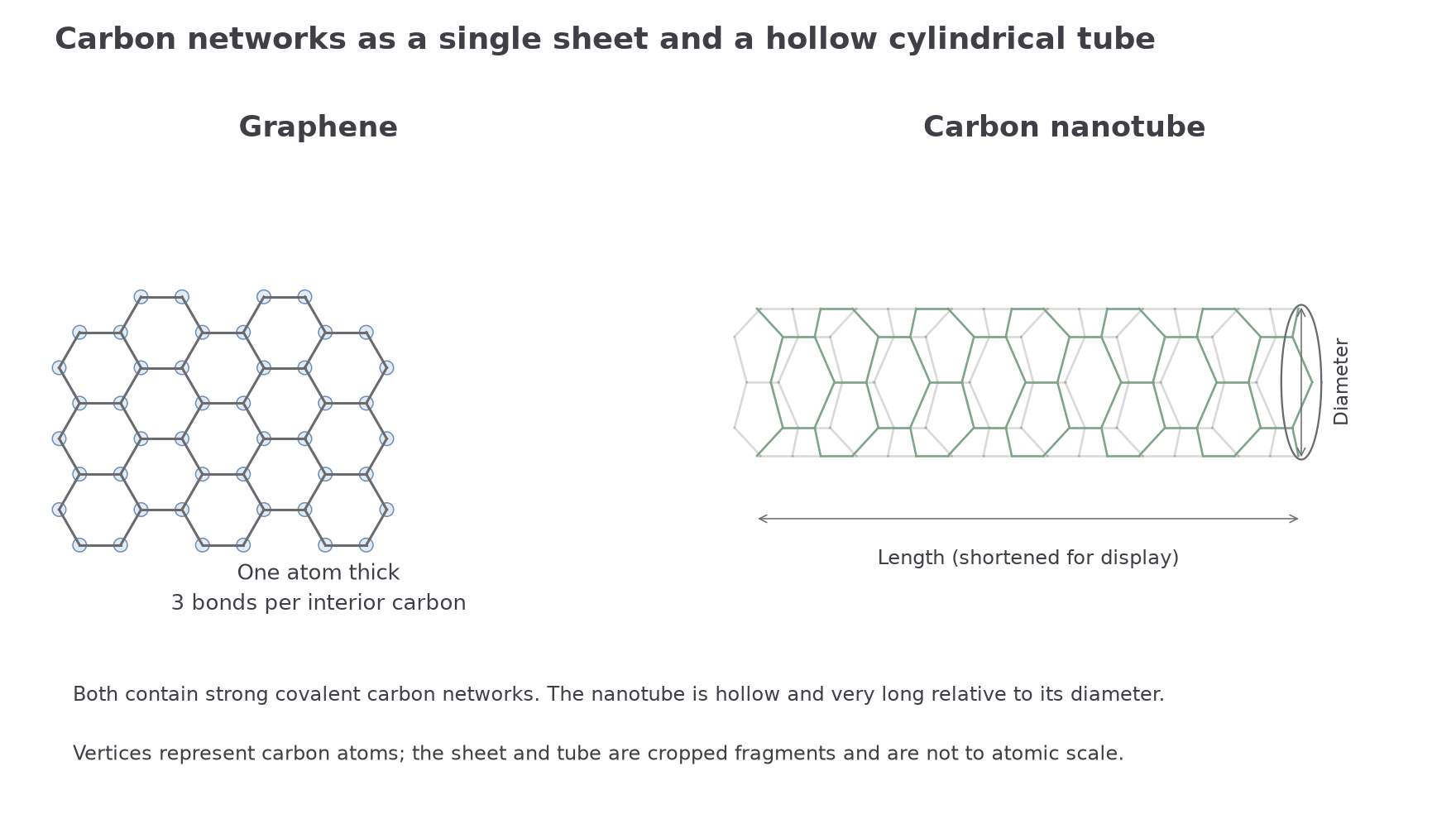
To recognise graphene, look for one sheet of connected hexagonal rings. Several stacked sheets suggest graphite. A single isolated hexagon is insufficient evidence: the description must establish that the network extends across a sheet. A page drawing can show the pattern, but the size of a sphere or bond in it is not the actual atomic size unless a scale is supplied.
Graphene's properties and uses
Graphene's strong covalent network and delocalised electrons explain why it is useful for reinforcing materials and for electronics.
Strong covalent bonds throughout the sheet resist pulling its atoms apart, giving graphene high strength. A composite combines materials so that their properties complement one another. Adding suitable graphene reinforcement to another material can help resist forces without requiring a large, heavy piece of reinforcement. The atom-thick sheet is very thin, but thinness does not mean its carbon–carbon bonds are weak.
Delocalised electrons can move across the sheet and carry charge. This makes graphene an electrical conductor and supports uses in electronic components or conducting layers. It does not conduct by carbon ions drifting through the structure; the bonded carbon network remains in place.
In October 2004, Konstantin Novoselov, Andre Geim and colleagues reported a graphene field-effect transistor in their study of atomically thin carbon films. This is a real electronic application of an atom-thick conducting sheet. The moving electrons provide the route for current; the carbon network supplies the material's structure. A research demonstration establishes performance under its measured conditions, while reliable large-scale devices also depend on making and connecting suitable sheets.
Hollow fullerene molecules
Fullerenes are molecules of carbon atoms with hollow shapes, rather than a stack of flat carbon layers.
Their structures are based on rings, commonly hexagons, but can also include rings of five or seven carbon atoms. These other ring sizes allow curved shapes instead of a purely flat hexagonal sheet. The atoms are joined by covalent bonds within each carbon framework.
Buckminsterfullerene, , was the first fullerene discovered. Its roughly spherical cage contains sixty carbon atoms arranged in pentagonal and hexagonal rings. The formula counts the carbon atoms in one complete molecule. It must not be confused with a giant carbon network that continues indefinitely.
[DIAGRAM: asset_name: Buckminsterfullerene carbon cage; asset_slug: 8462_c16_c60_cage; caption: Sixty carbon vertices form a hollow cage with five-membered and six-membered rings.; description: An exact truncated-icosahedral projection shows sixty carbon vertices and ninety edges, forming twelve pentagonal and twenty hexagonal faces. Rear edges are drawn more faintly to reveal the hollow spherical cage. Lines represent covalent connections; the model is not a filled solid ball and is not to atomic scale.]
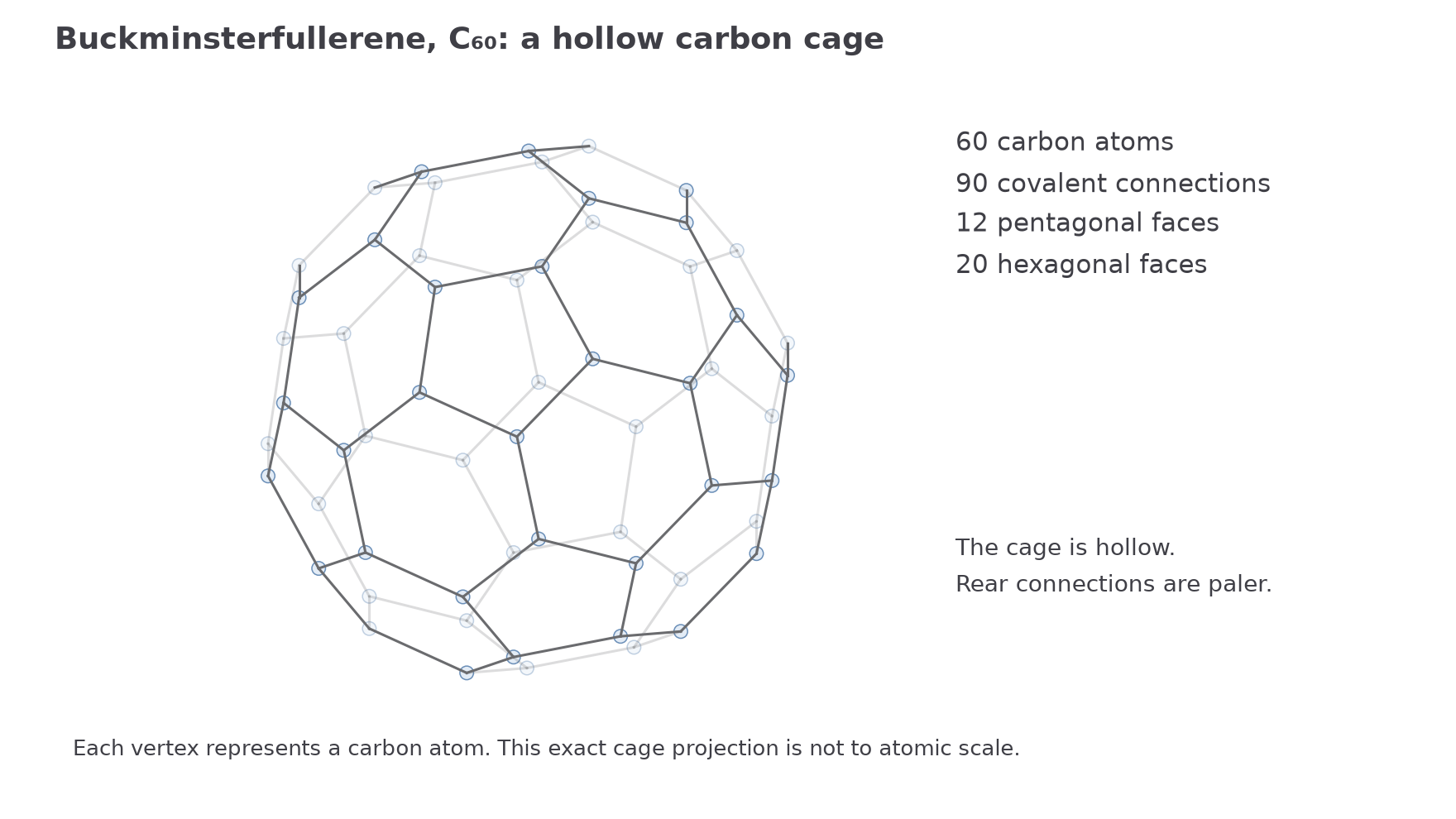
The hollow interior gives a possible way to carry or contain other substances. Fullerenes can therefore be considered for medicine delivery, provided that suitable information about transport, release and safety is supplied. Other possible uses include catalysts and lubricants: properties of the carbon surfaces or interactions between separate molecules may be useful. You should explain the property stated for the particular fullerene rather than assume every hollow molecule behaves identically.
Illustrative drug-carrier proposal: a hollow fullerene is designed to carry a small active substance and release it near target cells. Its hollow structure provides space for carrying material. The proposal also needs evidence that the cargo can be loaded and released, that the carrier reaches the target, and that it is compatible with the body.
Nanotube shape and applications
Carbon nanotubes are cylindrical fullerenes whose length is very large compared with their diameter.
A nanotube can be pictured as a carbon network shaped into a hollow tube. The graphene-and-tube diagram compares their patterns; manufacture does not require physically rolling a sheet. Some nanotubes have more than one wall, while the cylindrical shape and very high length-to-diameter ratio distinguish a tube from a spherical cage.
Strong carbon–carbon covalent bonds give nanotubes high tensile strength: resistance to pulling. This supports use as reinforcing fibres in composite materials. Their very small diameter and high length-to-diameter ratio make them useful structures in nanotechnology, the design and use of structures on a nanoscale. Many nanotubes can conduct electricity, supporting proposed electronic connections and components; electrical properties depend on the particular tube's structure, so do not assume all tubes have an identical conductivity.
For a tube long and in diameter, convert the two dimensions to the same unit before dividing:
A shorter, wider tube of length and diameter gives:
The second tube is still long relative to its diameter, but its ratio is smaller. Comparing the lengths without accounting for the diameters would miss that difference.
To recognise a nanotube in a description, combine “carbon”, “hollow cylinder” and “length much larger than diameter”. A spherical cage suggests Buckminsterfullerene; one flat hexagonal sheet suggests graphene. Link a use to the supplied properties: strength to reinforcing materials, conductivity to electronics, and controlled nanoscale shape to nanotechnology.