4.2.2.1,4.2.2.2 - States of matter and changes of state
Learn how particle arrangement, motion and attractions explain solids, liquids, gases and changes of state. Use melting and boiling data to predict a substance's state, add state symbols to equations, and recognise what a simple particle picture leaves out.
Particle arrangement and motion
The same substance can have different bulk properties because its particles are arranged and move differently in each state.
In the simple particle model, small spheres stand for the particles of a substance. A sphere might represent an atom, an ion or a whole molecule, depending on the substance. It is therefore important to say what the model's particles represent rather than assuming every sphere is an atom.
A solid has particles close together in fixed positions. They vibrate about those positions but do not travel freely through the solid. This explains its fixed shape and volume. In a liquid, particles are still close together, but their arrangement is less regular and they can move past one another. A liquid flows to take the shape of its container while keeping an approximately fixed volume. In a gas, particles are widely separated and move rapidly in random directions. They spread throughout the available container, so a gas has no fixed shape or volume.
[DIAGRAM: asset_name: Particle arrangements in three states; asset_slug: 8462_c13_particle_states; caption: Solids have fixed neighbours, liquids have mobile close particles, and gases have widely separated mobile particles.; description: Three containers show equal-sized schematic particles. The solid has a regular close arrangement with short double arrows representing vibration, the liquid has an irregular close arrangement and local movement arrows, and the gas has widely spaced particles with motion arrows in different directions. The same particle size is used in all states, and each panel is a slice rather than a complete three-dimensional sample.]
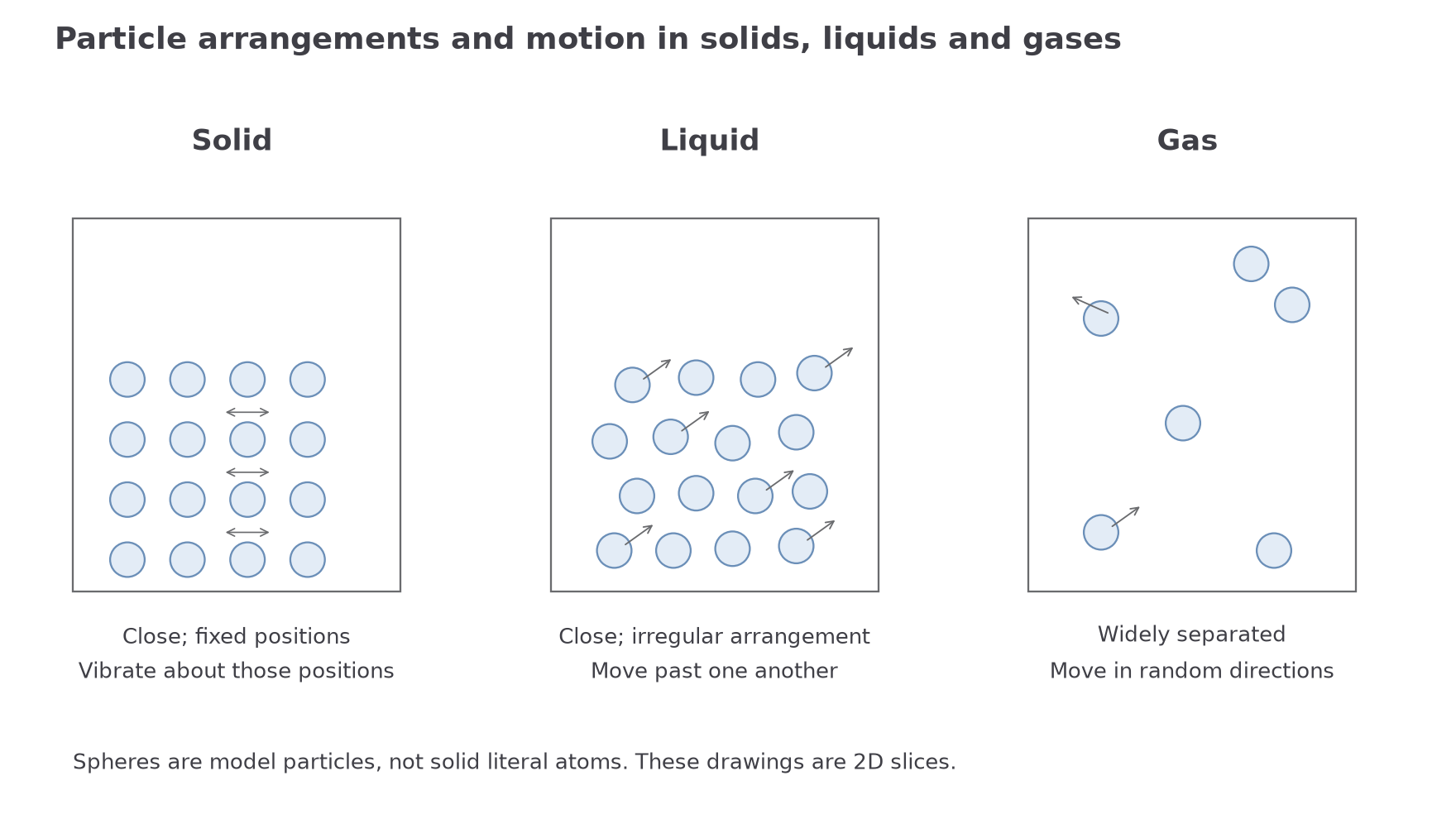
Gases compress much more readily than liquids and solids because there is far more space between their particles. Compression brings the gas particles closer together; it does not usually shrink the particles themselves. Likewise, melting does not make atoms into little liquid drops. An individual atom does not possess the bulk properties of a sample, such as fluidity or hardness. Those properties arise from many particles and their interactions.
Energy transfers in changes of state
A change of state transfers energy and changes the freedom of particles to move without necessarily making a new substance.
Melting changes a solid to a liquid; freezing reverses it. For a pure substance at a specified pressure, both occur at its melting point. Boiling changes a liquid to a gas throughout the liquid; condensing reverses it. These occur at its boiling point at that pressure. Evaporation can also occur at the surface of a liquid below its boiling point, so disappearance of a surface liquid does not prove it was boiling.
When a solid is heated before melting, its particles vibrate more energetically. At melting, energy is transferred to overcome enough of the attractions holding particles in their fixed arrangement so that they can move past one another. At boiling, further energy is needed for particles to separate much more widely. In an ideal heating curve of a pure substance, the temperature remains constant during each change while energy continues to be supplied. That energy changes the arrangement rather than raising the average kinetic energy of the particles.
Freezing and condensing transfer energy to the surroundings as particles become less free to move and attractions draw them into a closer or more ordered arrangement. The particles are not destroyed during cooling. Condensing a gas does not turn its individual molecules into solids: it brings many molecules together into a liquid.
The energy required depends on the attractions that must be overcome. Small molecular substances generally need relatively little energy to overcome weak intermolecular forces between molecules. Their strong covalent bonds inside molecules remain intact during an ordinary change of state. A giant ionic lattice has many strong electrostatic attractions to overcome, so it needs much more energy to melt. A giant covalent network requires strong covalent bonds to be overcome. Stronger relevant attractions therefore generally mean higher melting and boiling temperatures.
Predicting states and using state symbols
Melting and boiling temperatures tell you which state to expect when the pressure and the substance are specified.
At a temperature below the melting point, the stable state is solid. Between the melting and boiling points it is liquid; above the boiling point it is gas. At the melting point, solid and liquid may coexist while melting or freezing occurs. At the boiling point, liquid and gas may coexist. Data measured at one pressure should not be used uncritically at a different pressure, because boiling points depend on pressure.
For an illustrative pure substance with melting point and boiling point , the state is solid at , liquid at and gas at . At exactly , calling it definitely all solid or all liquid would ignore the possible change of state.
Chemical equations use state symbols after each formula: for solid, for liquid and for gas. The symbol means aqueous, dissolved in water. It does not mean a pure liquid. Solid sodium chloride is , molten sodium chloride is , and sodium chloride dissolved in water is .
For magnesium reacting with dilute hydrochloric acid, the observations and reagent information give:
Magnesium starts as a solid ribbon, hydrochloric acid is a solution, magnesium chloride remains dissolved and bubbles of hydrogen gas leave. State symbols describe the actual reaction conditions, rather than being permanently attached to an element's name. Water could be , or at different temperatures.
Limitations of the simple particle model (Higher)
A model using solid, inelastic spheres and no forces leaves out the interactions responsible for cohesion and energy transfers during changes of state.
The simple drawings help compare spacing and motion, but the spheres are representations. Real atoms are not solid balls: they contain a tiny nucleus and electrons and have internal structure. Real molecules can have several atoms and different shapes, so representing every particle as an identical sphere hides these differences. An inelastic solid sphere also does not represent the possible changes in real particles' interactions.
Most significantly for changes of state, a diagram with no forces between particles cannot explain the cohesion of a solid or liquid. If there were no attraction, it would not show why particles require energy to separate or why condensation releases energy. To explain changes of state, the model must be supplemented with the nature and strength of attractions between atoms, ions or molecules.
These limitations do not make every particle prediction useless. A sphere model can still explain why the large gaps in a gas allow easy compression, or why mobile close particles can flow. The appropriate conclusion identifies what the model explains and what additional chemistry it leaves out.