4.1.2.6 - Halogens and displacement
Learn how the seven outer electrons of Group 7 account for similar compounds and a decreasing reactivity trend. Compare chlorine, bromine and iodine, then use displacement reactions and colour evidence to decide which halogen is more reactive.
Halogen molecules and their compounds
The halogens are Group 7 non-metals whose atoms have seven outer-shell electrons.
Halogen elements consist of diatomic molecules, each containing two atoms: , , and represent fluorine, chlorine, bromine and iodine. A chlorine molecule is an element, because both atoms are chlorine, rather than a compound. Use the molecule's formula when writing an equation for the element.
When chlorine, bromine or iodine reacts with a metal, halogen atoms gain electrons and form negative ions with charge −1. These ions are named chloride, bromide and iodide. Their compounds with metal ions are ionic salts: sodium chloride , sodium bromide and sodium iodide all have a one-to-one ratio because sodium ions have charge +1. Magnesium chloride is , with two chloride ions for each magnesium ion of charge +2.
For example, sodium reacts with bromine:
With non-metals, the halogens form covalent compounds by sharing electrons. Hydrogen reacts with chlorine, bromine or iodine to form the molecular compounds hydrogen chloride , hydrogen bromide or hydrogen iodide . A chlorine example is . Their common outer-electron number explains the similar chemical patterns; it does not mean that every compound has identical properties or that every reaction is equally vigorous.
Physical properties down Group 7
The halogen molecules become more massive down the group, and their melting and boiling points increase.
| Halogen | Appearance of the element at room temperature | Molecular formula |
|---|---|---|
| Chlorine | Pale green gas | |
| Bromine | Red-brown liquid | |
| Iodine | Grey-black solid; purple vapour when heated |
Relative molecular mass is the sum of the relative atomic masses of the atoms in a molecule and has no unit. Each halogen molecule contains two atoms of the same element. For fluorine with :
For chlorine with :
Chlorine's molecules are therefore more massive than fluorine's molecules.
The attractions between molecules become stronger down the group as the molecules become larger. More energy is needed to overcome these attractions in melting and boiling, giving higher temperatures for those changes. Melting and boiling do not break the covalent bond inside each halogen molecule: remains when it changes from liquid to gas.
This increasing physical trend helps explain chlorine being a gas, bromine a liquid and iodine a solid at the same room temperature. From data showing successive rising boiling points, predict a still higher boiling point for the next element below iodine, within that trend. The trend supports a direction, not an exact value without further evidence. It also does not imply increasing chemical reactivity: that trend runs in the opposite direction.
Why halogen reactivity decreases downwards
A halogen atom tends to gain one electron, but this becomes more difficult down Group 7.
Chlorine has structure 2,8,7, so gaining one electron completes its outer shell as 2,8,8. Its nucleus attracts the incoming negative electron. Bromine and iodine have more occupied shells; the region where the incoming electron is gained is farther from the nucleus and more shielded by inner electrons. The effective attraction for that electron is weaker, despite the greater proton number.
The weaker attraction means that gaining the electron is more difficult, so reactivity decreases down Group 7. Chlorine is more reactive than bromine, and bromine is more reactive than iodine. Explain the electron being gained, rather than claiming the halogen loses its seven outer electrons.
Group 1 has the same structural changes downwards—more shells, greater distance and shielding—but reacts by losing an electron. Weaker attraction makes loss easier and gaining an electron harder. This is why the two groups have opposite reactivity trends even though both gain shells downwards.
A prediction from position should use the right process. An unfamiliar Group 7 element below bromine is expected to gain an electron less readily than bromine and be less reactive. Its greater molecular mass can still give it a higher boiling point. “More reactive” and “higher boiling point” answer different questions about matter.
Displacement reactions and colour evidence
A more reactive halogen displaces a less reactive halogen from an aqueous solution of its salt.
Adding chlorine water to sodium bromide solution produces bromine: chlorine becomes chloride in sodium chloride, while bromide becomes the bromine element. The salt's sodium is not displaced. The word equation is:
chlorine + sodium bromide → sodium chloride + bromine
Similarly, bromine displaces iodine from potassium iodide: . Chlorine displaces both bromine and iodine, bromine displaces iodine but not chlorine, and iodine displaces neither chlorine nor bromine. A less reactive halogen does not cause the reverse displacement. These comparisons give the order chlorine > bromine > iodine in reactivity.
[DIAGRAM: asset_name: Halogen displacement outcomes; asset_slug: 8462_c08_displacement; caption: Chlorine displaces bromine and iodine; bromine displaces iodine; iodine displaces neither.; description: A labelled matrix has chlorine, bromine and iodine as added halogens and chloride, bromide and iodide as salts. It identifies bromine or iodine produced in the three possible displacements, no displacement for less reactive additions, and no net change when the same halogen is added to its own halide.]
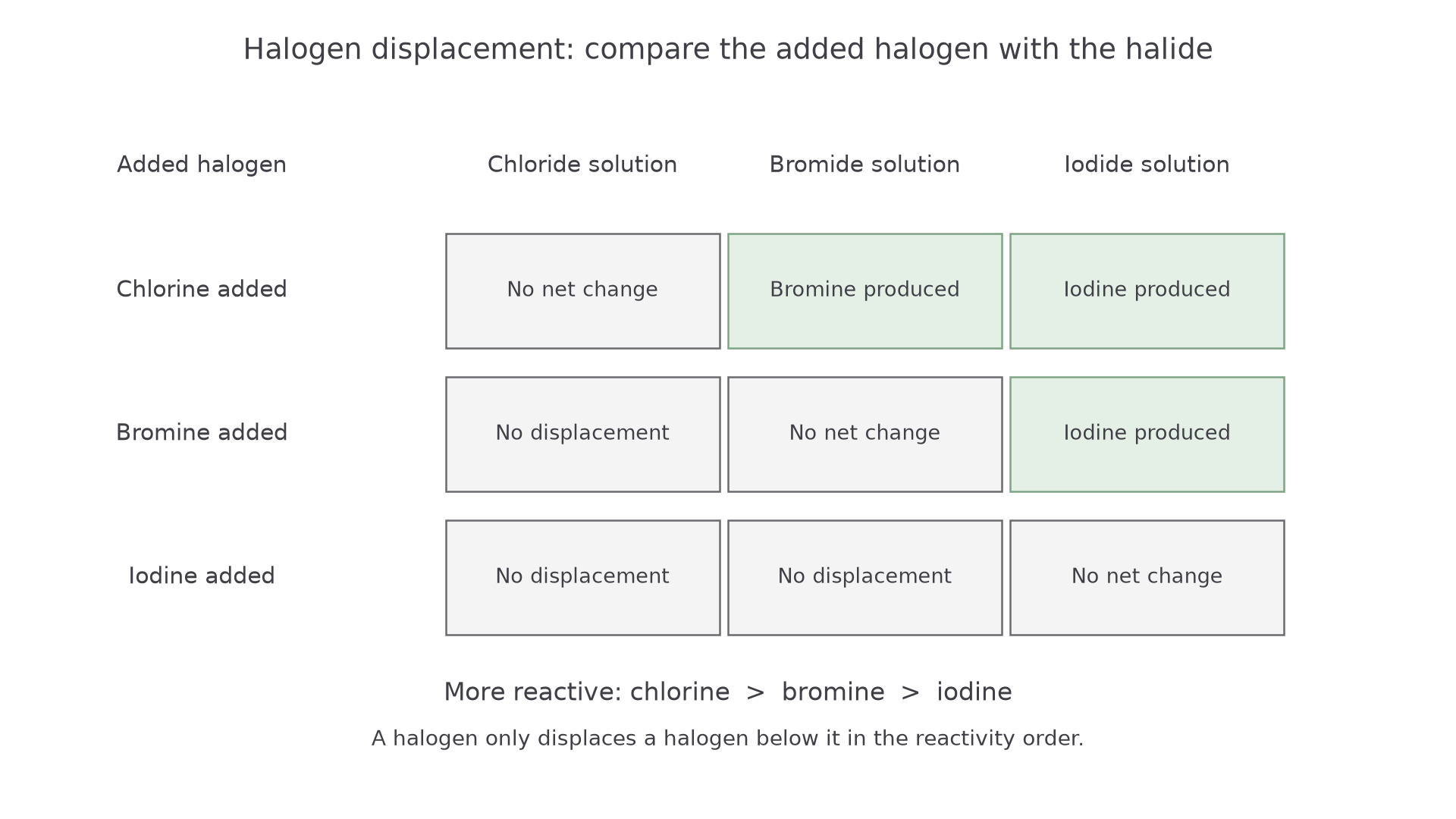
In water, bromine is orange and iodine is brown, whereas dilute sodium chloride, sodium bromide and sodium iodide solutions are colourless. Chlorine water is pale green/yellow-green depending on concentration. Newly appearing bromine or iodine colour can therefore provide evidence for displacement. Iodine vapour is purple, but aqueous iodine is brown: use the state and solvent in the question rather than a memorised colour without context.
To compare reactions, place small measured volumes of similarly concentrated halide solutions in labelled tubes, add the same measured volume of dilute halogen solution and observe against a white background. Compare with the original solutions and a control containing the added halogen diluted with water. A starting bromine colour alone is not evidence that bromine has displaced another halogen. Keep conditions comparable, record initial and final colours, and identify the product the new colour represents.
Halogen solutions are hazardous and can release irritating vapours. Use the laboratory's dilute solutions, small quantities, eye protection and specified ventilation; handle them under teacher supervision, avoid inhalation and dispose of them as directed. These controls protect the observer while allowing valid, comparable observations. A colour change must be interpreted chemically, and weak or overlapping colours may require comparison with controls.