4.10.3.3 - Ceramics, polymers and composites
Learn how ceramics, polymers and composites are made, how polymer structure affects melting and density, and how to use quantitative property data to select a material for a stated purpose.
Glass and clay ceramics
Ceramics are non-metallic materials made by processing mineral substances, usually with heating.
Most everyday glass is soda-lime glass, made by heating a mixture of sand, sodium carbonate and limestone. The ingredients are processed at high temperature into the glass material, which can be formed into products such as bottles and windows. This is a manufactured material, not simply grains of sand held together unchanged.
Borosilicate glass is made from sand and boron trioxide. It melts at a higher temperature than soda-lime glass. Different starting substances therefore produce glasses with different properties. If choosing between them for a high-temperature use, consider the temperatures they must withstand and any further data about thermal behaviour, rather than assuming all glass is interchangeable.
Clay ceramics, including pottery and bricks, are made by shaping wet clay and then heating it in a furnace. Wet clay can be moulded; drying and firing produce a hard material that retains the shape. Fired clay is not simply soft clay temporarily made cold. Heating changes the material so that adding water does not return a brick to the original mouldable clay.
Glass and clay ceramics are typically hard but brittle: they resist scratching or compression in suitable circumstances but can fracture rather than bend. Transparency makes glass useful for windows; clay bricks are useful as durable building units. A material's usefulness depends on the combination of properties and the form of the product. Hardness does not establish resistance to every type of impact.
Corning introduced PYREX borosilicate glass in 1915. Its laboratory PYREX products provide a named example of choosing glass composition for useful thermal and chemical behaviour. The brand history does not establish the composition of every present-day consumer product: use the specified material information when comparing particular objects.
Low-density and high-density poly(ethene)
The same monomer can produce polymers with different structures when manufacturing conditions change.
A monomer is a small molecule that can join with many others to form a long polymer chain. Ethene molecules join to make poly(ethene). The properties of a polymer depend both on the monomer used and on conditions such as temperature, pressure and catalyst during manufacture. Using the same starting monomer does not guarantee an identical final chain arrangement.
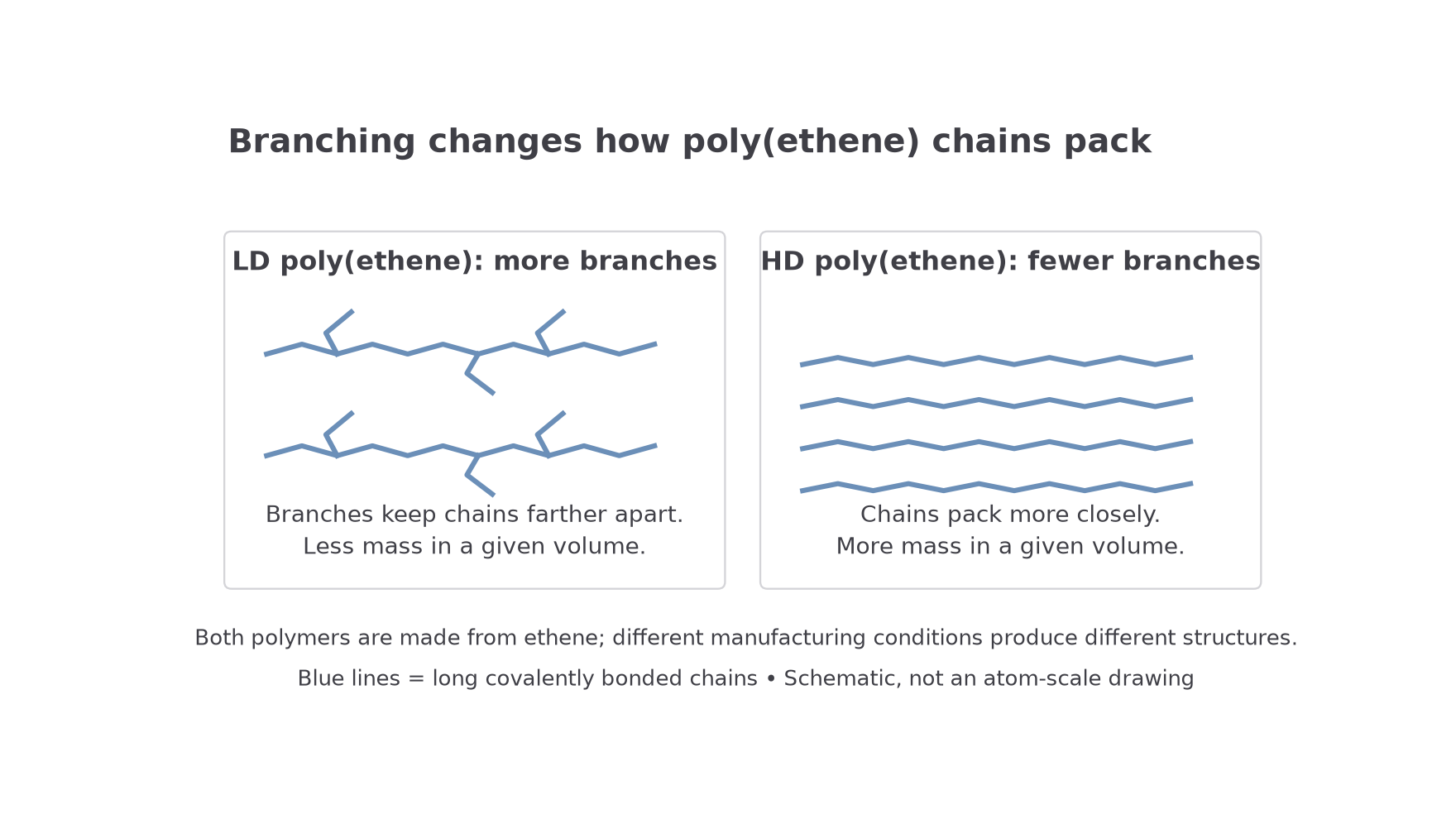
Low-density poly(ethene), LD poly(ethene), is made under conditions involving very high pressure and higher temperature. Its chains have more branches. These branches stop neighbouring chains packing as closely together, giving a lower mass per unit volume. The material is relatively flexible and is useful for products such as flexible film.
High-density poly(ethene), HD poly(ethene), is made under different conditions, using a catalyst at lower temperature and pressure. Its chains have fewer branches and can pack more closely. This gives a higher density and stronger overall attractions between closely packed chains, contributing to a stiffer material useful for products such as rigid containers.
The distinction is primarily chain architecture and packing, not that HD poly(ethene) is made from a different monomer. Density compares equal volumes: a large LD object can still have a greater total mass than a small HD object. The schematic below shows the packing idea, not a literal scale drawing of every atom.
[DIAGRAM: asset_name: Polyethene branching and packing; asset_slug: 8462_c70_polymer_structure; caption: More-branched LD chains pack less closely than HD chains, despite both polymers starting from ethene.; description: Two labelled molecular arrangement schematics compare branched low-density polyethene chains with fewer-branched, more closely packed high-density chains. Blue lines represent long covalently bonded molecules, not literal atom-scale structures. The labels relate packing to mass in a given volume.]
Thermosoftening and thermosetting structures
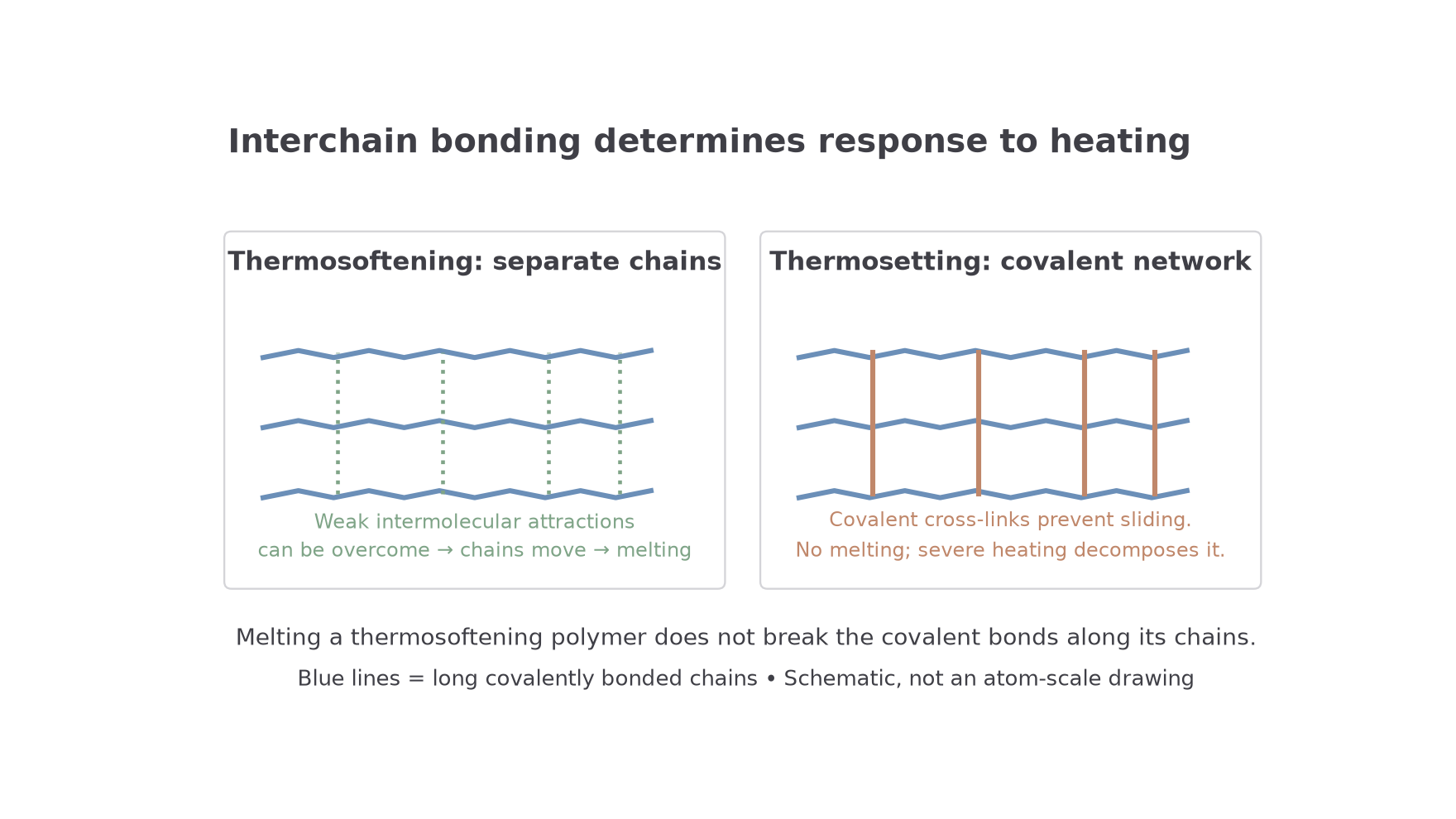
Whether a polymer melts on heating depends on how its long molecules are connected to each other.
A thermosoftening polymer has separate chains with no covalent cross-links forming a network between them. There are strong covalent bonds along each chain, but the attractions between chains are weaker. Heating provides enough energy to overcome these intermolecular attractions, allowing chains to move past each other and the material to soften and melt. Cooling allows the material to become solid again. Melting does not require breaking all the covalent bonds along the polymer chains.
A thermosetting polymer has covalent cross-links between chains, forming a network. The chains cannot simply slide apart when heated because the cross-links hold them together. It does not melt on heating; sufficiently severe heating can break bonds and decompose the material instead. Decomposition is a chemical change, not reversible melting.
[DIAGRAM: asset_name: Thermosoftening and thermosetting interchain structures; asset_slug: 8462_c70_thermal_structure; caption: Weak interchain attractions can be overcome in thermosoftening polymers, while covalent cross-links hold a thermosetting network together.; description: Two structure schematics show separate blue chains with dotted sage intermolecular attractions in a thermosoftening polymer and blue chains joined by solid clay covalent cross-links in a thermosetting polymer. Labels explain chain movement and melting versus a network that does not melt and can decompose on severe heating.]
Continue this lesson.
You’re previewing NovaLearn without an account. Create a free account to read the rest.
Create free account