4.10.4.1 - The Haber process
Learn how nitrogen and hydrogen are converted into ammonia and how the industrial process separates and recycles gases. Reacting gas ratios and the balance between equilibrium yield, production rate and cost explain the quantitative and commercial decisions.
Nitrogen, hydrogen and ammonia
The Haber process manufactures ammonia, which is an important starting material for nitrogen-based fertilisers.
Its raw materials are nitrogen and hydrogen. Nitrogen is obtained from air, for example by separating the components of liquefied air; it makes up about four-fifths of the atmosphere. Hydrogen can be obtained from natural gas, chiefly methane, by reaction with steam followed by further processing. This route uses a finite feedstock and produces carbon dioxide overall. Hydrogen can also be obtained by electrolysis of water, with its impacts depending on the electricity supply. Distinguish hydrogen from the resource and process used to manufacture it.
The purified gases react reversibly:
Nitrogen + hydrogen ⇌ ammonia.
The balanced equation shows one nitrogen molecule reacting with three hydrogen molecules to make two ammonia molecules. These proportions guide the feed mixture, but do not mean that all the gases react during a single pass.
Nitrogen-containing compounds provide nutrients needed for plant growth. Converting atmospheric nitrogen to usable fertiliser compounds increases the supply of such nutrients to crops. Ammonia is not itself an NPK formulation: further processing and combination with appropriate phosphorus- and potassium-containing compounds is needed for an NPK fertiliser.
BASF's first industrial ammonia-synthesis plant began operating at Oppau, Germany, in 1913. Turning a reversible laboratory reaction into reliable large-scale production required both chemistry and engineering: suitable raw-material feeds, a catalyst, pressure equipment and a separation/recycle system.
Industrial reaction, separation and recycling
The industrial process removes ammonia from a reversible reaction mixture and returns unreacted gases to the reactor.
Purified nitrogen and hydrogen pass over an iron catalyst at a high temperature of about 450°C and a high pressure of about 200 atmospheres. Some nitrogen and hydrogen form ammonia. Because the reaction is reversible, ammonia can also break down into nitrogen and hydrogen. The gas leaving the reactor therefore contains ammonia together with unreacted nitrogen and hydrogen.
The mixture is cooled so that ammonia liquefies. Under the separation conditions, nitrogen and hydrogen remain gases. Liquid ammonia is removed, and the unreacted nitrogen and hydrogen are recycled to the reactor. Cooling is the cause of condensation; simply saying “ammonia is removed” does not describe how separation happens. The recycled stream is the unreacted feed gases, rather than the removed ammonia product.
[DIAGRAM: asset_name: Haber reaction and gas recycle; asset_slug: 8462_c71_haber_loop; caption: Ammonia is condensed and removed while unreacted nitrogen and hydrogen return to the reactor.; description: A labelled industrial flow schematic shows purified nitrogen and hydrogen entering a reactor with iron at about 450 degrees Celsius and 200 atmospheres, the reaction mixture moving to a cooler, liquid ammonia leaving separately, and gaseous nitrogen and hydrogen recycling to the reactor.]
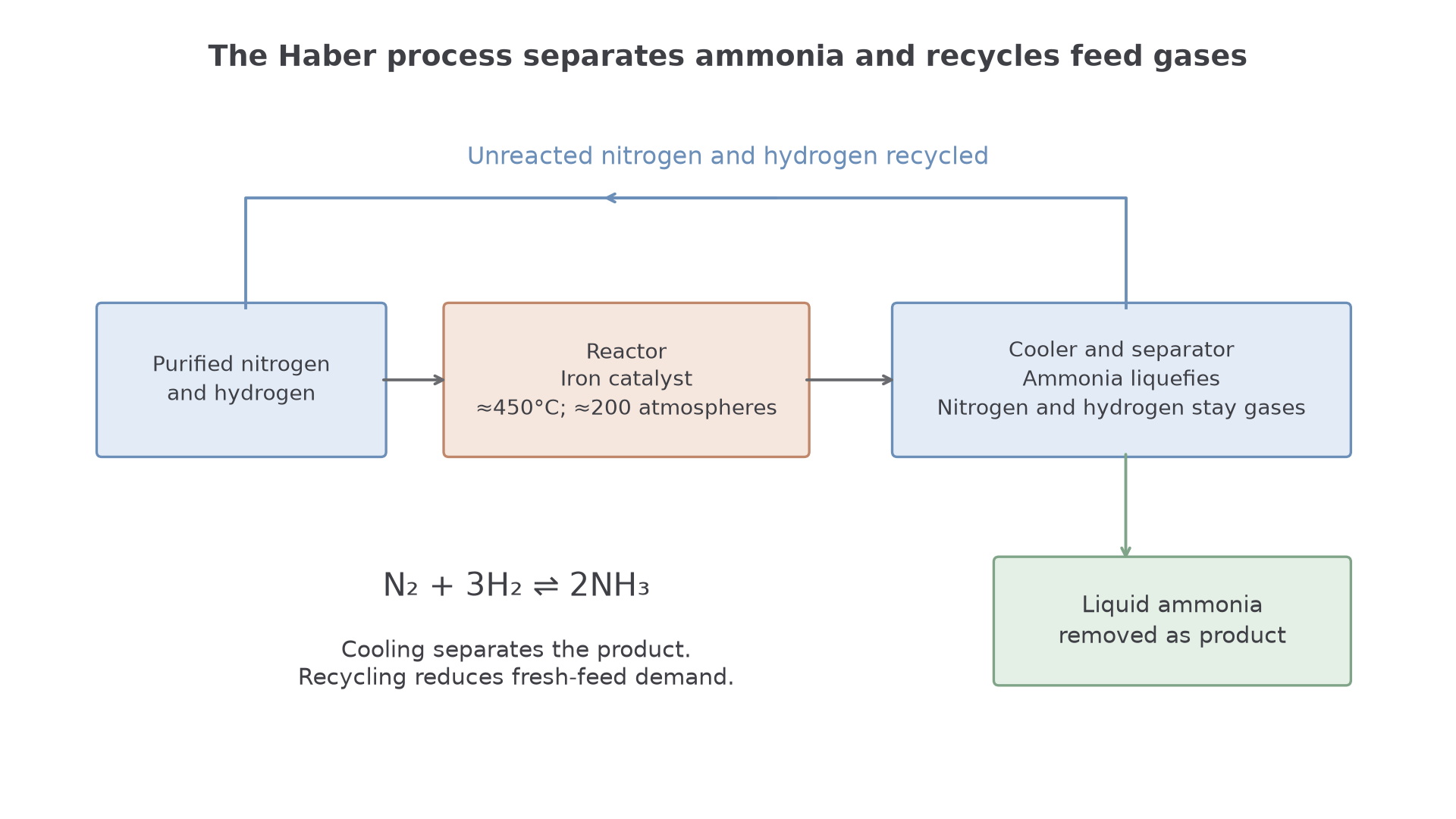
Recycling conserves useful raw materials and improves the total amount eventually converted, even if the conversion on each pass is limited. If of an available reacting feed is converted in one pass, remains for possible recycle. A real plant also controls impurities so that they do not accumulate indefinitely in the recycle stream.
Reacting gas volumes in ammonia production (Higher)
At the same temperature and pressure, gas-volume ratios follow the coefficients in a balanced equation.
For , the volume ratio of nitrogen reacting, hydrogen reacting and ammonia formed is . Compare all gas volumes at matching temperature and pressure. This ratio describes reacting quantities; a reversible industrial mixture does not all convert in one pass.
Finding the hydrogen requirement
For theoretical complete reaction of of nitrogen:
The hydrogen volume is three times the nitrogen volume; the ammonia volume is twice it.
Working backwards from ammonia
To form of ammonia by theoretical complete reaction:
The calculated feed ratio is . This checks the result without assuming that volumes are conserved: gas molecule counts change in the reaction.
Temperature, equilibrium and production rate (Higher)
The chosen temperature balances a faster reaction against a lower equilibrium proportion of ammonia.
In a closed system, the reversible reaction can reach dynamic equilibrium: the forward and reverse reactions continue at equal rates and the amounts of reactants and products remain constant. Equal rates do not mean equal amounts. Equilibrium yield describes the proportion of ammonia present at equilibrium under specified conditions; production rate describes how quickly ammonia is made. They answer different questions.
Continue this lesson.
You’re previewing NovaLearn without an account. Create a free account to read the rest.
Create free account