4.6.1.2,4.6.1.3,4.6.1.4 - Collision theory, rate factors and catalysts
Collision theory explains why changing concentration, gas pressure, solid surface area, temperature or a catalyst changes reaction rate. Learn how these factors affect collision frequency or the activation-energy requirement, and use particle explanations to predict unfamiliar situations.
Successful collisions and activation energy
Reacting particles must collide with sufficient energy for a reaction to occur.
Particles in gases and solutions are continually moving. Collisions bring reactants together so bonds can change and new products can form. Many collisions do not produce a reaction because the particles do not have enough energy. The minimum energy required is the activation energy. A collision that meets the requirements and forms products is a successful collision.
Reaction rate depends on how many successful collisions occur per unit time, not simply how many particles are present.
Two routes can increase the number of successful collisions per second. Increasing the collision frequency gives more opportunities to react. Increasing the fraction of collisions with sufficient energy makes more of those opportunities successful. Different rate factors work through different routes, so an explanation should name the route that actually changes.
Worked example 1 — changing collision frequency
Illustrative particle model: 100 collisions occur each second and one tenth are sufficiently energetic:
Doubling the frequency while retaining that fraction gives:
The increased frequency creates more successful opportunities without changing the fraction with enough energy.
Worked example 2 — changing the energetic fraction
In a second model, frequency remains 80 collisions per second. Raising the fraction energetic enough from 25% to 50% gives:
Rate doubles through a different cause. These models explain two mechanisms; they are not measured rates or a universal rate law.
A statement that particles “collide more” is incomplete if it only means more collisions in total over a longer experiment. Rate concerns collisions more frequently, or more successful collisions per second. Likewise, more kinetic energy does not automatically mean the activation energy has decreased: the particles' energy and the reaction's required barrier are separate.
Concentration, pressure and surface area
Concentration, gas pressure and solid surface area affect how often reactant particles can meet.
Increasing concentration in solution puts more reacting particles in a given volume. At the same temperature, particles do not move faster just because the solution is more concentrated. They are more crowded, so collisions between reactants occur more frequently. More successful collisions per second increase rate. Dilution reduces concentration, collision frequency and usually rate under the same conditions.
For reacting gases, raising pressure by compressing them into a smaller volume brings their particles closer together. At the same temperature, collision frequency increases and reaction is faster. Reducing pressure has the opposite effect. This gas-pressure explanation does not apply in the same way to an ordinary solid or liquid, which cannot be compressed appreciably by such changes.
For a solid reactant, other reactant particles collide with exposed surface particles. Breaking the same mass into smaller pieces exposes more surface area without adding more solid. Powder therefore normally reacts faster than large lumps of the same substance in the same conditions. Eventually both can give the same amount of product if the same total amount reacts; faster does not mean more product overall.
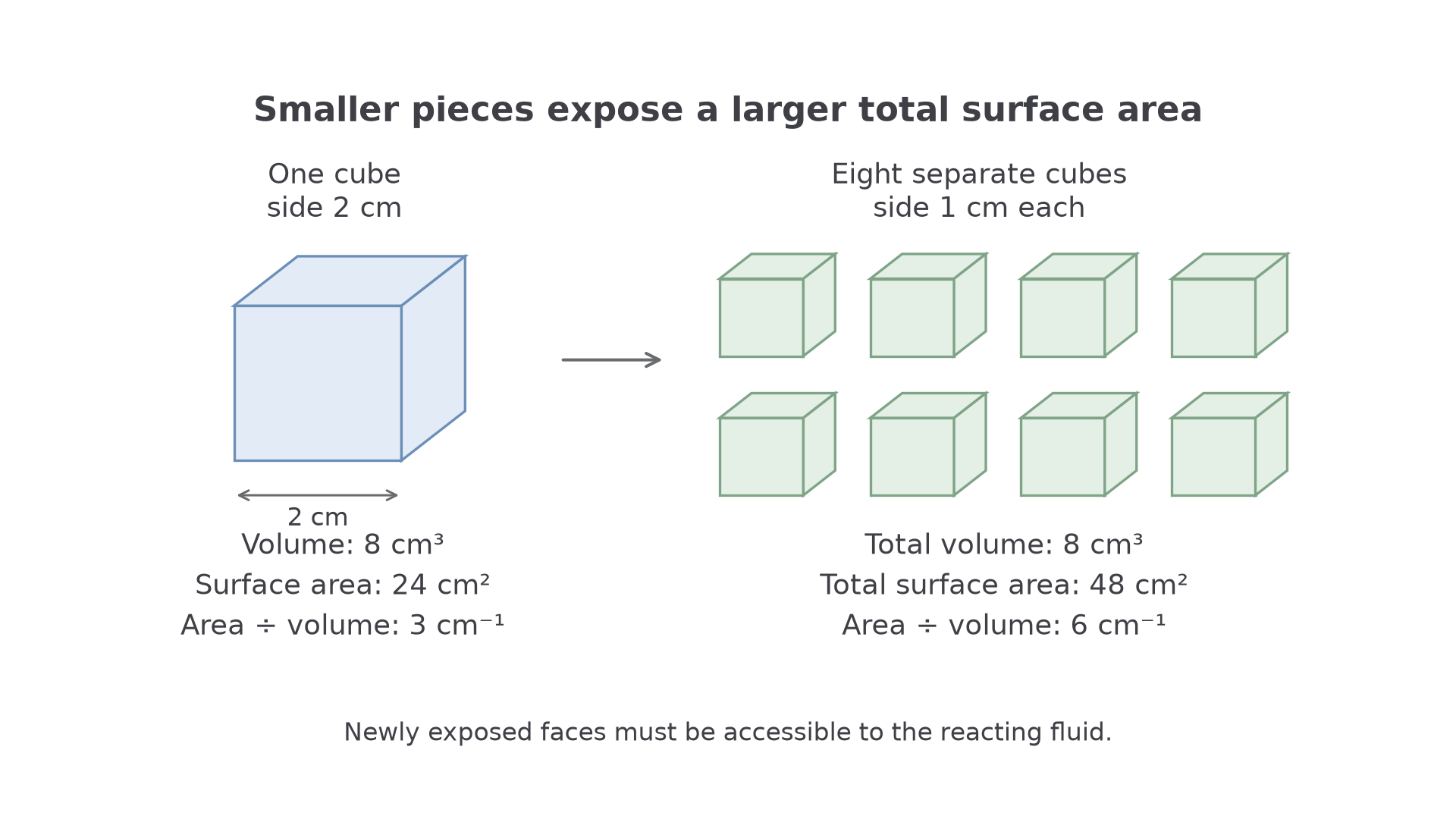
Worked example 1 — cutting a two-centimetre cube
For a cube of side , calculate volume, area and their ratio:
Cut it into eight cubes of side :
The material volume is unchanged but the exposed area doubles, assuming all separated faces contact the reacting fluid.
[DIAGRAM: asset_name: Piece size and exposed surface area; asset_slug: 8462_c42_surface_area; caption: Dividing one cube into eight smaller cubes keeps the solid volume constant but doubles the exposed area.; description: A dimensioned cube of side 2 cm and eight separated cubes each of side 1 cm. Text compares total volume 8 cm³ in both cases, total surface area 24 versus 48 cm², and surface area to volume ratio 3 versus 6 per cm.]
Worked example 2 — a different starting cube
A cube of side has:
Separating it into 27 one-centimetre cubes gives:
This increases exposed area threefold. Both calculations retain the same material amount, so the change is available surface rather than extra solid.
Simple proportionality is useful when its assumptions are stated. If doubling concentration approximately doubles collision frequency and the same fraction of collisions succeeds, rate approximately doubles. A directly proportional rate–concentration graph is a straight line through the origin. Real measurements may depart from this simplified relationship because other factors change or the reaction mechanism is different. Never claim that every temperature increase or every concentration change has one fixed numerical rate multiplier.
Continue this lesson.
You’re previewing NovaLearn without an account. Create a free account to read the rest.
Create free account