4.1.1.4,4.1.1.5 - Subatomic particles, isotopes and atomic scale
Use the nuclear model to explain atomic charge, count particles in atoms and ions, and distinguish isotopes. Comparing particle charges, masses and sizes shows why almost all atomic mass occupies a tiny part of an atom's volume.
Particle charges and neutral atoms
An atom contains a small nucleus of protons and neutrons, with electrons occupying energy levels around it.
| Particle | Location | Relative electrical charge | Relative mass |
|---|---|---|---|
| Proton | Nucleus | +1 | 1 |
| Neutron | Nucleus | 0 | 1 |
| Electron | Outside the nucleus | −1 | Very small compared with 1 |
“Relative” means comparing values on a chosen scale rather than giving charges in coulombs or masses in kilograms. A proton and an electron have charges of equal size and opposite sign. One electron balances one proton's charge, although their masses are very different.
In an atom, the number of electrons equals the number of protons, so the overall charge is zero. For an oxygen atom with eight protons and eight electrons:
For a lithium atom with three protons and three electrons, the same accounting gives:
Neutrons do not change either total because their charge is zero. A neutral atom does not lack charged particles: it contains balanced positive and negative charges.
Almost all atomic mass is in the nucleus, because protons and neutrons are much more massive than electrons. Most atomic volume is outside that nucleus. Mass, size and charge are different properties; a large region need not contain most of the mass, and a heavier particle need not have a larger charge.
Atomic number and mass number
Atomic number identifies the element, while mass number counts its nuclear particles.
Atomic number and mass number
Atomic number is the number of protons in an atom's nucleus. Mass number is the total number of protons and neutrons in that nucleus.
Every atom of an element has the same atomic number. Any nucleus with eleven protons belongs to sodium; changing its proton number would make a different element. Different sodium atoms can have different neutron numbers.
In the notation , the top-left number 23 is the mass number and the bottom-left number 11 is the atomic number. Read the proton number first, then find the remaining nuclear particles:
The nuclear count checks: . For a neutral chlorine atom, , use the same method:
Here , while the equal proton and electron counts give zero overall charge. The mass number counts nuclear particles, not all particles in the atom.
Number of protons = atomic number.
Number of neutrons = mass number − atomic number.
For a neutral atom, number of electrons = number of protons.
The mass number is a whole-number particle count for one isotope. It is not the decimal relative atomic mass often printed in the periodic table; that value can be an average over several isotopes. Electrons do not enter the mass-number count, even though their mass is not literally zero.
Isotopes and ions
An isotope changes neutron number, whereas forming an ion changes electron number.
Isotopes
Atoms of the same element with the same number of protons but different numbers of neutrons.
Chlorine-35 and chlorine-37 both have seventeen protons, so both are chlorine. Their neutron numbers are and . Neutral atoms of both also have seventeen electrons. The mass numbers differ because neutrons differ, not because one isotope contains more protons. Describing isotopes as “atoms with different masses” alone does not identify which particles differ.
An ion is a particle with an overall electrical charge. An atom forms a positive ion by losing electrons or a negative ion by gaining electrons. The nucleus stays the same in these ordinary chemical changes. Losing one negative electron gives a relative charge of +1; gaining one gives −1.
For the magnesium ion , the nucleus is unchanged by losing two electrons:
Its charge checks as . For the sulfur ion , forming a negative ion adds electrons:
The charge is . A charge magnitude of 2 means a difference of two between proton and electron counts, not double the electron number.
The overall relative charge equals proton number minus electron number. Use this to check an answer: twelve protons and ten electrons give . Never add protons to explain a positive chemical ion, because doing so would change the element.
Atomic size, standard form and scale
Atomic dimensions are so small that powers of ten and scaled comparisons make their sizes easier to understand.
A representative atomic radius is about , or . Nano means one billionth: . Multiplying 0.1 by this conversion gives . A negative exponent means a small fraction of a metre, not a negative distance.
The nucleus has a radius less than one ten-thousandth of the atomic radius, of order . These approximate dimensions vary between elements. They explain how most mass can be concentrated in a region occupying very little volume.
[DIAGRAM: asset_name: Scaling an atom and its nucleus; asset_slug: 8462_c04_scale; caption: If an atom's radius were enlarged to 100 m, its nucleus would have a radius below 1 cm.; description: A scale comparison labels atomic radius about 0.1 nm and nuclear radius less than one ten-thousandth of atomic radius, then maps them to an illustrative 100 m atomic radius and below 1 cm nuclear radius. The visible nucleus is enlarged for clarity rather than drawn to scale.]
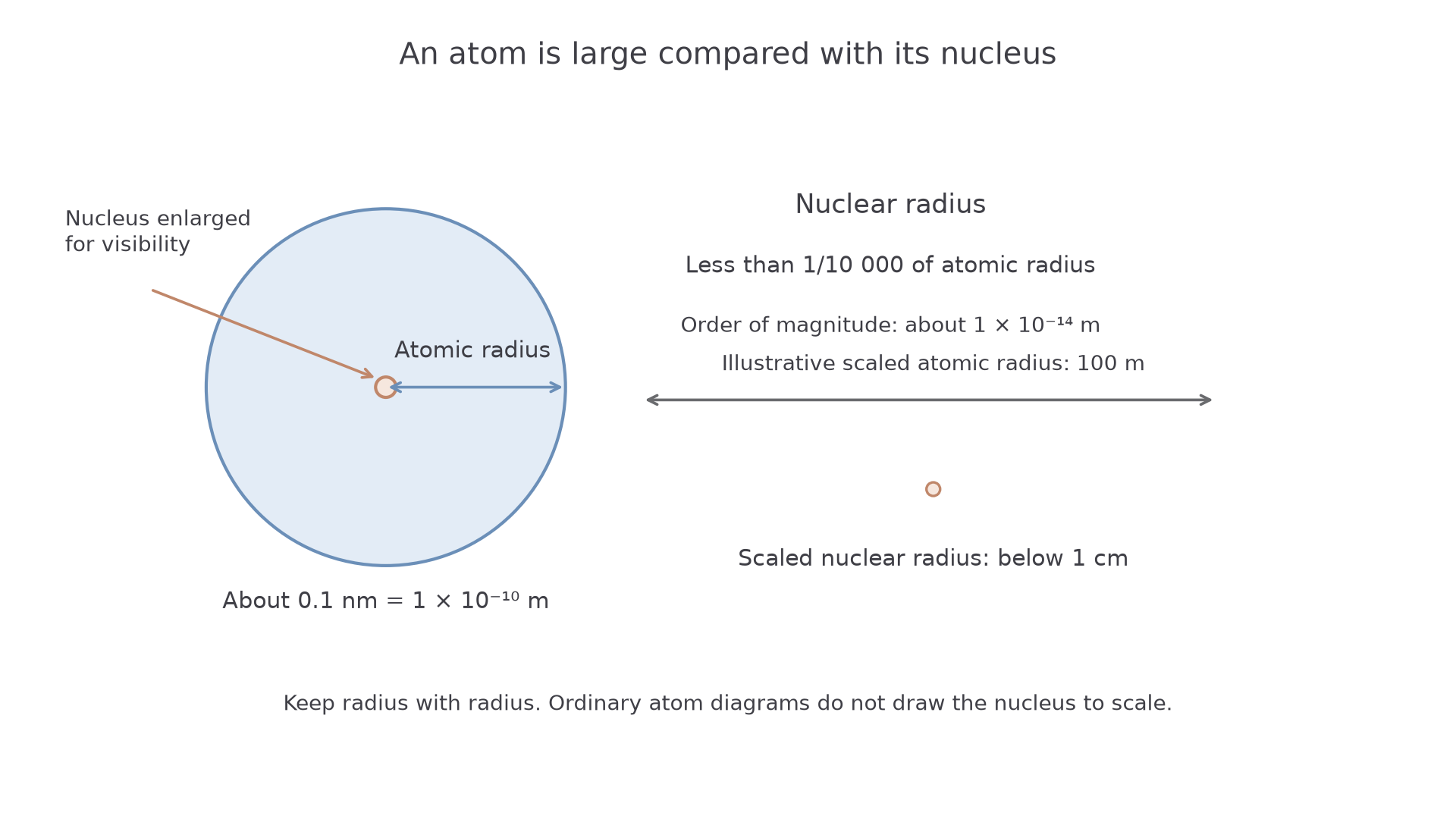
For a scale model with an atomic radius of , apply the same size ratio:
Keep radius with radius: using diameter for only one of the objects would introduce a factor-of-two error. A normal shell picture deliberately enlarges the nucleus so you can see it.
Standard form writes a number as , with and integer . To estimate how many atoms of diameter touch along a line, first give both lengths the same unit:
This is a size estimate assuming the stated equal diameters and a straight line, rather than a literal model of a solid's arrangement. An estimate should name its assumptions as well as its number.