4.1.1.2 - Separating mixtures
Learn why mixtures can be separated without chemical reactions and how filtration, crystallisation, distillation and chromatography work. Choosing a method means using a difference in physical properties while keeping the substance you want.
Mixtures and filtration
Substances in a mixture retain their chemical properties because they have not been chemically combined with each other.
Mixture
Two or more elements or compounds together without chemical combination. Its composition can vary, and its components can be separated by physical processes.
Air is a mixture of gases, and seawater is a mixture containing water and dissolved salts. Adding more salt changes a salt solution's concentration without making a different compound. Separation exploits properties such as solubility, boiling point or movement through paper. No new substance is made by the separation itself.
Filtration separates an insoluble solid from a liquid. Sand does not dissolve in water. Put folded filter paper into a funnel, support the funnel above a beaker and pour the sand–water mixture gently into it. The paper holds the sand as the residue; water passes through as the filtrate. Avoid overfilling above the paper's edge, because mixture could run around the paper without being filtered. Pouring down a glass rod helps control the flow.
For a mixture of salt and sand, first stir with water to dissolve the salt. Filter to remove the sand. The filtrate is salt solution, because dissolved salt particles pass through with the water. Filtration cannot remove dissolved salt from seawater. If pure sand is wanted, wash the residue with a little water to remove remaining salt solution, then dry it.
Safe handling is part of a valid method: wear eye protection where splashes are possible, secure the funnel and keep the collecting beaker stable. Choose a beaker large enough for the filtrate, and avoid pressing or tearing the filter paper. The aim is physical separation, so a reagent that reacts with the wanted substance would change the task.
Recovering a dissolved solid by crystallisation
Crystallisation recovers a soluble solid by making a solution too concentrated to keep all the solid dissolved.
A solvent is the liquid doing the dissolving and a solute is the dissolved substance. Evaporating some solvent increases the amount of solute per remaining volume. For many salts, solubility also decreases as the solution cools, so the excess solute separates as crystals. The crystals are the original compound, not a new product of a reaction.
To obtain crystals from a salt solution, place it in an evaporating basin and heat gently. Stop once it is sufficiently concentrated to form crystals on cooling, rather than heating it completely dry. One small drop on a cool glass rod can show whether crystallisation begins. Leave the hot concentrated solution to cool; filter off the crystals, rinse with a little cold suitable solvent and dry them between filter papers or in a suitable warm place. Use little cold liquid when washing because too much would dissolve the crystals and reduce the amount recovered.
Evaporation to dryness removes all the solvent and can be suitable for a stable solid such as sodium chloride. Crystallisation is a better choice when prolonged strong heating could decompose the solute, or when crystals of a purer solid are wanted. Some soluble impurities can remain in the mother liquor, the solution left after crystals form. This does not guarantee that all impurities are removed: an insoluble impurity should be filtered off first.
Heating should be controlled, with eye protection and a supported basin on suitable apparatus. A water bath or electric heater can give gentler heating where appropriate. Keep flammable solvents away from naked flames and do not handle hot glass or a hot basin as if it were cold. The sequence depends on the mixture, the desired product and the hazards, rather than on one memorised procedure for every solution.
Simple and fractional distillation
Distillation collects a liquid by evaporating it and then condensing its vapour.
Simple distillation separates a solvent from dissolved solids, or can separate liquids with sufficiently different boiling points. To collect water from salt solution, heat the solution in a flask. Water evaporates while the dissolved salt remains in the flask. Water vapour passes into a condenser, a tube surrounded by a cold-water jacket. It cools, condenses and flows into a receiver as the distillate. Collecting the vapour distinguishes distillation from evaporation when the solvent is wanted.
[DIAGRAM: asset_name: Simple distillation apparatus; asset_slug: 8462_c02_distillation; caption: Vapour from heated salt solution condenses to give liquid water while salt remains in the flask.; description: Schematic simple distillation apparatus with heated flask, thermometer bulb at the side-arm entrance, downward sloping water-jacketed condenser, cooling water entering at the lower end and leaving at the upper end, and an open receiving flask.]
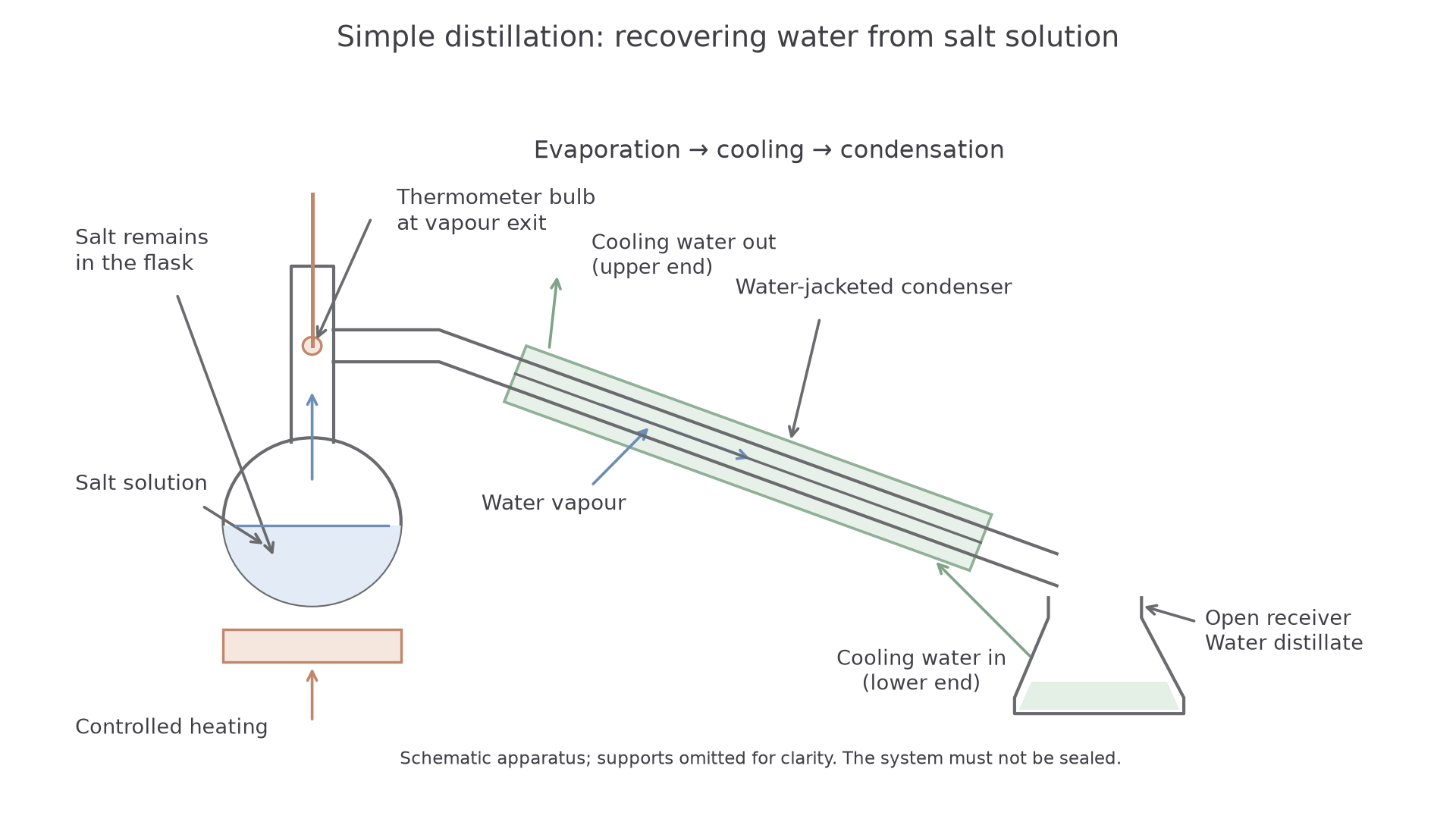
The thermometer bulb should be at the vapour exit to measure the temperature of vapour entering the condenser. Cooling water enters at the lower end and leaves at the upper end so the jacket fills. Support the flask and condenser securely. Add anti-bumping granules before heating where appropriate, heat steadily and leave the apparatus open to the atmosphere through its receiver; a sealed heated system can build pressure. Do not heat the flask dry. Use an electric heater rather than a naked flame for flammable liquids.
Fractional distillation separates a mixture of liquids using their different boiling points. A fractionating column is placed between the flask and condenser. The column is warmer at the bottom and cooler at the top. Vapours repeatedly condense and evaporate: the higher-boiling components are more likely to condense lower down and return to the flask, while vapour richer in the lowest-boiling component reaches the top and is collected first. Change the receiver as the temperature rises to collect later fractions.
For example, an ethanol–water mixture needs fractional rather than simple distillation to obtain an ethanol-rich fraction, because both liquids are volatile. Repeated condensation and evaporation improve the separation, although the collected fractions can still contain more than one substance. In crude-oil processing, fractions are groups of hydrocarbons with similar boiling points, rather than individual pure substances.
Chromatography and choosing a separation method
Chromatography separates dissolved substances because they move through a system at different rates.
In paper chromatography, a small spot of an ink is placed on a pencil baseline near the bottom of the paper. The bottom of the paper stands in a suitable solvent, with the baseline above the solvent surface. As the solvent rises, dissolved dyes move with it. A dye that spends more time carried by the solvent travels farther; a dye more strongly attracted to the paper travels less far. Different dyes can therefore form separate spots. The moving solvent is the mobile phase and the paper provides the stationary phase.
Use pencil because graphite does not dissolve in the solvent and introduce extra dye spots. Keep the starting spot above the solvent so the sample does not dissolve straight into the solvent reservoir. Remove the paper before the solvent reaches its top and mark the solvent front promptly. Compare a sample with known dyes under the same conditions. A single spot suggests a single dye in that solvent system, but two dyes could travel together. Comparing results with another suitable solvent can reveal substances that travelled together in the first run.
Choosing a separation method begins with what you want to recover. To obtain a dissolved salt, use crystallisation; to obtain its water, use distillation. To separate an insoluble solid, filter. To separate miscible volatile liquids, use fractional distillation. To compare dissolved dyes, use chromatography. Soluble, insoluble, volatile and the desired product determine the choice; the fact that a sample is “a mixture” alone is insufficient.
An integrated example is obtaining both sand and salt from their mixture. Add water to dissolve only the salt, filter, wash and dry the sand, then concentrate and cool the filtrate to crystallise the salt. Each step exploits a physical difference, and no step changes salt into its elements. If water is also required, collect it by distillation instead of letting all the vapour escape.