4.2.1.1,4.2.1.4 - Covalent bonding and representations
Learn how non-metal atoms share electrons to form covalent bonds and how to draw the required molecules. You will read molecular formulae, displayed structures and models, then distinguish small molecules, polymer chains and giant covalent networks without treating a drawing as a literal picture of an atom.
Shared electron pairs
A covalent bond forms when two atoms share a pair of electrons, rather than one atom transferring electrons to the other.
Covalent bonding occurs in most non-metallic elements and in compounds of non-metals. Hydrogen gas, chlorine gas, water and methane are familiar molecular examples. Unlike an ionic lattice, a molecule is a distinct group of atoms joined by covalent bonds.
Covalent bond
A strong bond formed by a shared pair of electrons between atoms, with electrostatic attraction between the shared negative electrons and the positive nuclei of both atoms.
Each atom contributes to the shared pair in the molecules studied here. Both atoms count that pair as part of their outer shell. Hydrogen starts with one electron and needs two in its first shell. In , each hydrogen contributes one electron, producing one shared pair. Both hydrogen atoms then count two electrons in their outer shell.
For the other required non-metal atoms, the useful target is eight outer electrons. Chlorine starts with seven and forms one bond; oxygen starts with six and forms two; nitrogen starts with five and forms three; carbon starts with four and forms four. These are the patterns for the simple molecules in this lesson, not a universal rule for every possible compound.
The shared electrons remain part of the molecule and are attracted to both nuclei. They do not become ions by being shared. Covalent bonds are strong, but “strong bonds” alone does not predict whether a whole substance has a high boiling point: you must also establish whether it consists of separate molecules or an extended network.
Dot and cross diagrams of molecules
A molecular dot and cross diagram shows shared pairs between atom symbols and unshared outer electrons around the atoms.
Only outer electrons need be shown. Use dots for one atom's electrons and crosses for the other atom's electrons. For molecules with several hydrogens, the same symbol can identify all hydrogen contributions. Dots and crosses are chemically identical electrons: the notation tracks their origin. A lone pair is a pair of outer electrons not shared in a bond.
Begin with each atom's outer-electron count, put one electron from each bonded atom into each shared pair, then place the remaining electrons as lone pairs. Finally check hydrogen counts two electrons and each of the other required atoms counts eight. There are no charged-ion brackets around these neutral molecules.
[DIAGRAM: asset_name: Dot and cross diagrams of hydrogen chlorine oxygen and nitrogen; asset_slug: 8462_c11_diatomic_electrons; caption: Single, double and triple bonds share one, two and three electron pairs.; description: Four complete outer-shell dot and cross diagrams show hydrogen with one shared pair and no lone pairs, chlorine with one shared pair and three lone pairs on each atom, oxygen with two shared pairs and two lone pairs on each atom, and nitrogen with three shared pairs and one lone pair on each atom. Dots and crosses distinguish contributions from the two atoms. These schematics are not to scale.]
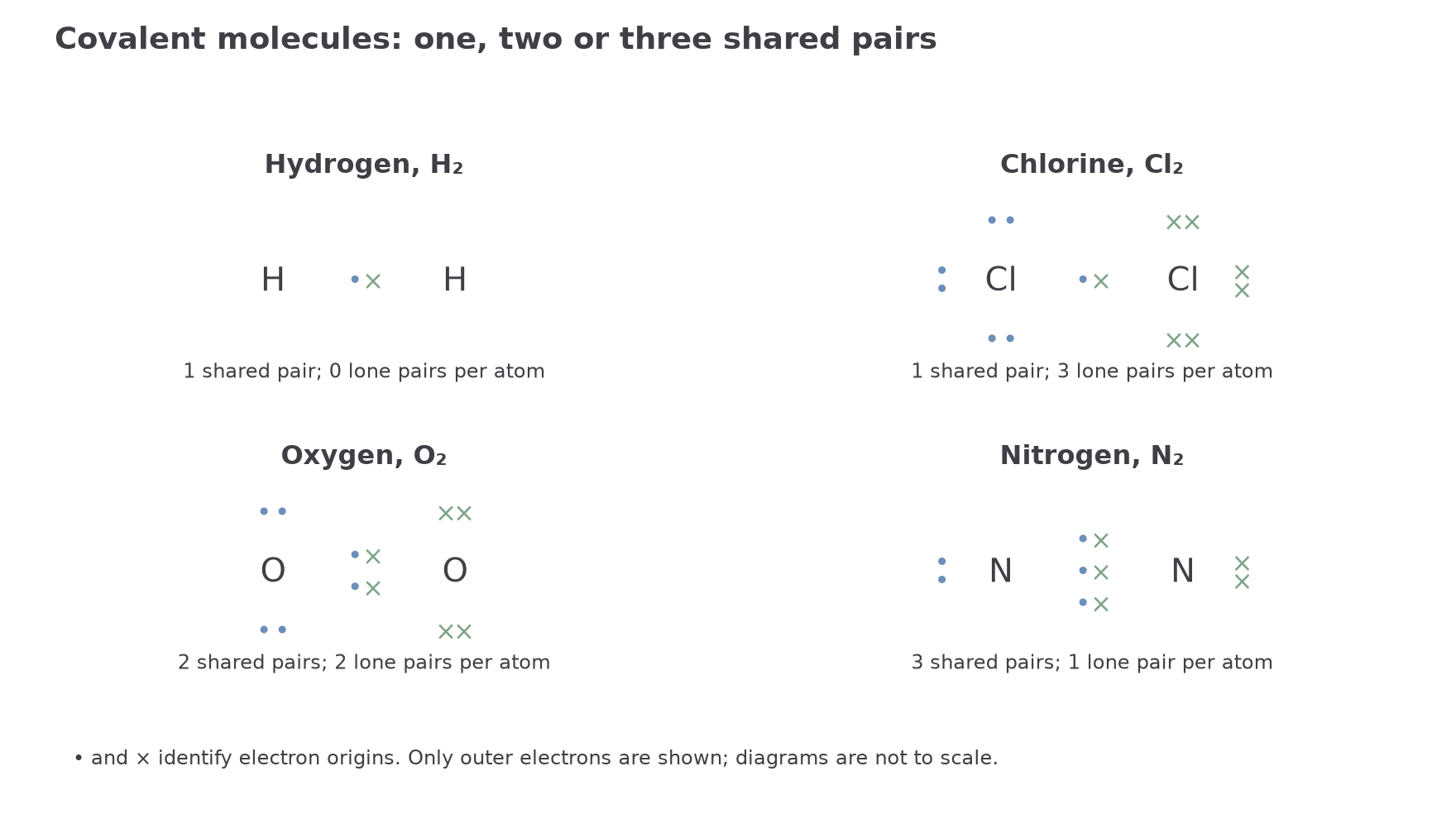
The required diatomic molecules illustrate different numbers of shared pairs. Hydrogen, , has one pair and no lone pairs. Chlorine, , has one shared pair and three lone pairs on each chlorine. Oxygen, , has two shared pairs, a double bond, and two lone pairs on each oxygen. Nitrogen, , has three shared pairs, a triple bond, and one lone pair on each nitrogen. An oxygen atom contributes two electrons to bonding, but counts all four shared electrons towards its outer shell.
[DIAGRAM: asset_name: Dot and cross diagrams of four covalent compounds; asset_slug: 8462_c11_compound_electrons; caption: Complete electron diagrams of hydrogen chloride, water, ammonia and methane.; description: Hydrogen chloride has one hydrogen-chlorine shared pair and three lone pairs on chlorine. Water has two oxygen-hydrogen shared pairs and two lone pairs on oxygen. Ammonia has three nitrogen-hydrogen shared pairs and one lone pair on nitrogen. Methane has four carbon-hydrogen shared pairs and no lone pairs on carbon. Each bond contains one dot and one cross. The flat layouts show electron counts rather than actual molecular shapes.]
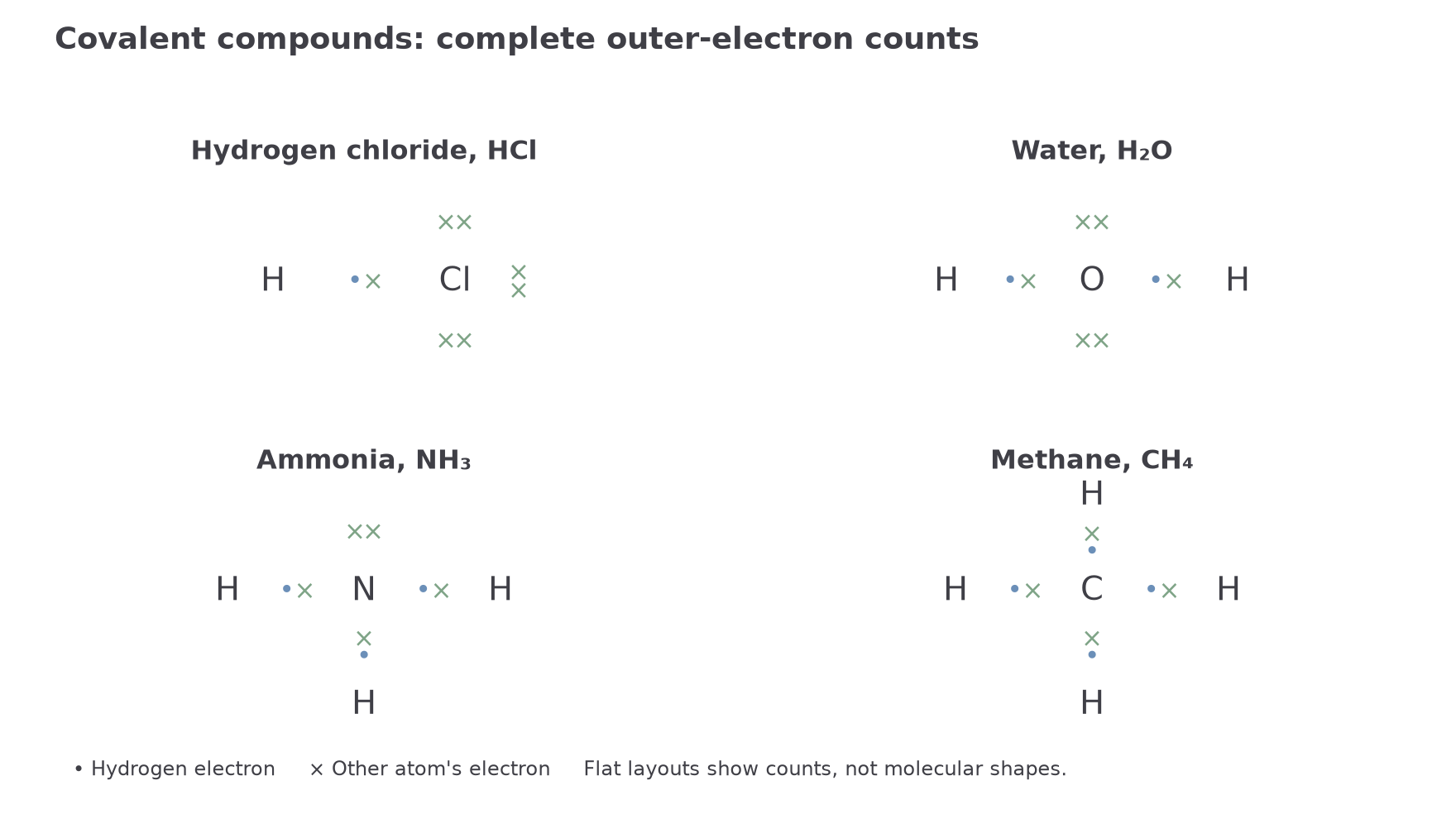
For hydrogen chloride, , chlorine shares one pair with hydrogen and keeps three lone pairs. In water, , oxygen shares one pair with each of two hydrogens and keeps two lone pairs. In ammonia, , nitrogen shares one pair with each of three hydrogens and keeps one lone pair. In methane, , carbon shares one pair with each of four hydrogens and has no lone pairs.
As a worked count for water, oxygen supplies two of its six outer electrons to the two bonds and retains four in two lone pairs. The two hydrogen atoms supply one electron each. The diagram therefore contains eight electrons in total: six from oxygen and two from hydrogen. Oxygen counts both shared pairs and both lone pairs, while each hydrogen counts its own shared pair.
Displayed bonds and molecular formulae
A displayed structure replaces a shared pair with a line, while a molecular formula counts the atoms in one complete molecule.
A single line represents one covalent bond: one shared electron pair. Two lines represent a double bond and three represent a triple bond. Thus hydrogen is , hydrogen chloride is , oxygen is and nitrogen is . Lone pairs are usually omitted from displayed formulae, so a line drawing is not a complete electron diagram.
To deduce a molecular formula, count each type of atom in one complete connected molecule. A model with one nitrogen sphere joined to three hydrogen spheres is . A model with two carbon spheres, one oxygen sphere and six hydrogen spheres gives . Do not count the number of bonds as the number of atoms: a double bond joins two atoms, not four.
Common formulae such as , , , , , , , and describe small molecules. Formulae must still be interpreted with chemical knowledge. The formula gives the ratio in giant silicon dioxide, not proof that there are separate three-atom molecules.
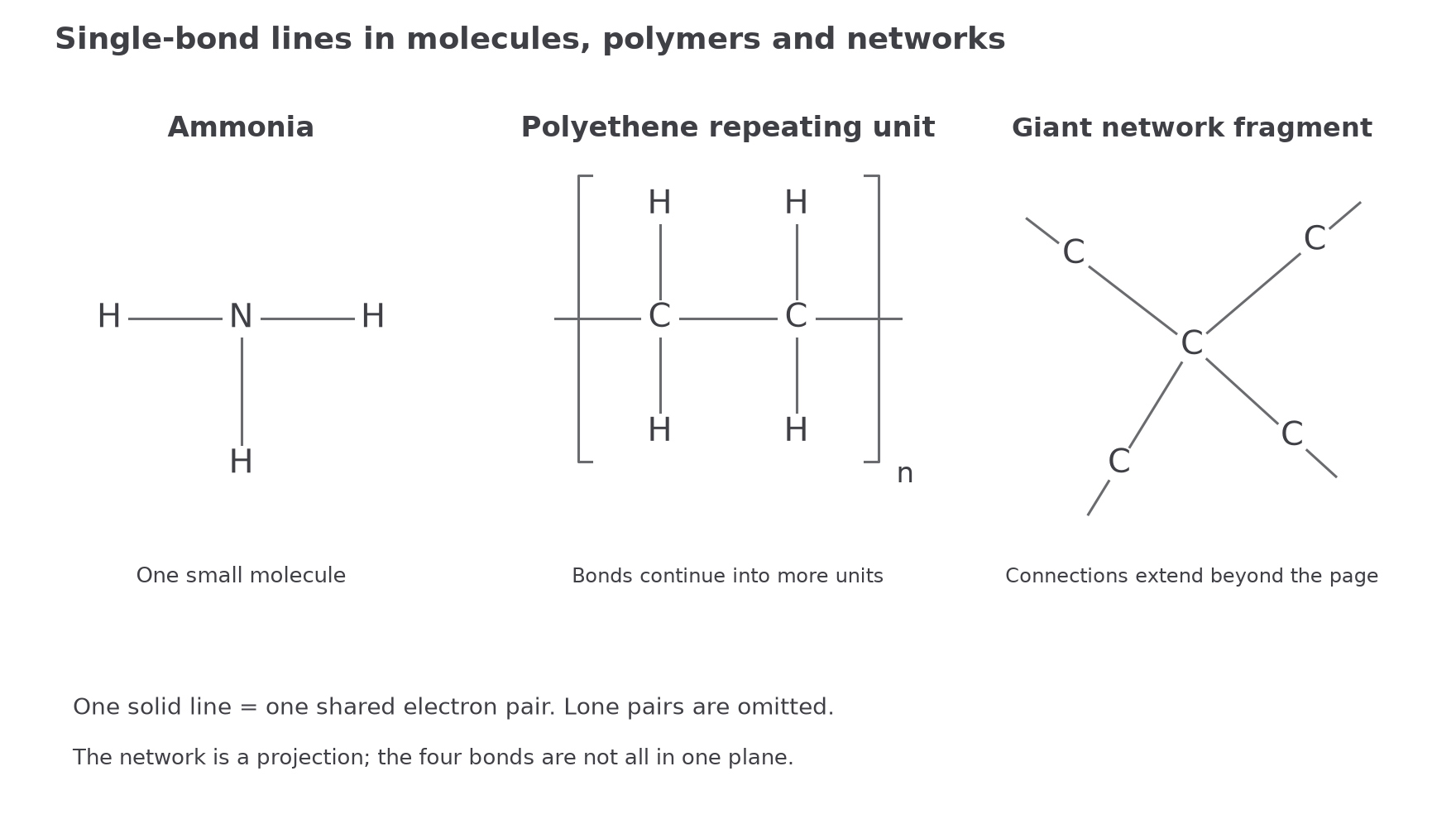
[DIAGRAM: asset_name: Lines representing covalent bonds in three structures; asset_slug: 8462_c11_displayed_structures; caption: The same single-bond line can represent a molecular bond, a polymer bond or a bond in a giant network.; description: Three panels show ammonia with three nitrogen-hydrogen single bonds, a bracketed polyethene repeating unit with two carbon atoms and four hydrogens and continuation bonds through the brackets labelled n, and a projected fragment of a diamond network with a central carbon joined to four carbon neighbours and continuation bonds. All solid lines represent single covalent bonds; the flat layouts do not imply planar three-dimensional structures.]
Molecules, polymers and giant structures
Covalent bonds can join atoms into separate small molecules, very large molecules or an extended network.
In a small molecular substance, each connected group contains a limited number of atoms and is separated from other groups. A diagram showing several disconnected water molecules represents many small molecules, even if the whole drawing contains numerous atoms.
A polymer contains very large molecules built from many repeating units. In the polyethene representation above, two carbon atoms form part of the chain and each carbon also bonds to two hydrogens. The bonds extend through the brackets to the next units. The symbol means a large number of repeats; it is not an atom symbol or a bond. Each carbon still forms four bonds when the continuation bonds are counted. One long chain is a molecule, with other chains separate from it.
In a giant covalent structure, bonds form an extended network rather than a collection of separate molecules. Diamond has carbon atoms joined through a three-dimensional network. Silicon dioxide also has a giant covalent structure. A drawn fragment must show or describe continuation beyond the edge; a small printed fragment is not the whole substance.
Recognition therefore depends on connectivity, not how many circles fit on the page. Separate compact bonded groups suggest small molecules; long repeating chains suggest polymers; a network extending through a solid suggests a giant covalent structure. Compare that with an ionic model showing positive and negative ions or a metallic model showing delocalised electrons. All have strong bonding, but their particles and connections differ.
What molecular models leave out
A representation is useful because it selects information, so it also leaves some information out.
Dot and cross diagrams make electron accounting clear but normally show only outer electrons. They do not give realistic atom sizes or bond lengths, and a flat layout need not show the molecule's actual shape. A water diagram drawn as hydrogen–oxygen–hydrogen is a useful bond-counting diagram; it does not establish that water is linear. Distinguishing dots from crosses also does not mean an electron remains a labelled object in reality.
A two-dimensional displayed formula makes bonds and atom counts easy to read but often omits lone pairs and does not show spatial angles. A three-dimensional ball and stick model shows relative positions and bond directions more clearly, but atoms are not hard coloured balls and bonds are not physical sticks. Sizes and spacing may be exaggerated. A space-filling model better suggests occupied space but can hide bonds or atoms behind the front surface.
For a giant structure, every small model also has an artificial boundary. It cannot contain the enormous number of atoms in a real sample. A three-dimensional model helps with depth, but a photograph or projection of it can still hide connections. Choose a model according to the question: electron pairs for bonding, displayed lines for connectivity, and a three-dimensional representation for spatial arrangement.