4.2.4.1,4.2.4.2 - Nanoparticles, surface area and applications
Learn how nanoscale dimensions compare with atoms and larger particles, and calculate why small particles have a high surface-area-to-volume ratio. You will use that relationship to explain potential applications, then evaluate supplied evidence about benefits and possible risks without assuming that every nanoparticle has the same properties.
Particle size ranges and scale
Nanoscience deals with structures about 1 to 100 nanometres in size, much smaller than particles of ordinary dust.
A nanometre, , is . One metre therefore contains one thousand million nanometres. For a diameter of :
In the reverse direction, a diameter of gives:
Standard form uses a number at least 1 but less than 10 multiplied by a power of ten. Convert to a common unit before comparing dimensions.
These approximate size bands compare nanoparticles with larger particles:
| Particle description | Diameter in nanometres | Diameter in metres |
|---|---|---|
| Nanoparticle | 1–100 | to |
| Fine-particle comparison band, associated with PM2.5 | 100–2500 | to |
| Coarse-particle comparison band, associated with PM10 | 2500–10 000 | to |
Coarse particles are often called dust. The band boundaries are approximate rather than points where every material's properties suddenly change. In air-quality measurements, PM2.5 usually includes particles and smaller, including nanoparticles; PM10 includes particles and smaller. These measurement categories overlap, while the table separates size bands to compare their scales.
A typical atom has diameter of order . Nanoscale structures are therefore larger than individual atoms. At the smaller end they may contain only a few hundred atoms; the actual count depends on their size, shape and material. A nanoparticle is not simply one unusually large atom.
For a scale comparison, take a molecule of width and a particle of diameter . The particle is 20 times wider than the molecule. Compared with an atom of approximate diameter , it is times wider. This compares lengths rather than counting all atoms in a three-dimensional particle.
An order of magnitude is a factor of ten. A dimension is 100 times a dimension, so it is two orders of magnitude larger. Estimate the power of ten before calculating: it helps catch an accidental reversal of the nanometre conversion.
Surface area to volume ratio
As a particle gets smaller, its surface area decreases less rapidly than its volume, so a larger fraction of its material is close to a surface.
For a cube with side length , each face has area . There are six faces, giving total surface area . Its volume is , so:
Use one length unit consistently. The numerical ratio has inverse-length units, such as .
For a cube of side , calculate the six-face area before dividing by volume:
For a cube of side :
Decreasing the side by a factor of ten increases the ratio by a factor of ten. The smaller single cube has less surface area in total, but more surface area per unit volume.
Sometimes volume is given instead of side length. A cubic particle of volume has three equal side lengths whose product is 216:
Taking a square root would find a length from an area, not from a volume. Keep the square and cubic units distinct even when the numerical values match.
[DIAGRAM: asset_name: Subdivision increases exposed surface area; asset_slug: 8462_c17_cube_surface; caption: Cutting one cube into eight half-side cubes doubles their total exposed surface area while preserving volume.; description: A projected cube of side two arbitrary length units has surface area twenty-four square units and volume eight cubic units. Eight separated cubes of side one unit each have combined surface area forty-eight square units and the same combined volume of eight cubic units. Separation exposes faces that were formerly internal. A side-halving arrow and ratio values three and six inverse length units show the increase.]
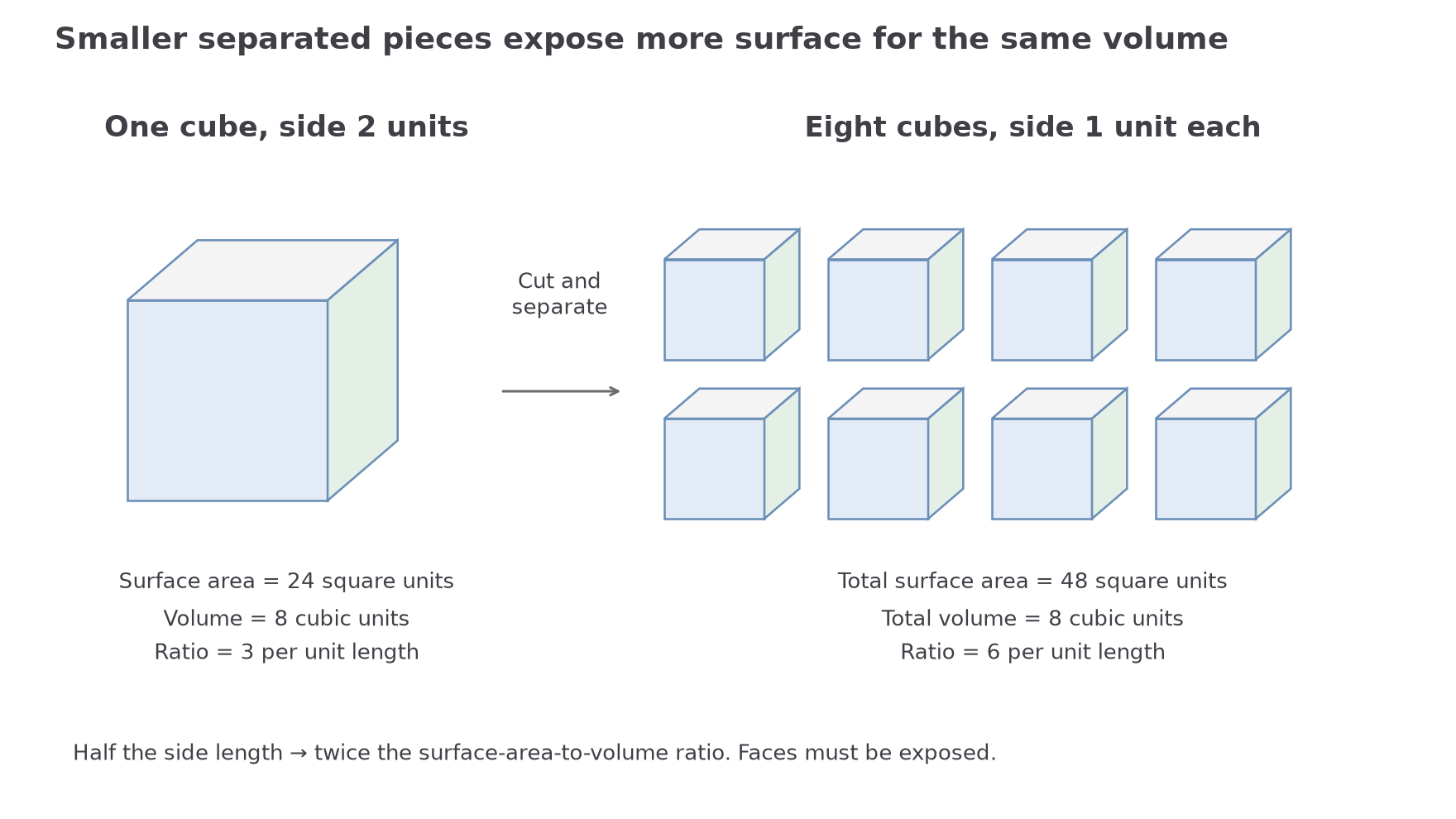
The same idea explains why breaking a fixed volume into smaller pieces increases exposed area. A cube of side has volume and area . Cutting it into eight separate cubes preserves the total volume but gives of exposed area, a 100% increase. If the pieces remain tightly pressed together, the contacting faces are not exposed to the surroundings; separation matters.
Surface properties and applications
Nanoparticles can behave differently from the same material in bulk because their high surface-area-to-volume ratio makes surface interactions much more significant.
In a large piece, most atoms are inside and are not directly exposed to the surroundings. Dividing the same amount into tiny particles exposes more material. Where a process occurs at a surface, a smaller mass may therefore produce a useful effect. This is a reason why a small quantity of nanoparticles can be effective; it does not mean that reducing size improves every property of every material.
For a catalyst, reactions occur at accessible surfaces. A high exposed surface area for a given amount of catalyst can provide more places for reactant particles to interact, supporting a faster reaction or less catalyst for a specified performance. Agglomeration, where particles clump together, can reduce the accessible area, so the simple cube calculation is an idealised comparison.
Applications include medicine, electronics, cosmetics and sun creams, deodorants, and catalysts. Each use needs a suitable property: a medicine carrier must deliver and release its cargo, an electronic component needs the appropriate electrical behaviour, and a deodorant ingredient may reduce the microorganisms involved in odour. A small size alone does not establish these effects; measurements of the actual material and product do.
Titanium dioxide nanoparticles provide a named sun-cream example. In its opinion revised on 22 April 2014, the European Commission's Scientific Committee on Consumer Safety assessed specified nano titanium dioxide forms as ultraviolet filters in sunscreens at concentrations up to 25%. The ultraviolet-filter function supports skin protection. Its assessment concerned particular particle forms and skin exposure; it excluded applications that could lead to inhalation. The same ingredient therefore needs different evidence if the exposure route changes.
New applications are an active research area because changing dimensions can change physical and chemical behaviour. The correct comparison is between the specified nanoparticle and the same material in a bulk form, using relevant evidence. Do not replace that comparison with a claim that “nano” automatically means safe, dangerous or superior.
Evidence, benefits and possible risks
Evaluating a nanoparticle application means comparing evidence for the intended benefit with evidence and uncertainty about unwanted effects.
Small dimensions and different surface behaviour create possible risks as well as opportunities. A particle might enter the body by breathing, swallowing or another exposure route, interact with cells differently from bulk material, or reach the environment during manufacture, use or disposal. These are possible routes and effects to investigate, not a statement that every nanoparticle crosses every barrier or causes the same harm.
Distinguish hazard, a potential to cause harm, from the actual exposure in a proposed use. A coating firmly holding particles may create a different exposure from a loose powder. Dose, particle size, chemical composition, exposure route and duration matter. Results for one material or one route should not be assumed to cover all nanoparticles.
Useful evidence compares the proposed form with an appropriate alternative, states the quantity and conditions, includes repeated measurements and checks relevant health or environmental effects. A small laboratory trial can support a limited conclusion but may not settle long-term use, different doses or disposal. Absence of a measured harm in one experiment does not prove all possible risks are absent.
For an illustrative coating, suppose separated nanoparticles provide the required catalytic activity using less material, but the durability of the coating and release into wastewater have not been studied. The lower material requirement supports a benefit. The unmeasured release and long-term effects limit confidence in unrestricted use. A reasoned decision could support a controlled trial with release measurements, rather than assume either complete safety or inevitable harm.
The 2014 titanium dioxide opinion also left environmental release effects outside its assessment. Evidence about skin application therefore answered one safety question, without answering what happens to particles entering rivers during disposal. A sound conclusion names the material, dose and exposure actually studied, and identifies which further evidence is needed.