4.8.1.1,4.8.1.2 - Purity and formulations
This lesson distinguishes chemical purity from the everyday meaning of “pure”, uses melting and boiling evidence to judge a sample, and explains why useful products are often carefully designed mixtures. You will learn to recognise a formulation from its composition and the purpose of its ingredients.
Chemical and everyday purity
A chemically pure substance contains just one element or one compound, with no other substance mixed into it.
A pure sample of copper contains copper atoms. A pure sample of water contains water molecules, even though each molecule contains two different elements. Purity therefore does not mean “contains only one type of atom”: that would wrongly exclude every compound. A compound has elements chemically combined in a fixed ratio; a mixture contains two or more substances that have not all chemically combined with one another.
Pure substance
In chemistry, a single element or compound that is not mixed with any other substance.
Everyday language uses the same word differently. “Pure milk” can mean milk in its natural state with nothing added. Milk still contains water, fats, proteins and other substances, so it is a mixture in chemistry. Similarly, a label claiming “pure orange juice” does not say that the liquid consists of a single compound. A natural sample can be chemically impure, and a manufactured sample can be chemically pure.
Purity is also different from safety or usefulness. Pure substances can be toxic. Mixtures can be safe and useful: drinking water usually contains dissolved minerals, and a medicine can deliberately contain several ingredients. Decide which meaning of “pure” is being used before drawing a conclusion from a label.
Melting and boiling evidence
At a fixed pressure, a pure element or compound has characteristic melting and boiling temperatures that can be compared with reference data.
During melting, energy is transferred to overcome attractions between particles rather than continually raising the temperature. A pure sample melts over a very narrow temperature interval; on an ideal heating graph this appears as a horizontal section. A mixture often melts over a broader range and may begin melting below the pure substance's melting point. A mixture may also boil over a range as its composition changes. A dissolved substance can change water's boiling point, so boiling above or below a reference value is evidence to investigate, not a new definition of purity.
For a fair comparison, use the same pressure as the reference. Water's familiar boiling temperature of refers to approximately normal atmospheric pressure. A lower boiling temperature on a mountain does not by itself show an impurity. Use a suitable thermometer or temperature probe, heat gradually near the transition, and record when melting begins and finishes. A probe touching a hot container wall can read the wall's temperature rather than the sample's.
[DIAGRAM: asset_name: Pure and impure melting evidence; asset_slug: 8462_c54_melting; caption: Illustrative samples differ in the temperature interval over which they melt.; description: Two illustrative heating curves. Reference pure substance P has a melting plateau at 80 degrees Celsius from minutes 3 to 6. Impure sample Q melts across 70 to 77 degrees Celsius over the same time interval. Axes show time in minutes and temperature in degrees Celsius.]
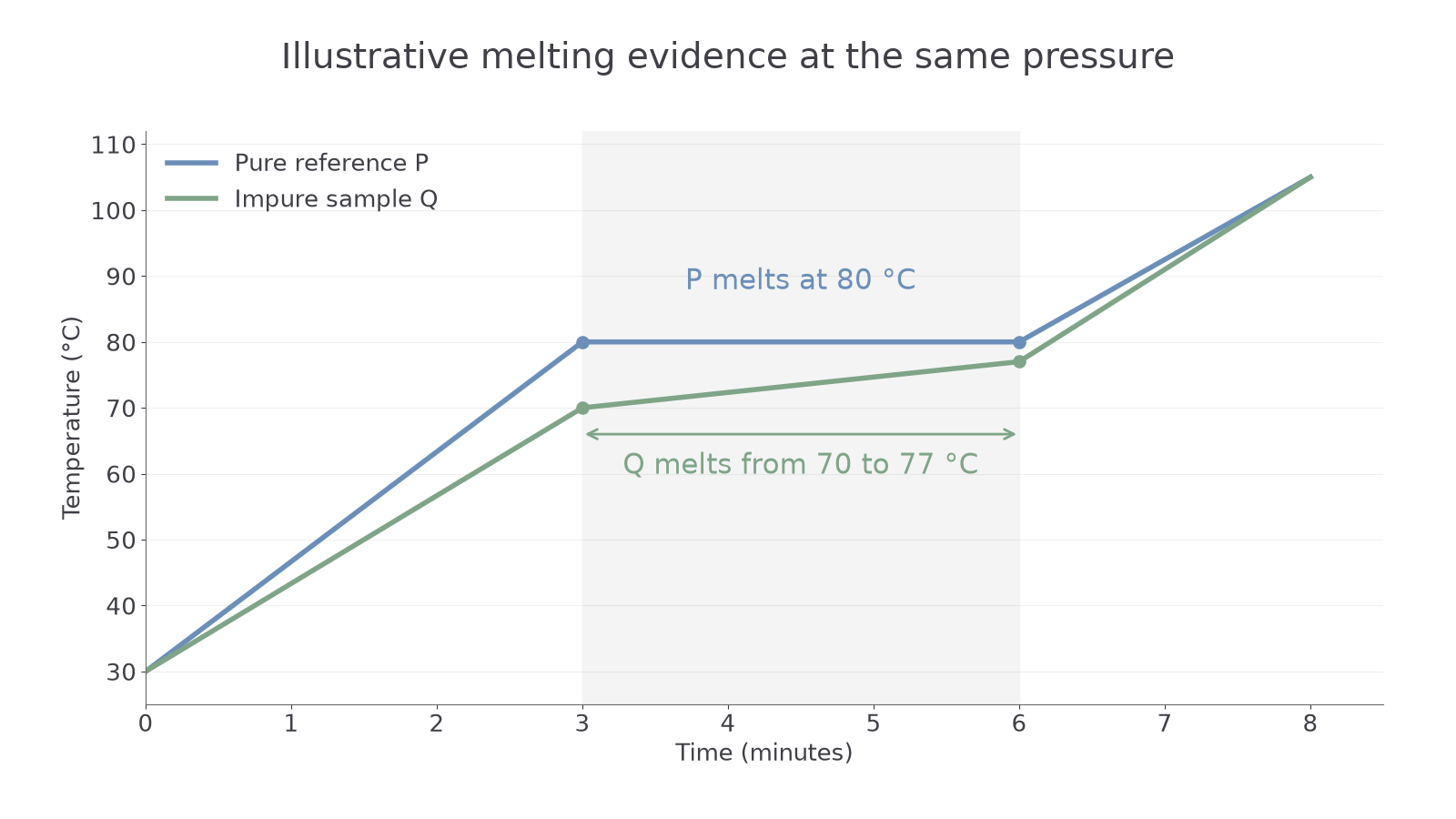
Suppose reference substance P melts at . An illustrative sample that melts from to is inconsistent with pure P under the same conditions. A sample melting sharply at is consistent with pure P, but the result alone does not prove its identity: another substance may have a similar melting point. Combine observations where necessary. Boiling data can be used in the same way: in an illustrative comparison at normal atmospheric pressure, a water sample that boils steadily at is consistent with pure water, whereas one that boils over to as its composition changes is inconsistent with the pure-water reference. The pressure and reliable temperature measurements must be checked before attributing the difference to impurities.
Continue this lesson.
You’re previewing NovaLearn without an account. Create a free account to read the rest.
Create free account