4.7.3.2,4.7.3.3 - Condensation polymers and amino acids
Learn how monomers with two functional groups make condensation polymers. Alcohol and acid groups in 4.7.3.2 form polyesters, while the two different groups of an amino acid in 4.7.3.3 form polypeptides and proteins.
Two functional groups (Higher)
Condensation polymerisation joins monomers through reactions between functional groups, usually forming a small molecule such as water as well as the polymer.
A functional group is an atom or group of atoms responsible for characteristic reactions. For a long chain to form, a monomer needs two reactive functional groups. One group can connect it to one neighbour and the other can connect it to the next. A molecule with just one reactive group can make one connection but cannot keep extending the chain by the same process at its other end.
The simplest examples use two different monomer types. Each monomer has two of the same group: a diol has two alcohol OH groups and a dicarboxylic acid has two COOH groups. The groups on one monomer react with the complementary groups on the other.
The specification example uses ethanediol, , and hexanedioic acid, . Count the acid carbons carefully: the four middle carbons plus the two carboxyl carbons give six. Ethanediol has two OH groups; hexanedioic acid has two COOH groups. These names and structures matter, rather than just the generic labels “alcohol” and “acid”.
[DIAGRAM: asset_name: Two-functional-group monomers; asset_slug: 8462_c52_monomers; caption: Ethanediol has an OH group at each end; hexanedioic acid has a COOH group at each end.; description: Fully displayed ethanediol and hexanedioic acid, labelled with their names and complete end groups. All O–H and C=O bonds are explicitly drawn.]
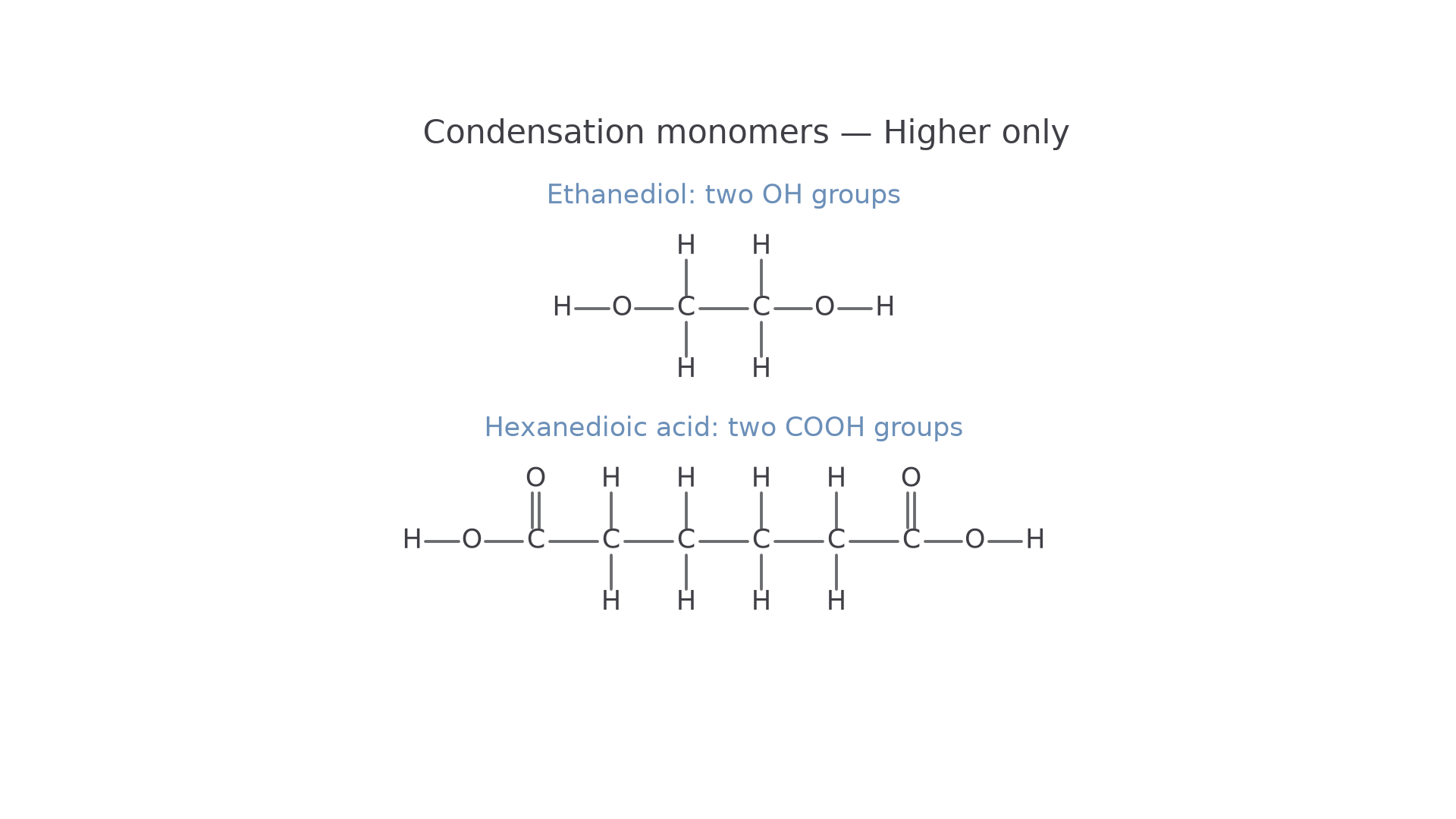
To model the process, imagine each carbon framework as a connecting piece with two chemically different kinds of end connector on the two monomer types. The model shows why alternating units can form a chain, but an actual reaction also changes bonds and produces the small molecule. It is not simply physically clipping unchanged molecules together.
Polyester links and water (Higher)
A diol reacting with a dicarboxylic acid forms a polyester because its chain contains repeated ester links.
Each link is formed when an alcohol OH group reacts with a carboxyl COOH group. The acid group loses OH and the alcohol group loses H, together forming water. The alcohol oxygen remains in the chain and bonds to the carboxyl carbon, giving an ester link, . The carbonyl oxygen, double-bonded to carbon, is retained; it is not removed to make the water.
The remaining OH and COOH groups can react again, so many monomers join in a long chain. The small water molecules are separate products, not links within the polymer. A polyester is a polymer containing many ester links; it is not simply one small ester molecule.
[DIAGRAM: asset_name: Polyester repeating unit; asset_slug: 8462_c52_polyester; caption: Ethanediol and hexanedioic acid residues alternate in a polyester joined by ester links.; description: Fully displayed repeating unit O–CH2–CH2–O–C(=O)–CH2–CH2–CH2–CH2–C(=O), with continuation bonds through brackets, n outside, and explanatory labels showing two ester connections per repeating pattern, including the connection to the next unit.]
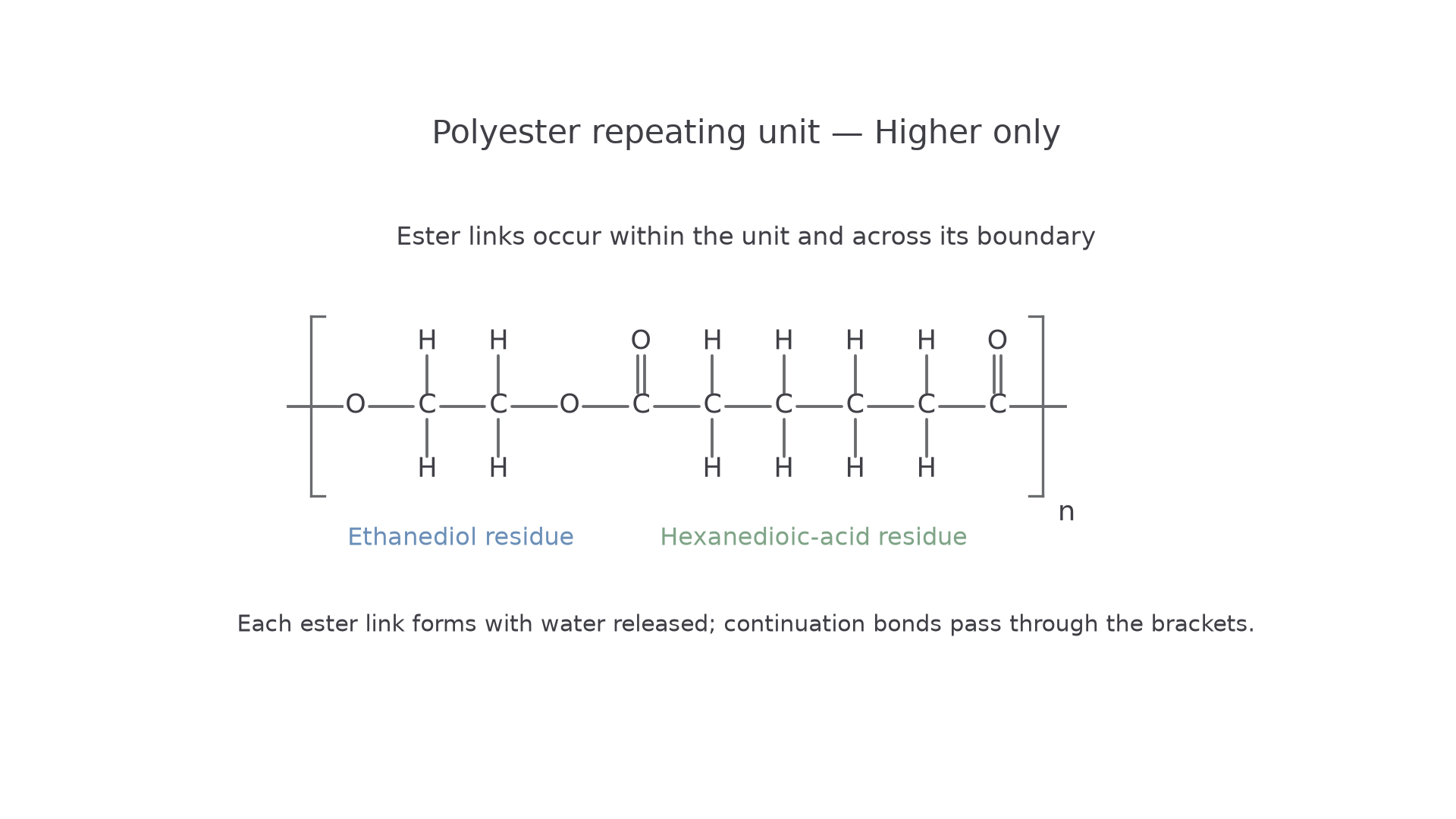
Each ester-link formation releases one water molecule. Repeating-unit equations often ignore the polymer's end groups and summarise a long chain. For a small finite chain, count actual links to determine the water released; a bracketed repeating-unit picture alone does not specify its two end groups. The essential principle is that condensation changes the monomer atom totals in the polymer because atoms also enter the small-molecule product.
Compare this with addition polymerisation: alkene monomers use their double bonds to join, their repeating units retain all the monomer atoms and no small molecule is formed. Polyester formation instead needs complementary functional groups and produces water. Neither the size of the molecule nor the word “polymer” alone tells you which process occurred.
Continue this lesson.
You’re previewing NovaLearn without an account. Create a free account to read the rest.
Create free account