4.3.5 - Gas volumes at room temperature and pressure
Learn how gas volume is related to amount in moles, use the molar gas volume at room temperature and pressure, and calculate reacting gas volumes from balanced equations. Connect a measured gas volume with the mass of a gas or a solid reactant.
Molar gas volume at room temperature and pressure (Higher)
Equal amounts in moles of gases occupy equal volumes when their temperature and pressure are the same.
The approximate molar gas volume is at room temperature and pressure, abbreviated rtp: and one atmosphere pressure. Use it under these conditions; changing temperature or pressure can change the volume occupied by one mole.
At rtp, for gas volume in and amount in mol:
Alternatively, use when the volume is in .
One mole of helium atoms and one mole of carbon dioxide molecules each occupy about at rtp. They have the same number of stated gas particles, but different masses. Helium has molar mass , while carbon dioxide has . A heavier gas molecule does not require a larger molar gas volume under these conditions; gases consist mostly of space between their particles.
For gas at rtp:
The amount is a quarter mole, so the volume is a quarter of 24 cubic decimetres. For a gas sample of :
Dividing 600 by gives the same amount. Mixing a cubic-centimetre value with 24 gives a 1000-fold error.
Gas volume from mass and formula mass (Higher)
To calculate gas volume from a mass, first use the gas's molar mass to find its amount in moles.
For 8.80 g carbon dioxide, use :
This route separates the substance's molar mass from the common gas molar volume.
The combined equation is:
with mass in grams, molar mass in and final volume in . Rearranging gives . For oxygen at rtp, use :
Using atomic mass 16 would wrongly count oxygen gas as separate oxygen atoms.
Equal masses of different gases need not give equal volumes. A 4.00 g sample of helium is 1.00 mol and occupies at rtp. A 4.00 g sample of carbon dioxide is only and occupies about . A lighter particle gives more particles, and therefore more moles, in a fixed mass.
Use these equations for gases under the stated conditions. They do not give the volume of a solid or liquid from its moles: those substances have very different particle spacing and volumes.
Gas-volume ratios in equations (Higher)
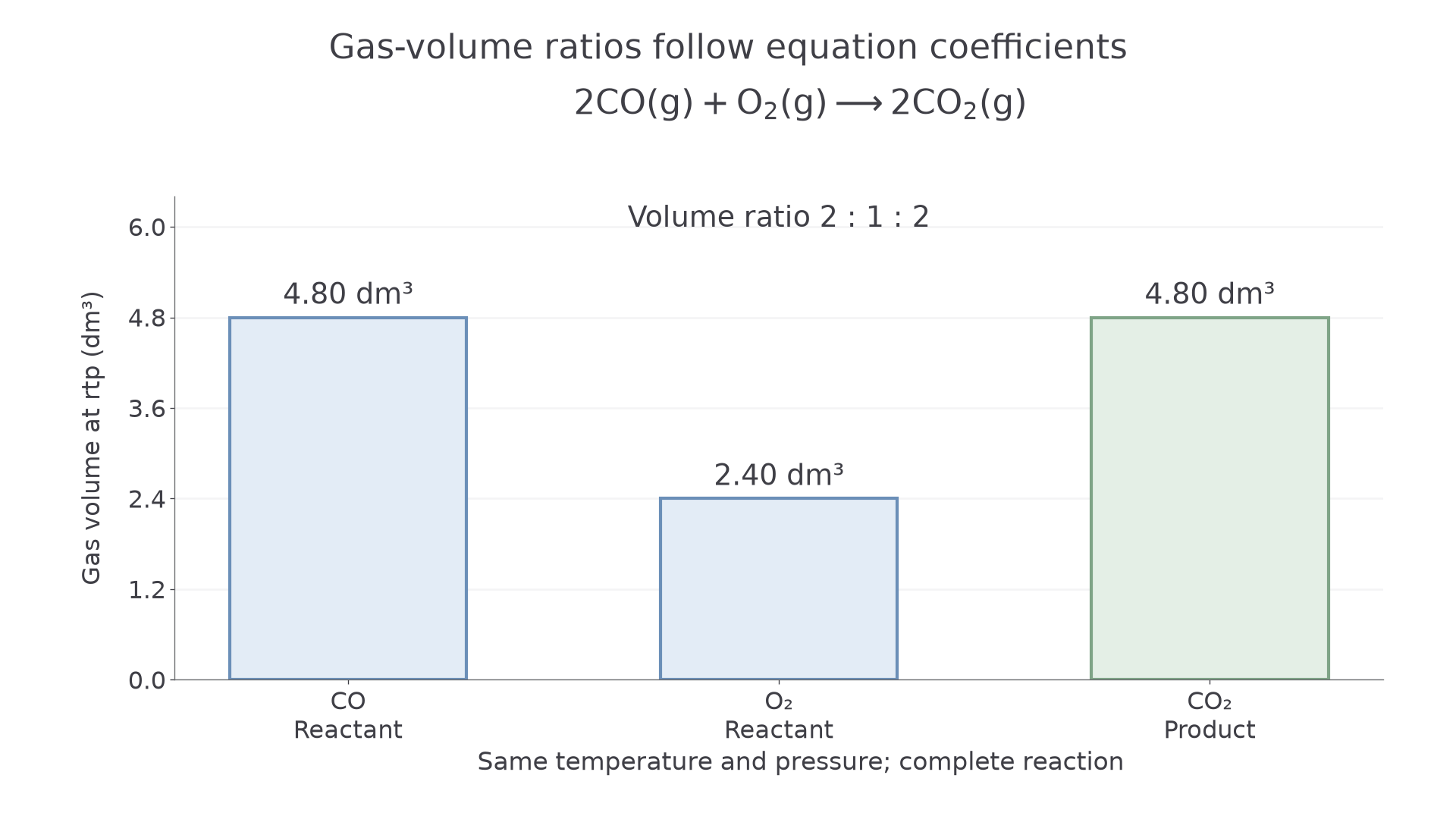
For gases measured at the same temperature and pressure, a balanced equation's mole ratios are also volume ratios.
For complete carbon monoxide oxidation,
two volumes of carbon monoxide react with one volume of oxygen to form two volumes of carbon dioxide. At rtp, for carbon monoxide:
This is the theoretical result for complete reaction with enough oxygen.
[DIAGRAM: asset_name: Gas volumes follow mole ratios; asset_slug: 8462_c26_gas_volume_ratios; caption: At the same temperature and pressure, reacting gas volumes for carbon monoxide oxidation have the coefficient ratio 2 to 1 to 2.; description: Three bars on a volume axis show CO at 4.80 cubic decimetres, O2 at 2.40 cubic decimetres, and CO2 at 4.80 cubic decimetres. The balanced equation 2CO gas plus O2 gas produces 2CO2 gas appears above. The two reactant bars are blue and the product bar is sage; all volumes are at rtp and describe complete reaction.]
Continue this lesson.
You’re previewing NovaLearn without an account. Create a free account to read the rest.
Create free account