4.7.2.4 - Carboxylic acids and esters
Learn to recognise the first four carboxylic acids, describe their reactions with carbonates and alcohols, and identify ethyl ethanoate as an ester. Ionisation explains how acidic solutions form, while functional groups explain the different organic products.
The carboxylic acid family
Carboxylic acids contain the functional group , in which the same carbon is double-bonded to one oxygen and single-bonded to another oxygen bearing a hydrogen.
The whole group is called the carboxyl group. It is different from the OH group of an alcohol: the nearby carbon–oxygen double bond is part of the carboxylic-acid functional group. This structural difference explains why a carboxylic acid has acidic reactions rather than behaving simply like an alcohol.
| Acid | Condensed structural formula | Total carbon atoms |
|---|---|---|
| Methanoic acid | 1 | |
| Ethanoic acid | 2 | |
| Propanoic acid | 3 | |
| Butanoic acid | 4 |
[DIAGRAM: asset_name: First four carboxylic acids; asset_slug: 8462_c50_acids; caption: The carboxyl group includes both C=O and O–H bonds.; description: Fully displayed methanoic, ethanoic, propanoic and butanoic acid structures, with every hydrogen and bond shown and the complete carboxyl group distinguishable.]
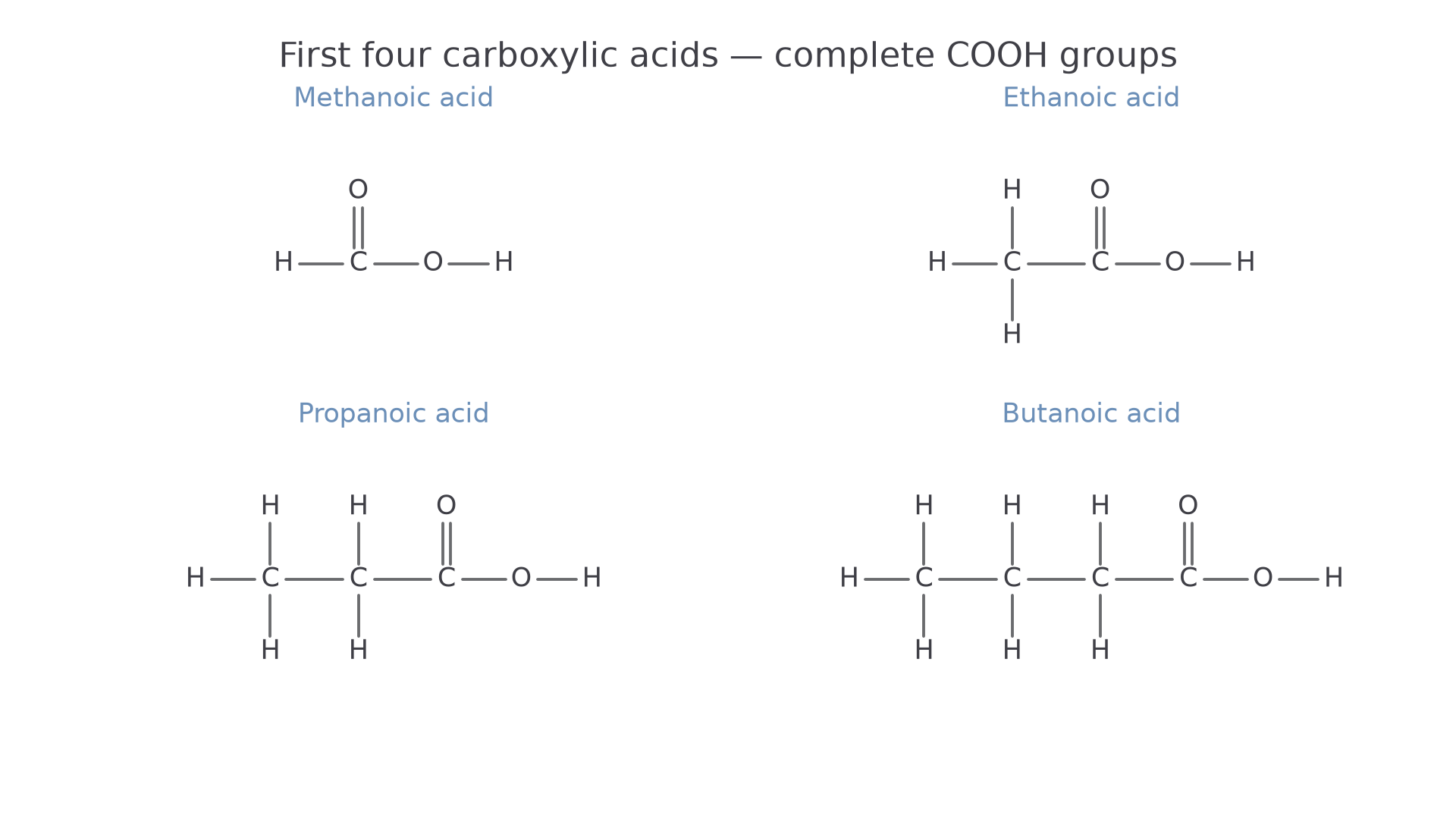
The carbon in COOH is included in the name's carbon count. Ethanoic acid has one carbon in its group and a second in COOH. Forgetting the carboxyl carbon would wrongly identify it as methanoic acid. Methanoic acid has a hydrogen attached directly to its carboxyl carbon, so it has no additional carbon chain.
Recognise the family from names ending in “oic acid”, or from the connected group in a structure. Oxygen atoms alone are insufficient evidence: an alcohol also contains oxygen but lacks that complete group. You need these first four acid names; names of additional individual carboxylic acids are not required.
Carbonate reactions and water solubility
The first four carboxylic acids dissolve in water to form acidic solutions and react with carbonates to release carbon dioxide.
An acidic aqueous solution has a pH below 7 and turns blue litmus red. Dissolving the acid allows its particles to interact with water throughout the solution. The colour of an indicator tests acidity; the solution's appearance alone does not reveal its pH. These small carboxylic acids are soluble in water, so adding them produces acidic solutions rather than the neutral solutions associated with small alcohols.
A carboxylic acid reacting with a carbonate forms a salt, water and carbon dioxide. Effervescence is the visible bubbling as carbon dioxide escapes. For example, ethanoic acid reacts with sodium carbonate to make sodium ethanoate, water and carbon dioxide. The acid name determines the salt ending: methanoic acid gives methanoates, ethanoic acid ethanoates, propanoic acid propanoates and butanoic acid butanoates.
Carboxylic acid + carbonate → salt + water + carbon dioxide.
To identify the gas, bubble a collected sample through limewater. Carbon dioxide turns limewater milky or cloudy. Bubbles alone show only that a gas is produced: the limewater observation supplies the evidence that it is carbon dioxide.
In a supervised comparison, use small measured quantities of acid and carbonate in test tubes, collect the gas safely and record the observation. Wear eye protection and avoid building pressure in sealed apparatus. When comparing different acids, keep the carbonate amount, acid volume and concentration, and temperature the same. Otherwise a faster fizz could be due to a different amount or temperature, rather than the acid identity.
The word equation identifies the reacting families and products. Product observations provide evidence for the chemical change.
Continue this lesson.
You’re previewing NovaLearn without an account. Create a free account to read the rest.
Create free account