4.10.3.1,4.10.3.2 - Corrosion protection and useful alloys
Learn the conditions needed for rusting, how barrier and sacrificial protection prevent corrosion, and how the composition of copper, gold, steel and aluminium alloys makes them suitable for particular uses.
Rusting and controlled evidence
Corrosion is the destruction of a material by reactions with substances in its environment.
Rusting is the corrosion of iron. Iron reacts when both water and oxygen from the air are available, forming rust. Water alone or dry air alone does not cause ordinary rusting. Rust does not form a reliable protective layer, so corrosion can continue and weaken the metal. Use “rusting” specifically for iron: aluminium can corrode, but it does not rust.
To establish the conditions, compare identical clean iron nails in three tubes. In the first, a nail contacts water and air. In the second, the nail is in dry air with a drying agent, such as anhydrous calcium chloride, and the tube is sealed. In the third, the nail is in water that has been boiled to remove dissolved air, then cooled with an oil layer preventing oxygen from re-entering. The third comparison must exclude dissolved oxygen as well as preventing contact with the air above.
[DIAGRAM: asset_name: Controlled conditions for rusting; asset_slug: 8462_c69_rusting; caption: Only the nail supplied with both water and air rusts in the controlled comparison.; description: Three labelled tubes contain equal clean iron nails. One has water and air and shows rust. One has dry air, a drying agent and a stopper and shows no rust. One has boiled water covered by an oil layer excluding air and shows no rust. The diagram separates the presence of water from the presence of oxygen.]
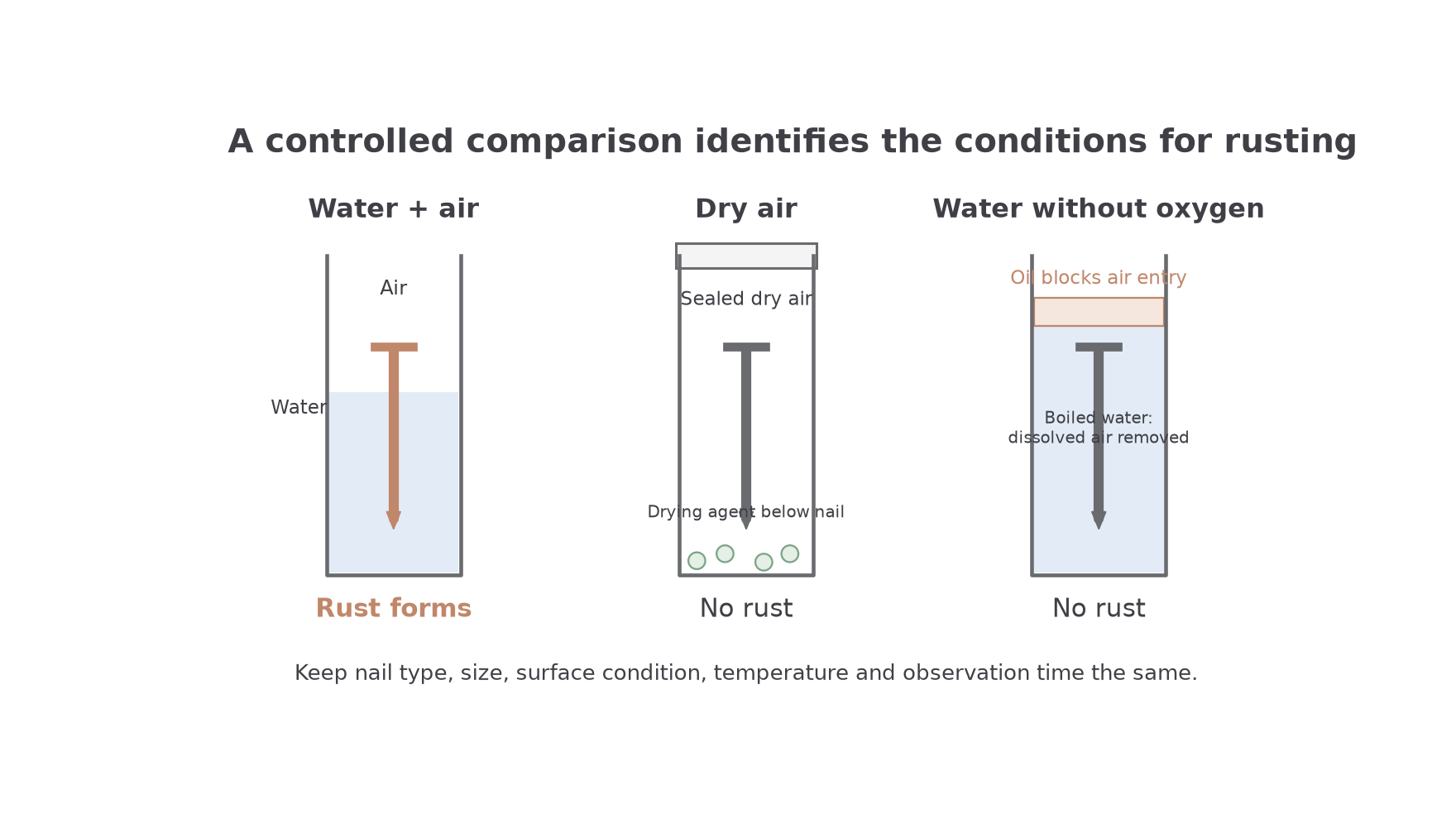
Keep the nail material, nail size and surface condition, temperature and observation time the same. The independent variable is access to water or oxygen; the dependent observation is the extent of rusting after a fixed time. Repeated tubes reduce the chance that a single contaminated tube determines the conclusion. The expected result is rust only in the first tube. Because each other tube removes one required condition, the pattern supports the conclusion that both are necessary.
A short experiment may show little visible change even when conditions are suitable. Give sufficient time and use the same observation method. A loose stopper or failure to remove dissolved air weakens the comparison by reintroducing the condition meant to be absent.
Barrier and sacrificial protection
A protective coating can either keep reactants away from a metal or react in preference to it.
A barrier physically prevents water and oxygen reaching the iron. Greasing, painting and electroplating can provide barrier coatings. Their effectiveness depends on coverage: a scratch in a paint layer exposes iron, allowing rusting where both reactants can reach it. A barrier need not be more reactive than iron; its main action is separation from the environment.
Aluminium reacts to form a thin aluminium oxide coating. This adheres to the surface and protects the aluminium underneath from further corrosion by acting as a barrier. Aluminium oxide protection is not sacrificial protection: it is the oxide layer preventing access, not a more reactive metal being consumed instead of aluminium. This helps explain why aluminium products resist continued corrosion despite aluminium being a reactive metal.
Sacrificial protection uses a metal more reactive than the metal being protected. Zinc can protect iron because zinc reacts in preference to iron. The zinc is gradually consumed: it is “sacrificed”. It must remain in suitable contact with the iron for this protection to work.
Coating iron with zinc is called galvanising. The coating acts as a barrier while intact, and zinc can also provide sacrificial protection if a small scratch exposes the iron. This is why a damaged zinc coating can behave differently from a damaged paint coating. A less reactive metal coating, such as tin, can provide an intact barrier but does not sacrifice itself to protect exposed iron. Relative reactivity, rather than simply the presence of another metal, determines sacrificial protection.
Copper alloys and gold jewellery
An alloy is a mixture containing a metal and one or more other elements, chosen to change useful properties.
Most metals in everyday use are alloys. In a pure metal, similar-sized atoms form regular layers that can slide relatively easily. Adding atoms of different sizes disrupts that regular arrangement, often making sliding more difficult and increasing hardness. Exact properties depend on composition: “alloy” does not guarantee that every mixture is suitable for every purpose.
Bronze is an alloy of copper and tin. It is used for objects such as sculptures or medals, combining useful strength with the ability to be cast. Brass is an alloy of copper and zinc. It can be used for fittings such as taps and for musical instruments. Remember the different added elements; replacing tin with zinc changes the alloy's identity and properties.
Pure gold is soft, so jewellery is usually made from an alloy of gold with metals such as silver, copper and zinc. The proportion of gold is measured in carats. Pure gold is 24 carat. An 18-carat alloy contains , or 75% gold by mass. The remaining 25% consists of other elements, not a specified equal mixture unless information says so.
Continue this lesson.
You’re previewing NovaLearn without an account. Create a free account to read the rest.
Create free account