4.7.3.4 - DNA and naturally occurring polymers
Learn how nucleotide chains make DNA and how other naturally occurring polymers are built from amino acids or glucose. Comparing their monomers and chain arrangements explains why “natural polymer” describes a broad group of substances with different roles in life.
DNA and nucleotides
DNA, short for deoxyribonucleic acid, is a very large molecule that stores genetic instructions.
These instructions guide the development and functioning of living organisms. DNA also carries the genetic instructions of viruses whose genetic material is DNA. Some viruses instead use RNA, so “DNA is essential for life” does not mean every virus has the same genetic molecule.
DNA is a polymer, built from many small units called nucleotides. DNA uses four different types of nucleotide. “Four types” describes the range of monomers, not the total number of units in a DNA molecule: a long DNA chain contains very many nucleotide units, chosen from those four types.
The sequence, meaning the order of the nucleotide types along the chain, stores information. An analogy is a message written using a small alphabet: a few kinds of symbol can be arranged into many different messages. DNA is a chemical molecule rather than a printed message, but the analogy explains why four monomer types can encode a huge range of instructions.
Nucleotide
A monomer from which a DNA polymer chain is made. DNA uses four different nucleotide types.
The nucleotide types are often labelled A, T, C and G according to their bases. Their detailed structures and these base names are not required for this chemistry section; the important required monomer name is nucleotide. A DNA molecule is therefore not a polymer made from amino acids, and “gene” is not the name of its monomer.
Two chains in a double helix
Most DNA molecules consist of two polymer chains arranged in a double helix.
A helix is a coiled shape. A double helix has two strands coiling around the same axis, like a twisted ladder. Each strand is a long polymer chain made of nucleotide units. The two strands together form the usual DNA molecule; a double helix is not one chain folded in half.
[DIAGRAM: asset_name: DNA double-helix model; asset_slug: 8462_c53_dna; caption: Two nucleotide polymer chains coil together to form a double helix.; description: Simplified twisted-ladder representation of two continuous strands, labelled chain 1 and chain 2. A legend uses A, T, C and G to show four nucleotide types, with paired labels on rungs and a note that shapes and distances are schematic.]
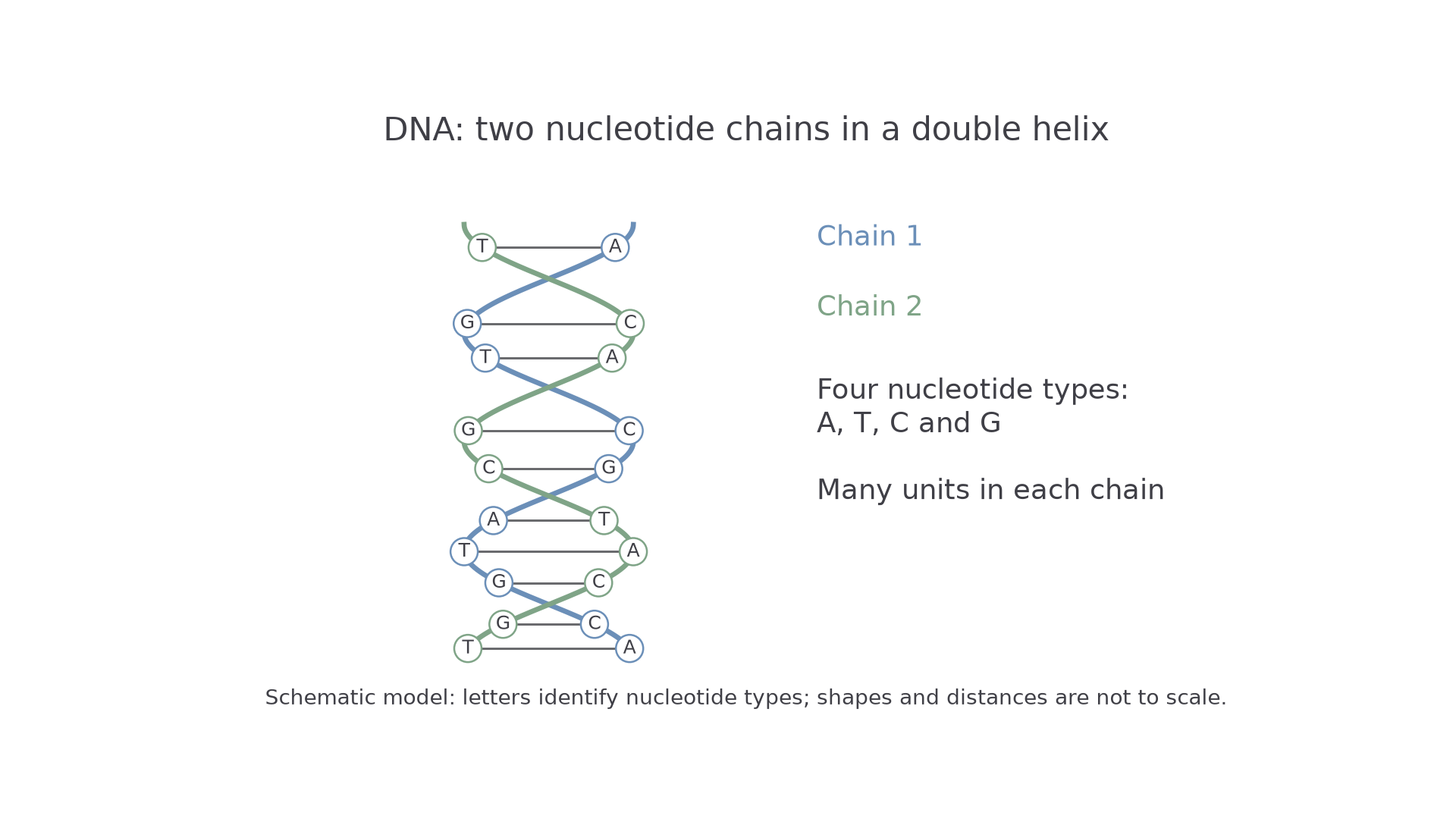
The diagram is a simplified model, not an atom-by-atom structural formula. The strand lines represent the connected chains; a label represents a nucleotide type rather than an individual atom. Nucleotides join along each chain. The connections between the two chains are not additional polymer chains, and the gaps in the drawing are not holes through a literal ladder.
Continue this lesson.
You’re previewing NovaLearn without an account. Create a free account to read the rest.
Create free account