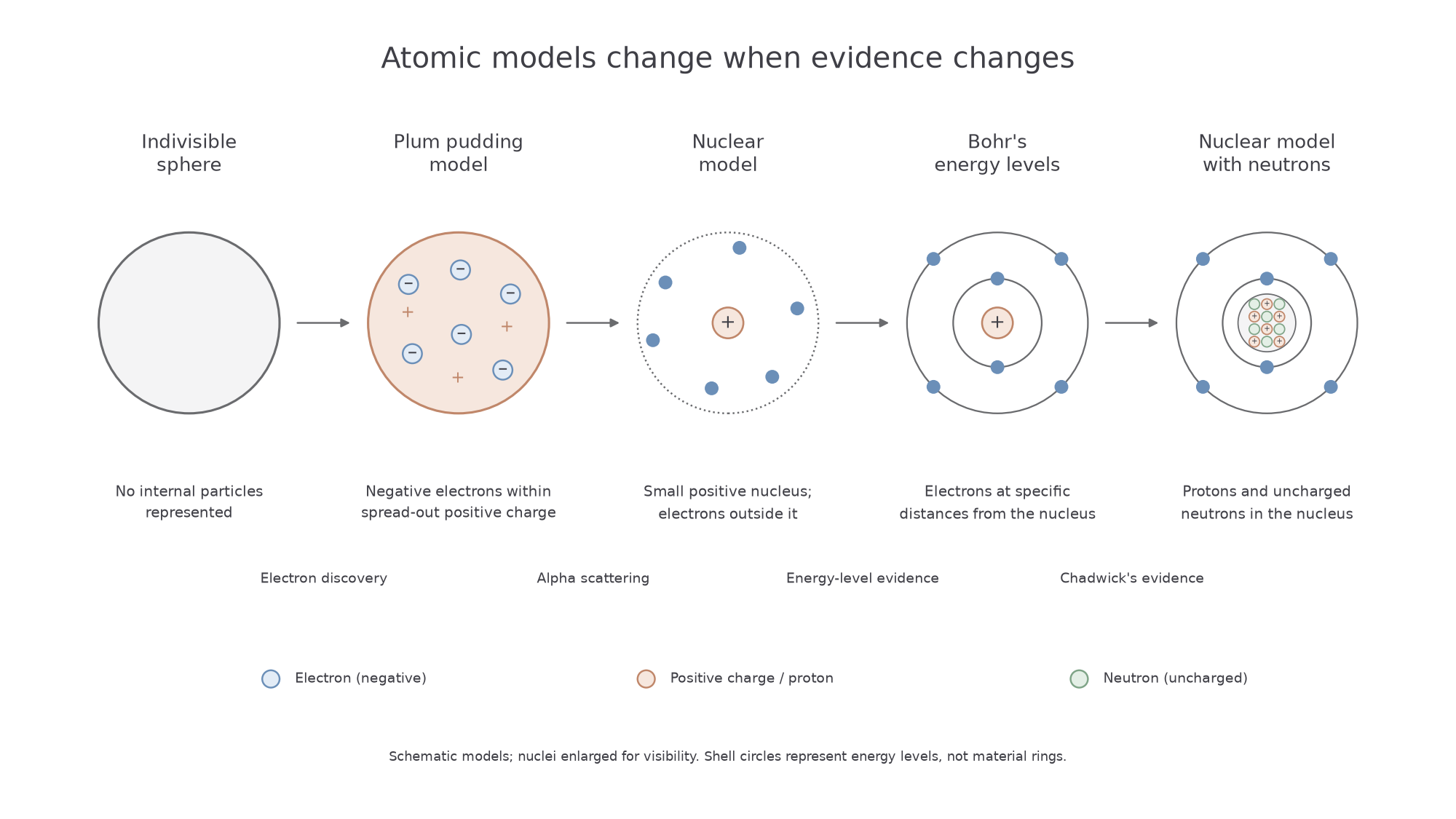
4.1.1.3 - How the atomic model developed
Learn how experimental evidence changed the model of the atom from an indivisible sphere to a tiny nucleus surrounded by electrons. Comparing a model's predictions with observations explains why scientists keep useful ideas but replace parts that no longer fit the evidence.
From indivisible spheres to plum pudding
A scientific model is a representation used to explain observations and make predictions, and it can change when new evidence appears.
Before electrons were discovered, atoms were thought to be tiny spheres that could not be divided. The discovery of negatively charged electrons showed that atoms contained smaller particles. An indivisible-sphere model could no longer account for that evidence.
The plum pudding model represented an atom as a ball of positive charge with negative electrons embedded throughout it. The positive and negative charges balanced, accounting for an atom's lack of overall charge. Its positive charge was spread across the atom; there was no small central nucleus. The name is an analogy for embedded particles, not a claim that an atom contains separate pieces of pudding.
This was a reasoned model based on the evidence available. Finding electrons did not by itself reveal where the positive charge and most of the mass were located. A further experiment was needed to distinguish a diffuse positive ball from a much more concentrated arrangement.
Alpha scattering and a concentrated nucleus
The alpha particle scattering experiment tested how positive charge and mass were distributed inside atoms.
Positively charged alpha particles were aimed at a very thin metal foil. A detector showed the directions in which they emerged. If positive charge were spread throughout each atom as in plum pudding, individual encounters should generally produce only small deflections. That diffuse charge could not readily explain a large backward deflection of a fast alpha particle.
Three observations were important. Most particles passed straight through, showing that most of an atom's volume offered little obstruction: the atom is mostly empty space. Some were deflected, showing that the positive alpha particles were repelled by a positively charged region. A very small fraction were deflected through large angles or back towards the source. A tiny, dense region concentrated the mass and positive charge strongly enough to cause these deflections.
[DIAGRAM: asset_name: Interpreting alpha particle paths; asset_slug: 8462_c03_scattering; caption: Straight, deflected and backward paths give different evidence about atomic structure.; description: Three schematic panels show a positive alpha particle passing far from a tiny positive nucleus, passing closer and being deflected, and approaching very closely and returning towards the source. The panels are not to scale and do not represent numerical outcome frequencies.]
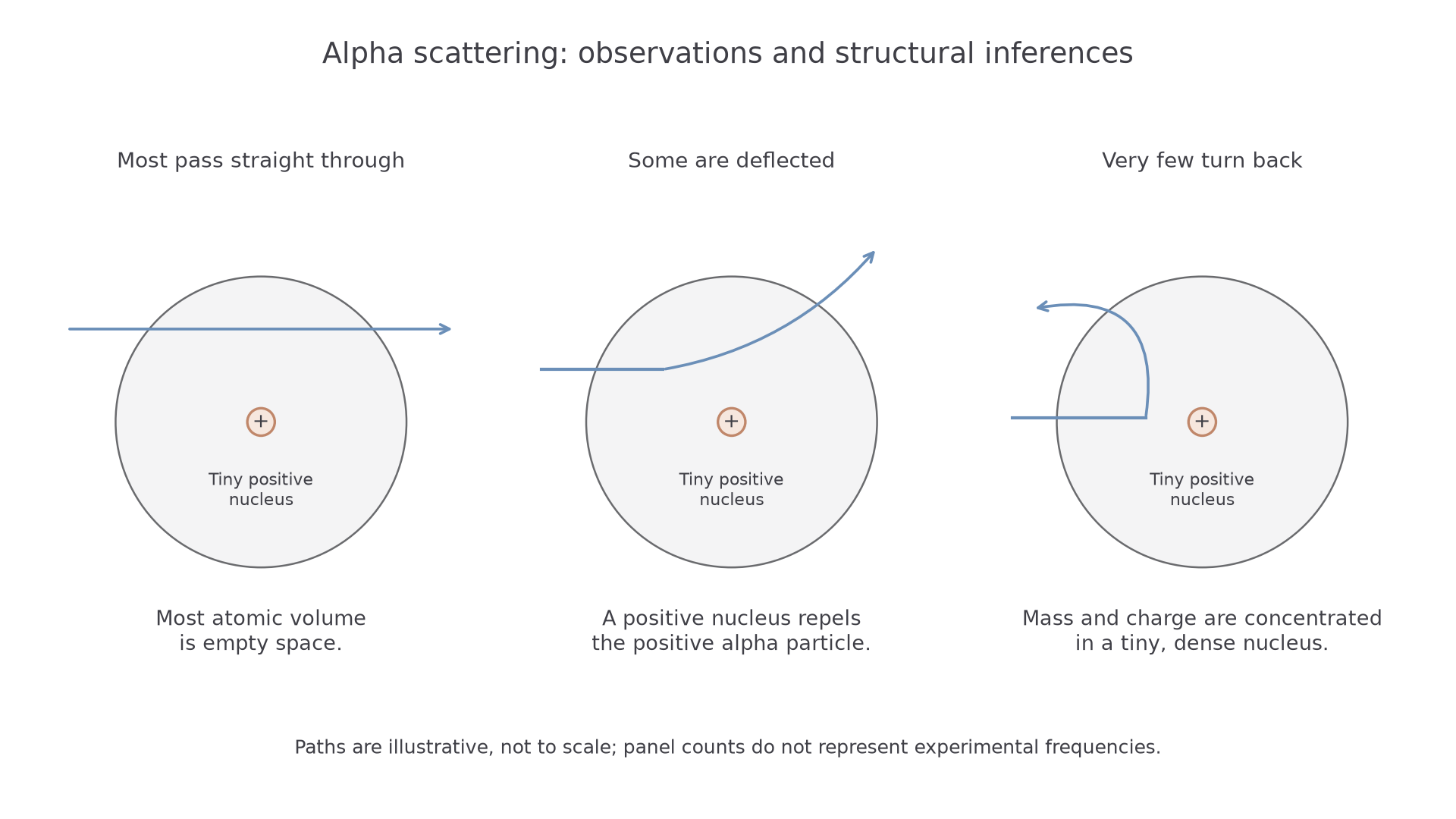
The rarity of large deflections mattered as much as their existence. If the dense region filled the whole atom, many more particles would meet it. Together the observations supported a small positive nucleus containing most of the atom's mass, surrounded by a much larger mostly empty region.
An observation is what the experiment detected, such as a backward path. The nucleus is an inference that explains those observations. The experiment did not photograph a nucleus, and it did not identify neutrons. A strong explanation links each observation to the part of the model it supports instead of merely stating that “the experiment proved the model”.
The nuclear model and Bohr's energy levels
The nuclear model replaced diffuse positive charge with a concentrated nucleus and placed electrons around it.
In the original nuclear model, most mass was in the small positive nucleus, with electrons outside it and mostly empty space between. This differed from plum pudding, whose electrons were embedded in a spread-out positive ball. Both models contained electrons and could represent an electrically neutral atom; their main disagreement concerned the distribution of positive charge and mass.
Niels Bohr adapted the nuclear model by proposing that electrons occupy orbits at specific distances from the nucleus, corresponding to particular energy levels or shells. They were not allowed just any distance in this model. Bohr's theoretical calculations agreed with experimental observations, giving evidence for the refinement.
The distinction matters historically: discovering a nucleus and proposing specific electron energy levels were different changes, supported by different evidence. Do not attribute shells to the plum pudding model or say that the alpha scattering experiment itself established the shell arrangement.
Shell diagrams are useful two-dimensional representations of a three-dimensional atom. Their circles show energy levels, not physical hoops attached to the nucleus. They help count electrons and explain broad reaction patterns while leaving out the electrons' more detailed spatial behaviour.
Evidence for protons and neutrons
Later evidence developed the internal structure of the nucleus without discarding the successful idea of a small central nucleus.
Experiments showed that a nucleus's positive charge could be divided into a whole number of smaller equal positive charges. The particles carrying these charges were named protons. Different elements have different numbers of protons, rather than arbitrary fractions of one proton's charge.
Positive charge alone did not account for all nuclear mass. James Chadwick's experimental work provided evidence for neutrons, particles in the nucleus with no electrical charge. This came about twenty years after the nuclear idea had become accepted. Neutrons added a way to explain nuclear mass without adding positive charge.
Scientific change is often a refinement: electrons remained in the model after the nucleus was proposed, and the nucleus remained after neutrons were identified. Results are communicated so other scientists can examine the reasoning and investigate whether observations are reproducible. Agreement comes from evidence that a model explains and predicts successfully, rather than a model being immune to future change.
[DIAGRAM: asset_name: Changes in models of the atom; asset_slug: 8462_c03_atomic_models; caption: Electron discovery, scattering evidence, energy levels and neutron evidence refined the model of the atom.; description: Five labelled schematics compare an indivisible sphere, a plum pudding positive sphere with embedded electrons, a nuclear atom with a small positive nucleus and electrons outside it, Bohr's nuclear model with electrons at specific distances, and a nucleus containing protons and neutrons. The final example has six electrons, six protons and six neutrons. Blue marks represent negative electrons, clay represents positive charge and sage represents neutrons. Nuclei are enlarged for visibility; the pre-Bohr nuclear model has no specified shells.]