4.5.2.1,4.5.2.2 - Cells, batteries and hydrogen fuel cells
Chemical cells use reactions to provide electricity, while hydrogen fuel cells keep operating when fuel and oxygen are supplied. Learn how electrode and electrolyte choices affect cells, how batteries and recharging work, and how to evaluate energy devices.
Simple cells and their voltage
A chemical cell contains substances that react to produce a potential difference, or voltage, between its electrodes.
Connect two different metals with wires to a voltmeter and place both metals in contact with an electrolyte. The electrolyte is a liquid or solution containing mobile ions. The metal pieces are electrodes, and they must not touch each other. Chemical changes at the electrodes allow charge to flow through an external circuit when a conducting path is present. Mobile ions carry charge through the electrolyte; the electrolyte is not simply an inert liquid holder.
The voltage depends on the electrode materials and the electrolyte, among other conditions. Using two pieces of the same metal under identical conditions does not give the useful difference provided by a pair of different metals. Using water with too few dissolved ions can make the circuit conduct poorly. Two cells made from the same metals need not behave identically if their electrolytes differ.
[DIAGRAM: asset_name: A simple chemical cell; asset_slug: 8462_c40_simple_cell; caption: Two different metal electrodes contact an electrolyte and are connected to a voltmeter.; description: A beaker of electrolyte containing separated zinc and copper strips. Wires join the two strips to separate voltmeter terminals. Labels identify the electrodes, electrolyte containing mobile ions, external wires and voltmeter. The circuit is a schematic, not a specification of a particular cell voltage.]
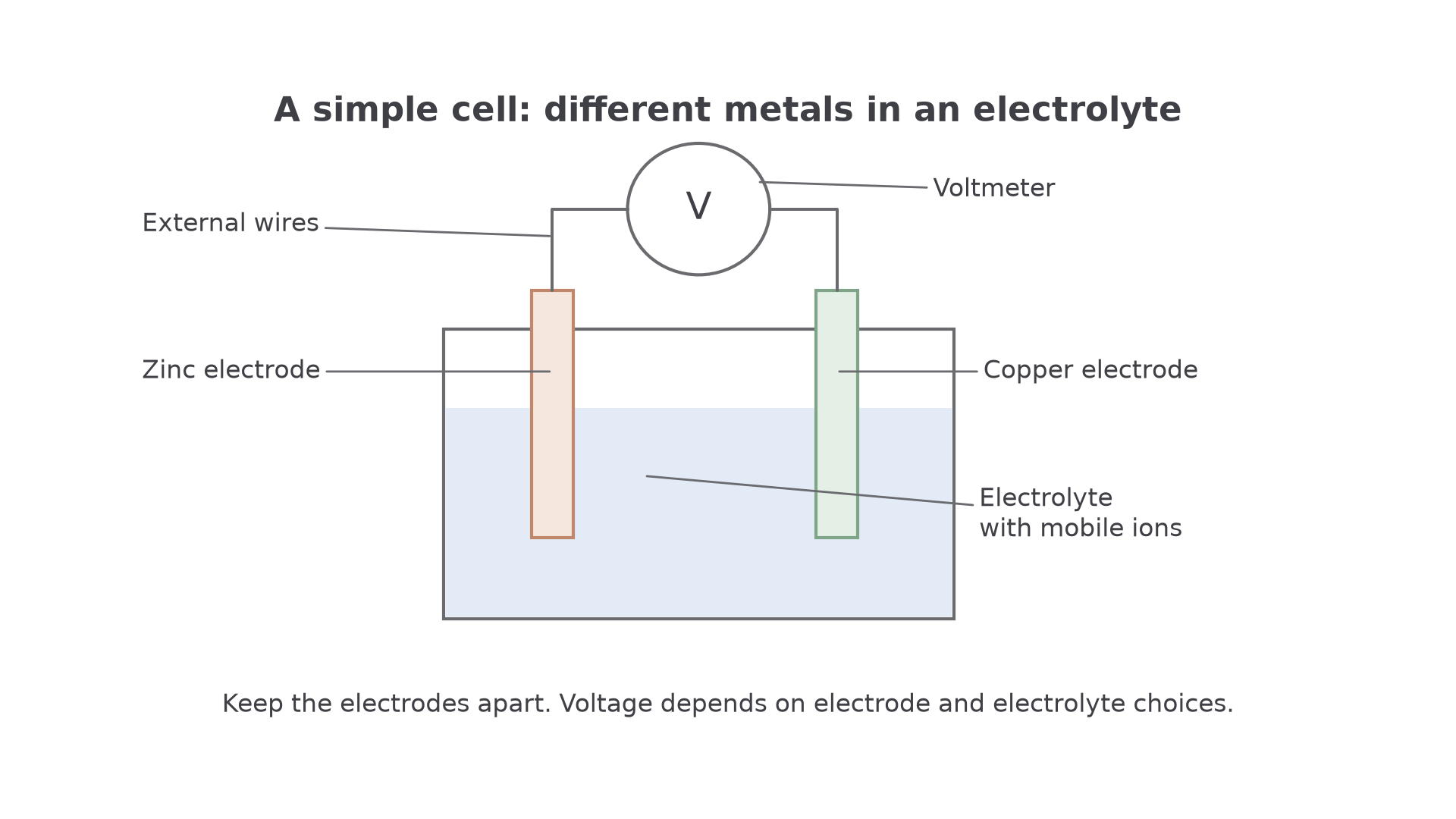
Use a voltmeter to measure potential difference, keeping electrode area, immersion depth, temperature and electrolyte concentration constant when comparing metal pairs. Clean surfaces consistently, use fresh electrolyte when needed and avoid contamination between runs. Eye protection and careful handling are needed for the selected electrolyte; collect metal-containing solutions for the instructed disposal route.
In an illustrative set of cells with copper as the common comparison electrode and one specified electrolyte, magnesium–copper gives , zinc–copper , and iron–copper . With the accompanying evidence that magnesium is more reactive than zinc, and zinc more reactive than iron, the larger voltage is associated with a larger reactivity difference in these cells. Such data help choose a pair; voltage alone is not a universal numerical scale of metal reactivity across different electrolytes and conditions.
Batteries and recharging
A battery combines cells, and whether it can be recharged depends on whether its chemical reactions can be reversed by an external current.
A battery consists of two or more cells connected together in series to provide a greater voltage. Connect the positive terminal of one cell to the negative terminal of the next. Add their voltages when all the cells are oriented in the same direction.
Worked example 1 — identical cells
Three cells in series give:
The battery has three times the voltage of one cell, provided their terminal voltages remain as stated under the measurement conditions.
Worked example 2 — different cell voltages
A cell and a cell are joined positive-to-negative in series:
The total exceeds either separate voltage. Reversing one cell would oppose its contribution; placing cells in parallel is a different connection and does not give this voltage sum.
In a non-rechargeable cell or battery, the reactions stop when one reactant has been used up. Ordinary alkaline batteries are non-rechargeable. They contain a finite chemical supply; switching the device off does not regenerate that supply. A device requiring reliable portable power may still benefit from their convenience, long storage life and low initial cost when these features are supported by its product data.
In a rechargeable cell or battery, an external electrical current reverses the chemical reactions. Charging restores the chemical substances needed for discharge, transferring electrical energy into the device. Charging is not just pushing back the same electricity that left. Use the charger and conditions designed for the cell, because unsuitable charging can cause heating or damage.
Rechargeable batteries can be used repeatedly, reducing the number of replacement cells consumed. Their initial cost, charging time, useful lifetime, capacity and access to electricity matter in a comparison. Reusable does not mean everlasting: real rechargeable devices eventually deteriorate. Do not assume all batteries are rechargeable or try to recharge a conventional alkaline battery.
Hydrogen fuel-cell operation
A hydrogen fuel cell receives hydrogen and oxygen from outside the cell and uses their reaction to supply electricity.
Fuel cells are supplied by an external source of fuel, such as hydrogen, and by oxygen or air. The fuel is oxidised electrochemically within the cell: reactions at the electrodes produce a potential difference that can drive an external circuit. It is not simply hydrogen burning beside a generator.
For a hydrogen fuel cell, the overall reaction is
Hydrogen is oxidised and water is produced. The overall product is water rather than carbon dioxide because the fuel contains no carbon. Some energy also transfers to the surroundings as heat, so not all of the chemical energy becomes useful electricity.
Continue this lesson.
You’re previewing NovaLearn without an account. Create a free account to read the rest.
Create free account