4.7.3.1 - Addition polymers and monomers
Learn how alkene molecules join to form addition polymers and how to move between a monomer structure and a polymer repeating unit. Bond and atom checks let you predict unfamiliar structures without memorising a separate polymer for every monomer.
Joining alkene monomers
Addition polymerisation joins many small alkene molecules into a very large molecule with a long carbon backbone.
Monomer and polymer
A monomer is a small molecule that can join with many others to make a polymer. A polymer is a very large molecule built from many joined monomer units.
An alkene monomer contains a bond. During polymerisation that double bond becomes single, and the two carbons form new covalent bonds to carbons from neighbouring monomers. It is the double-bonded carbon pair that enters the backbone. Existing atoms or groups attached to those carbons remain attached.
Ethene produces poly(ethene). Propene produces poly(propene). The name “poly” indicates many units; it does not mean a single monomer has merely grown longer without reacting. Thousands of monomers can become part of one chain. A short model showing three joined units represents the bond pattern, not the whole size of a typical polymer molecule.
[DIAGRAM: asset_name: Alkene monomers and addition polymers; asset_slug: 8462_c51_polymerisation; caption: Ethene and propene form carbon backbones with single bonds; propene's methyl group stays as a side group.; description: Two rows compare fully displayed ethene and propene monomers with their bracketed repeating units, each having single backbone bonds, continuation bonds through both brackets and n outside the brackets. Propene's CH3 side group is fully displayed.]
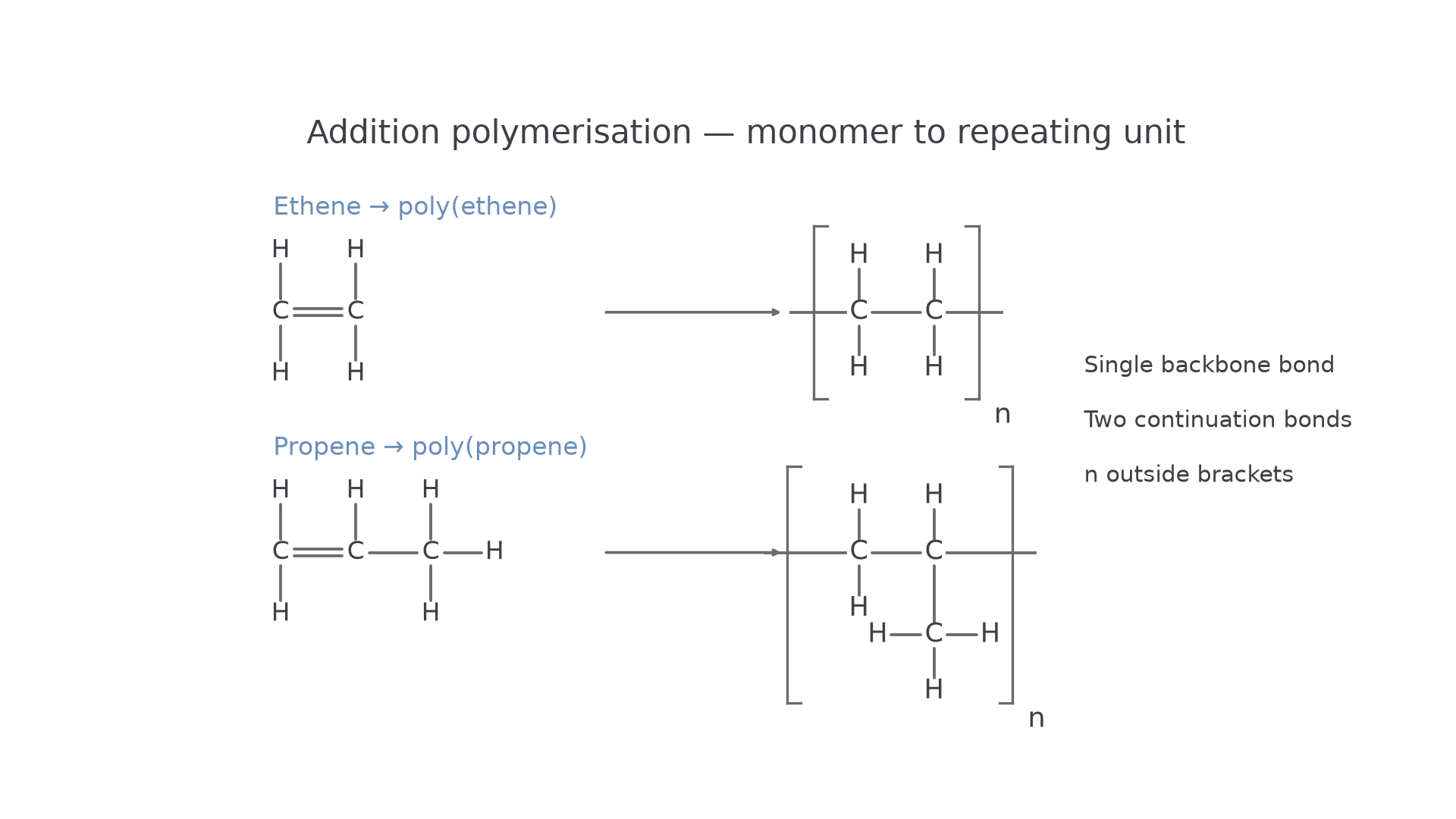
Models help explain the process: retain each monomer's atoms, replace the double bond by a single bond and connect the former double-bonded carbons to adjacent units. A model must not leave a double bond between the backbone carbons while adding two extra bonds: that would give carbon too many bonds.
Drawing repeating units
A repeating unit is the smallest section of a polymer's structure that can be repeated to show its chain.
Worked example 1 — ethene to its repeating unit
Start with . Retain both carbons and all four hydrogens, replace the double bond by a single bond and add continuation bonds:
Each backbone carbon has two bonds along the chain and two to hydrogen, giving four. Both continuation bonds pass through the brackets.
Worked example 2 — propene with a side group
Start with . Only the two double-bonded carbons become the backbone. Keep the methyl group attached to its original carbon:
The second backbone carbon has two chain bonds, one bond to hydrogen and one to . There are still three carbons and six hydrogens per unit. Converting propene to a three-carbon straight backbone would change the connectivity incorrectly.
To draw a repeating unit from an alkene:
- Copy the two double-bonded carbons and all the atoms or groups attached to them.
- Replace their double bond with a single bond.
- Draw one single continuation bond to the left and one to the right of the carbon pair.
- Put brackets around the unit, with both continuation bonds passing through the brackets, and place outside.
The continuation bonds show that the chain extends in both directions. The symbol means the unit repeats many times. Brackets enclose the repeating pattern rather than indicating that it is a separate small molecule.
Every backbone carbon must still have four bonds: the two along the chain plus two bonds to hydrogen atoms or side groups. For a fully displayed formula, draw every atom and bond in a side group too. A condensed label can be useful in a simplified structural representation, but it is not itself a fully displayed methyl group.
The repeating-unit representation is deliberately a flat model of connectivity. Twisting or bending the chain in three dimensions does not change which atoms belong to each unit. When practising a paper drawing, check the carbon bonds, both continuation bonds and the bracket/ notation against the supplied structures.
Continue this lesson.
You’re previewing NovaLearn without an account. Create a free account to read the rest.
Create free account