4.5.1.3 - Bond energies and reaction energy changes
Bond breaking and bond formation explain the overall energy transfer in a reaction. Learn to count bonds from balanced equations, use supplied bond energies, and calculate or interpret the balance between energy taken in and released.
Energy in bond breaking and formation (Higher)
Breaking bonds requires energy, while forming bonds releases energy.
Atoms joined by a covalent bond attract one another. Separating them requires energy to overcome that attraction. Bond breaking is therefore an endothermic process. When separated atoms form a bond, energy is released: bond formation is exothermic. Burning a fuel does not release energy simply because its bonds break; breaking those bonds costs energy, and forming the products' bonds releases energy.
Bond energy
A bond energy is the energy needed to break one mole of a specified covalent bond. Bond energies are usually supplied in .
The same bond formed releases the corresponding amount of energy in the opposite direction. Values supplied in GCSE questions are normally average bond energies: the exact value can depend on the molecule containing the bond. Using these averages gives an estimate of the reaction energy change. Use the supplied values consistently rather than replacing them with remembered values.
A reaction involves both processes. First total the energy needed to break the reactant bonds. Then total the energy released when the product bonds form. The overall effect depends on their difference. More energy released than required gives an exothermic reaction; more required than released gives an endothermic reaction.
The bond-energy calculation is an accounting route, not a claim that a real reaction always happens by separating every molecule into free atoms in a single step. It gives the difference between the same starting and finishing substances. The activation energy of the actual reaction pathway is a separate quantity.
Counting bonds in a balanced equation (Higher)
A balanced equation determines how many molecules, and therefore how many bonds, belong in each energy total.
Begin with the balanced equation and the structures of its reactants and products. A coefficient multiplies the entire molecule. A subscript describes the atoms inside one molecule. Confusing these roles changes both the atom balance and the energy calculation.
Worked example 1 — water formation
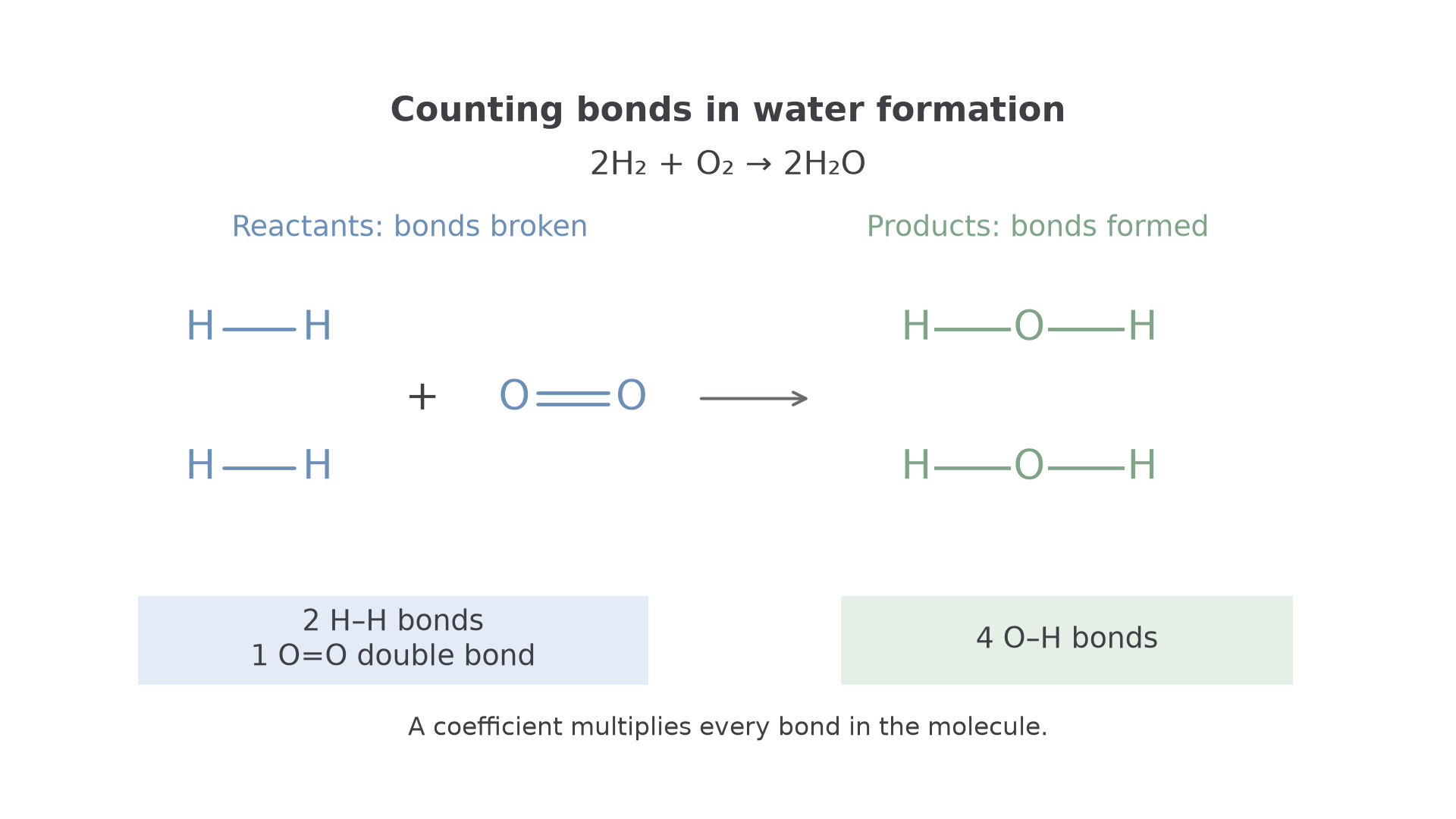
For
multiply each molecule's bond count by its coefficient:
The supplied energy for an oxygen–oxygen double bond applies to that double bond; do not treat it as two single bonds with an unrelated energy.
[DIAGRAM: asset_name: Counting bonds in water formation; asset_slug: 8462_c39_bond_counting; caption: The balanced equation requires two H–H bonds and one O=O bond to be broken, and four O–H bonds to be formed.; description: Displayed structures for two hydrogen molecules and one oxygen molecule on the reactant side, and two water molecules on the product side. Every bond is drawn and a bond-count summary identifies two H–H, one O=O and four O–H bonds.]
Worked example 2 — methane combustion
For methane combustion,
carbon dioxide has the structure , with two carbon–oxygen double bonds. Count each type separately:
Each bond is counted once. Group identical types before multiplying by their supplied energies.
A small table reduces errors:
| Stage | Bond type | Number in the methane equation |
|---|---|---|
| Broken | Carbon–hydrogen | 4 |
| Broken | Oxygen–oxygen double | 2 |
| Formed | Carbon–oxygen double | 2 |
| Formed | Oxygen–hydrogen | 4 |
Check the atom balance before proceeding: both sides contain one carbon, four hydrogens and four oxygens. A correct bond count cannot repair an unbalanced equation.
Calculating the overall energy change (Higher)
Subtract the energy released by making product bonds from the energy required to break reactant bonds.
Keep the two positive totals separate before taking their difference.
Continue this lesson.
You’re previewing NovaLearn without an account. Create a free account to read the rest.
Create free account