4.2.1.5,4.2.2.7,4.2.2.8 - Metallic bonding, metals and alloys
Learn how a metal's giant structure and delocalised electrons explain strong bonding, electrical and thermal conduction, and the ability to bend. You will compare a pure metal with an alloy and use the arrangement of its atoms to explain why mixing elements can make a useful harder material.
Delocalised electrons and metallic bonding
Metal atoms form giant structures in which outer-shell electrons are shared throughout the material.
In a pure metal, atoms are arranged in a regular pattern. Their outer electrons become delocalised, meaning that they are not associated with one particular atom or one particular pair of atoms. They can move throughout the giant structure. The remaining positive centres are often represented as positive metal ions, surrounded by the shared electrons. The whole piece of metal remains electrically neutral: its positive and negative charges balance.
Metallic bonding
Strong electrostatic attraction between positive metal ions and the shared delocalised electrons throughout a giant metal structure.
Metallic bonding occurs in metallic elements and alloys. It differs from an ionic compound, where positive and negative ions attract, and from a covalent molecule, where particular atoms share pairs of electrons. In a metal, the attraction extends through the whole structure and is not restricted to isolated electron pairs between neighbours.
[DIAGRAM: asset_name: Metallic bonding and distorted layers in an alloy; asset_slug: 8462_c12_metal_and_alloy; caption: Delocalised electrons move through a metal, while different-sized atoms distort alloy layers.; description: A pure-metal panel shows equal-sized positive metal centres in regular layers with small delocalised-electron symbols in the spaces. An alloy panel uses larger clay centres among the blue host-metal centres to show locally distorted layers. A motion arrow identifies electron mobility in the pure metal. All spheres and spacing are schematic, and the drawn slice represents a three-dimensional structure.]
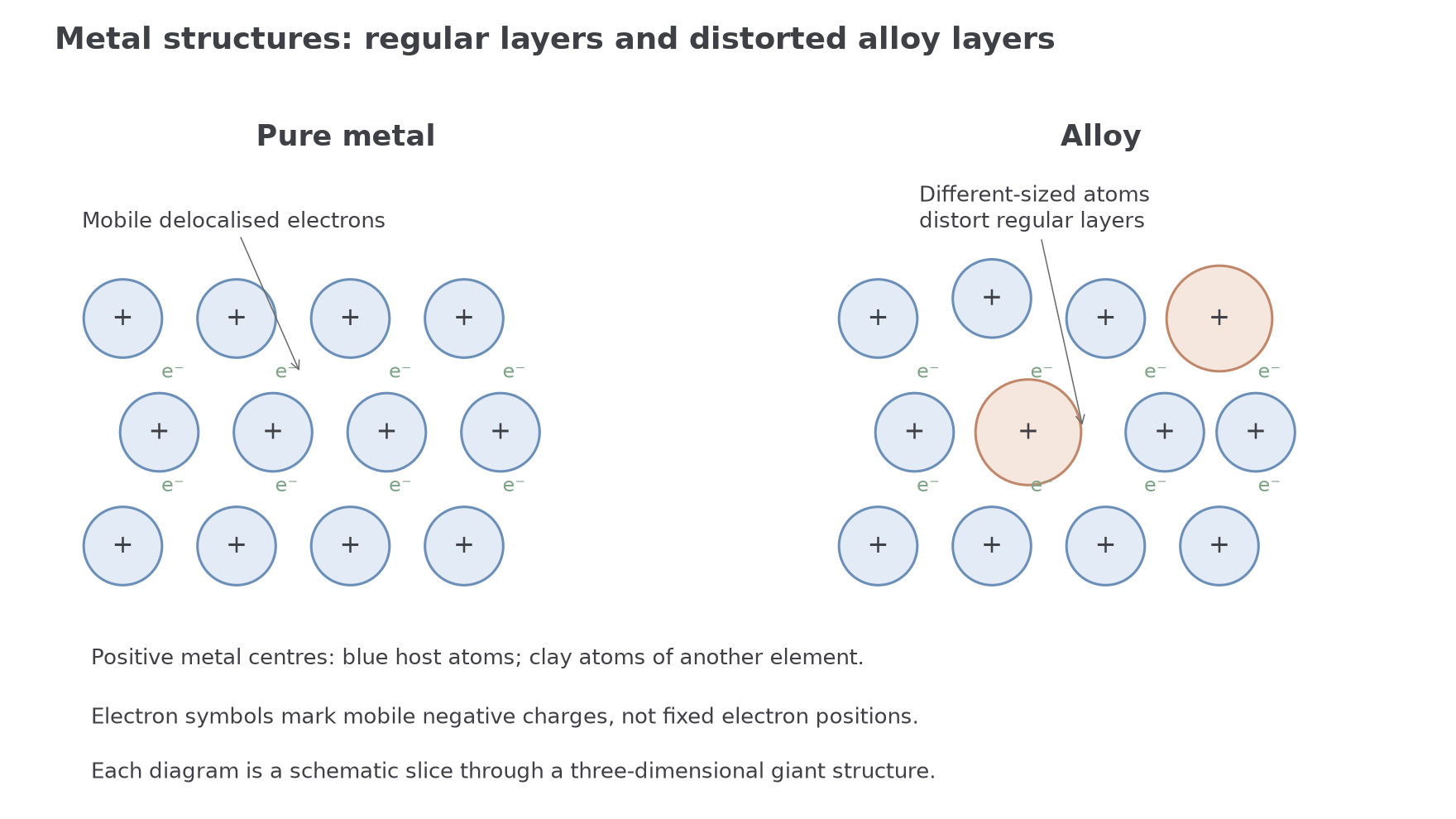
Recognise the model by its regular positive centres and mobile negative electron symbols, without separate negative ions. The drawing is a two-dimensional slice of a three-dimensional structure. The background is not a liquid “sea” inside the metal, and electrons do not sit permanently in the positions chosen for the symbols.
Most metals have high melting and boiling points because much energy is needed to overcome their strong metallic bonding. “Most” matters: metals do not all have the same melting point. The model identifies the type of bonding; it does not provide the numerical melting point without further information.
Electrical and thermal conduction
Delocalised electrons provide a route for both charge and energy to travel through a metal.
An electric current is a flow of charge. In a solid metal, the delocalised electrons can move through the structure. Applying a potential difference gives a net flow of those negative charges, so the metal conducts electricity. The positive centres need not move from one end of a wire to the other. This explains why a metal conducts while solid sodium chloride, whose ions cannot move through its lattice, does not.
Metals are also good conductors of thermal energy. At the hotter end of a metal object, electrons gain energy. As the mobile electrons move and interact with other particles, they transfer energy through the metal towards cooler regions. Vibrations of the positive centres also transfer energy, but the delocalised electrons provide the explanation required for metals' good thermal conduction.
These properties support different uses. A metal wire can carry current because it has mobile charge carriers. A metal pan can transfer thermal energy from a heat source to its contents. Whether a particular metal is suitable also depends on other requirements, such as corrosion resistance, melting point and cost; good conduction alone is not a complete material choice.
Layers and malleability
The layered arrangement in a pure metal allows its shape to change while metallic bonding continues to hold it together.
In a pure metal, similarly sized atoms form regular layers. When a force is applied, layers can slide past one another. The shared delocalised electrons still attract the positive centres in their new positions, so the metal can bend instead of immediately breaking apart. This is the particle explanation for malleability, the ability to be hammered or pressed into shape. Many metals are also ductile: they can be drawn into wires.
Compare the strength of a bond with the ease of changing the arrangement. A pure metal can have strong metallic bonding and a high melting point while also being relatively easy to bend. Bending permits layers to rearrange without overcoming all the bonding as melting would. A statement that a bendable metal must have weak bonding therefore confuses two different processes.
This property makes forming a metal sheet possible but can be a disadvantage in a part that must resist deformation. A very soft pure metal might dent or change shape too easily. The next step is to change the arrangement so that layers cannot slide as readily.
Alloys and hardness
Adding atoms of another element can disrupt a pure metal's regular layers and make movement through the structure more difficult.
An alloy is a mixture containing a metal and one or more other elements. Many are made by mixing metals; some also contain non-metals. The different elements commonly have different-sized atoms. Those atoms distort the regular layers, making it harder for layers to slide past each other. An alloy is therefore generally harder than the pure metal that supplies most of its structure.
The alloy panel in the diagram uses larger spheres to make the distortion visible. Actual alloys may include smaller atoms as well, and the drawn sizes are not a measured scale. The key mechanism is a less regular structure resisting layer movement, not simply “more atoms” or “more bonds”. Metallic bonding and delocalised electrons still exist in the alloy, although the exact physical properties depend on its composition.
The US Mint introduced copper–nickel five-cent coins in 1866. Its coin specification checked in October 2026 gives 25% nickel and 75% copper by mass. Despite the name “nickel”, this coin is an alloy rather than pure nickel. Different atoms in an alloy disturb the host metal's regular arrangement, helping a shaped object resist deformation. The composition identifies the mixture; the particle model explains the hardening mechanism, without implying that every alloy has the same hardness.
For an illustrative choice, suppose a component must keep its shape under repeated force. A suitable alloy may be preferable to a very soft pure metal because distorted layers slide less easily. If the task supplies costs, corrosion data or conductivity values, those must also be considered. “Alloys are better” is too broad: a property is useful only in relation to the intended purpose.