4.8.1.3 - Chromatography and retention factors
Paper chromatography separates coloured mixtures and provides evidence about their components. This lesson explains the two phases, teaches the method for Required Practical 6, and shows how to interpret spots and calculate retention factors without overstating what one chromatogram proves.
Stationary and mobile phases
Chromatography separates substances because they distribute differently between a phase that stays in place and a phase that moves.
In school paper chromatography, the paper provides the stationary phase and the solvent moving through it is the mobile phase. The solvent rises through the paper and dissolves substances in the sample spot. A substance can spend some time travelling with the solvent and some time associated with the stationary phase. Different substances spend different proportions of their time in the two phases, so they travel different distances.
Chromatography
A separation technique in which substances are distributed between a stationary phase and a mobile phase.
A substance more strongly attracted to the stationary phase tends to move less. One that spends more time dissolved in the moving solvent tends to move farther. It is the balance between the phases that matters: simply saying “the colours have different masses” does not explain the separation. If two substances behave similarly in a chosen solvent, they may remain together even though the sample is a mixture.
Changing the solvent can change the balance and therefore the separation. A solvent that separates one pair of dyes poorly may separate them well in another run. Changing the type of chromatography paper can also change the stationary phase and the separation. The substances themselves have not necessarily changed: their movement depends on the conditions. Chromatography is a physical separation, rather than a reaction that deliberately changes the dyes into new compounds.
Archer Martin and Richard Synge received the 1952 Nobel Prize in Chemistry for partition chromatography. Their work used differences in how substances distribute between phases to achieve separation. The same principle explains why a sample can separate into different spots on paper, even though the school apparatus is much simpler than many analytical systems.
A reliable chromatography method
A useful chromatogram starts with small separated sample spots above the solvent and ends with a recorded solvent front.
For Required Practical 6, draw a horizontal pencil line near the bottom of chromatography paper and label the sample positions in pencil. Add a small spot of each coloured sample with a capillary tube or suitable applicator. Let it dry; another small application at the same place can concentrate a faint sample without making a broad wet patch. Leave enough space between samples to prevent their spots overlapping.
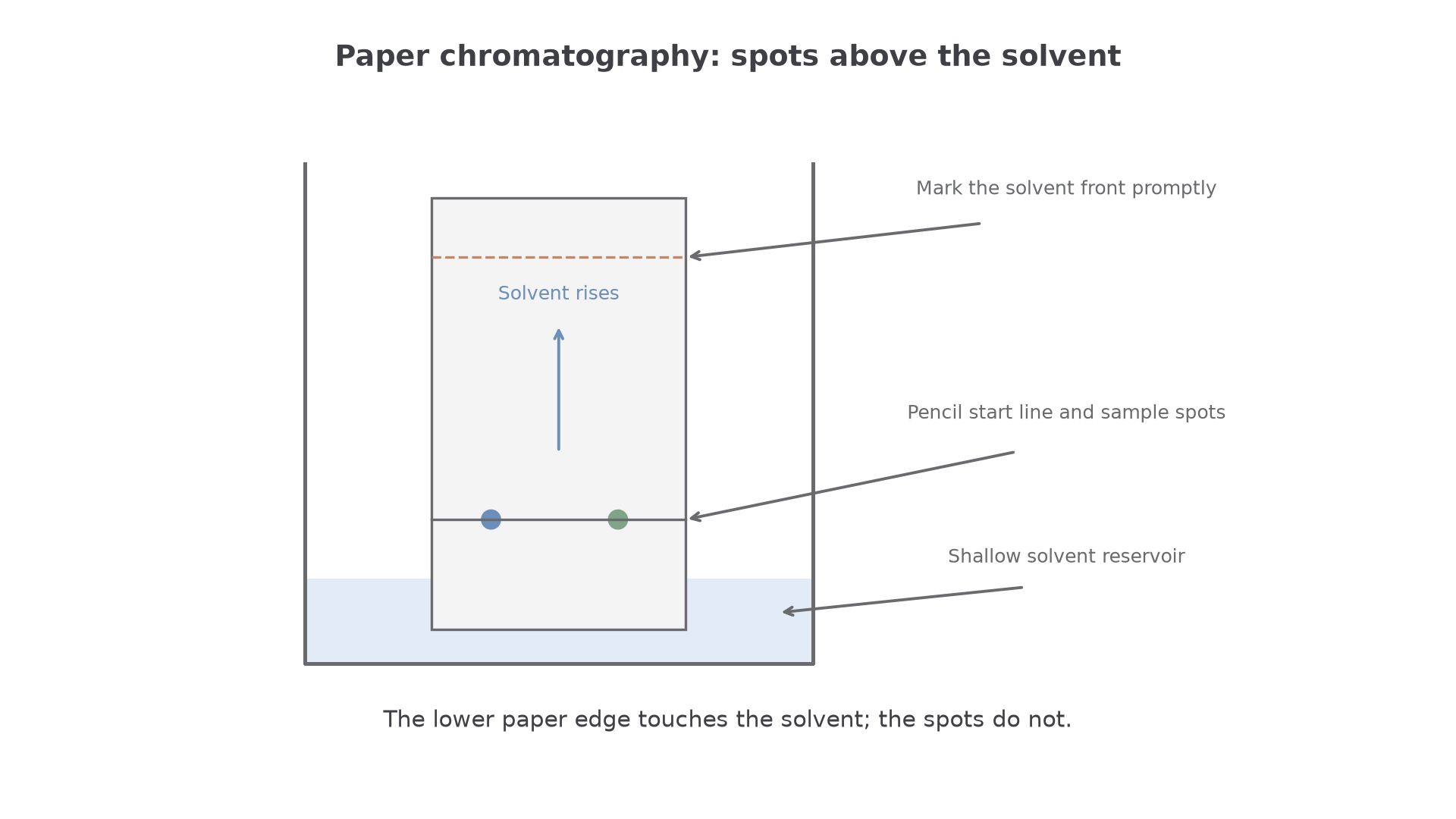
Place a shallow layer of a suitable solvent in a beaker. Suspend the paper so its lower edge touches the solvent but the start line and sample spots remain above the solvent level. If a spot is submerged, the sample may dissolve into the solvent reservoir and wash off instead of moving up the paper. Pencil graphite does not dissolve and travel with the chosen solvent; pen ink might produce extra spots and confuse the result.
Cover the vessel to reduce solvent evaporation. Allow the solvent to rise without disturbing the paper, then remove the paper before the solvent reaches its top. Mark the solvent front immediately in pencil, because it becomes difficult to see after evaporation. Let the paper dry. Measure from the start line to the centre of each spot and to the solvent front using the same unit. Record the observations and measurements in a labelled table.
Wear eye protection, handle small quantities, and follow the solvent's risk assessment. Some solvents are flammable: keep them away from flames. A coloured substance need not be safe to touch or ingest. This written method develops understanding of apparatus, separation and measurement; it does not replace carrying out the required practical under supervision.
For a fair identification comparison, run the unknown and reference dyes together using the same solvent and paper. Control spot size and starting position. Repeated runs can reveal poor reproducibility; large or smeared spots make their centres uncertain. Improving spot preparation is more useful than recording distances with unjustified precision.
[DIAGRAM: asset_name: Paper chromatography method; asset_slug: 8462_c55_method; caption: The paper touches the solvent while the pencil start line and sample spots remain above the reservoir.; description: A standard beaker-and-paper schematic shows a shallow solvent reservoir, paper dipping into it, a pencil start line and two sample positions above the liquid, an upward solvent direction and a marked solvent front. The diagram distinguishes the start line from the bottom of the paper.]
Continue this lesson.
You’re previewing NovaLearn without an account. Create a free account to read the rest.
Create free account