4.7.2.3 - Alcohols and fermentation
Learn to recognise the alcohol family, explain its characteristic reactions and understand how yeast makes ethanol from sugar. You will connect the first four alcohol structures to their uses, combustion and practical observations.
The alcohol family and its uses
Alcohols contain the functional group , with oxygen bonded to a carbon atom and to a hydrogen atom.
The first four members are methanol, ethanol, propanol and butanol. Their names end in “ol”. The table uses straight chains with OH on an end carbon; these propanol and butanol structures can also be called propan-1-ol and butan-1-ol. Other arrangements exist, so identify an alcohol from the OH group and its bonding rather than the carbon count alone.
| Alcohol | Condensed structural formula |
|---|---|
| Methanol | |
| Ethanol | |
| Propanol | |
| Butanol |
[DIAGRAM: asset_name: First four alcohols; asset_slug: 8462_c49_alcohols; caption: Every structure has an O–H group bonded to its carbon chain.; description: Fully displayed methanol, ethanol, propan-1-ol and butan-1-ol, showing every carbon–hydrogen, carbon–carbon, carbon–oxygen and oxygen–hydrogen bond.]
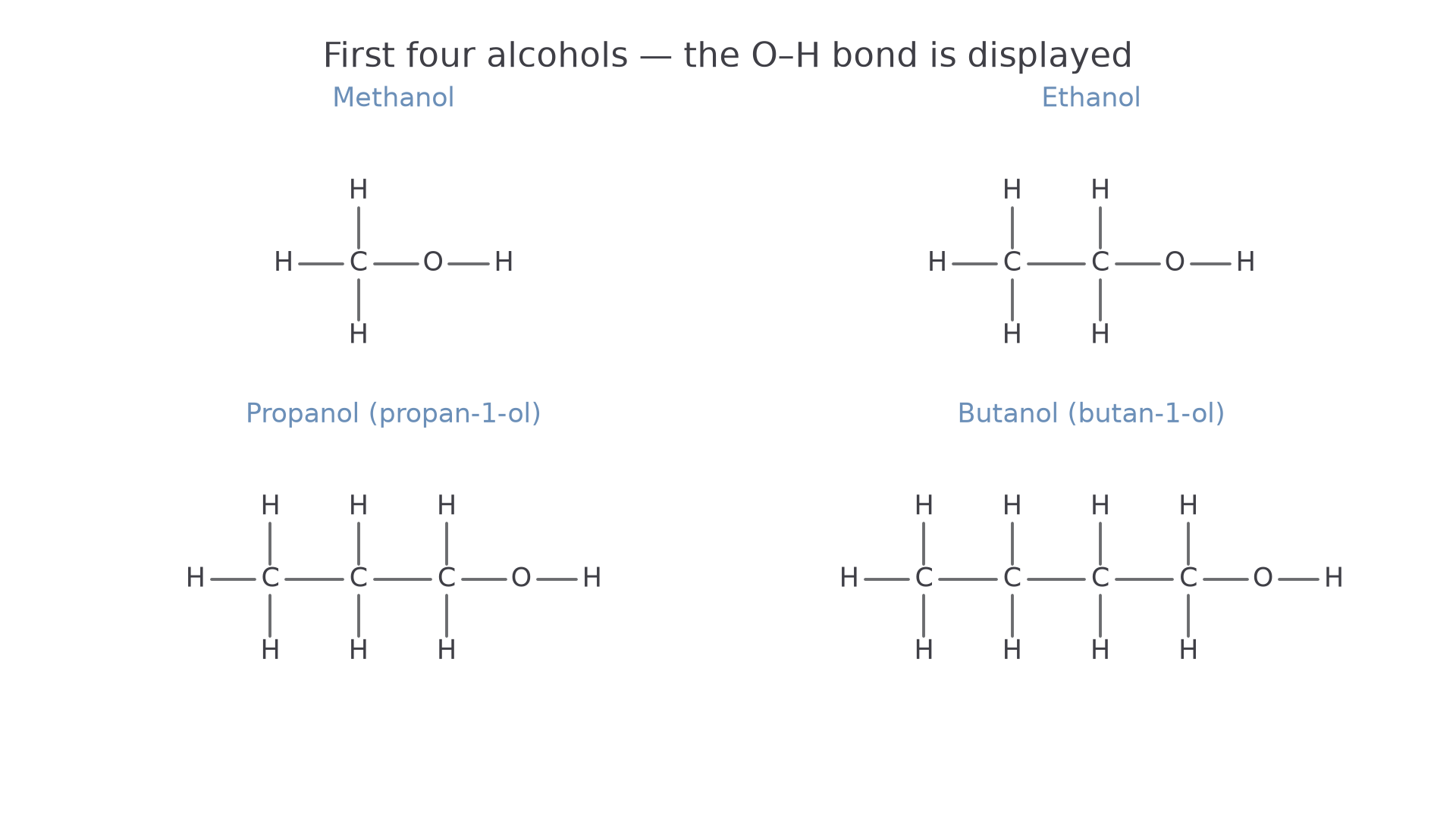
Alcohols are not hydrocarbons, because they contain oxygen as well as carbon and hydrogen. The OH group is part of a neutral molecule; it is not a free hydroxide ion. Carboxylic acids also contain O–H bonds, but their whole group is a different functional group with different reactions.
The first four alcohols are used as fuels and solvents. Their combustion releases energy, while their solvent properties allow them to dissolve substances in products such as inks, coatings and cleaning mixtures. Methanol and ethanol are also chemical feedstocks. Ethanol is the alcohol in alcoholic drinks, but that use must not be generalised to the other members: methanol is toxic, and laboratory alcohols must never be tasted.
Sodium reactions and water solubility
The first four alcohols react with sodium to release hydrogen and dissolve in water to varying extents.
When a small piece of sodium is added to an alcohol, bubbles of hydrogen form and the sodium is consumed. The other product is a sodium alkoxide, formed when the hydrogen of the OH group is replaced by sodium. For ethanol this product is sodium ethoxide. You need to describe the products and observations, not write a balanced sodium–alcohol equation.
Hydrogen can be identified by its squeaky pop with a lighted splint. An alcohol reaction is usually less vigorous than sodium's reaction with water, but both the sodium and the flammable liquids require a controlled teacher demonstration. A flame must not be brought to a container of alcohol; any gas test uses a safely collected small gas sample away from it. Water contamination can change the observation because sodium reacts with water too.
The OH group helps alcohol molecules interact with water molecules. Methanol, ethanol and propan-1-ol mix completely with water. Butan-1-ol is less soluble: some dissolves, but enough added alcohol can leave a separate layer. Increasing the non-polar carbon-chain length reduces water solubility. Thus “alcohols dissolve in water” does not mean every amount of every alcohol will form one uniform liquid.
The resulting aqueous solutions are neutral, rather than acidic like carboxylic-acid solutions. Dissolving is a physical process: it spreads alcohol molecules among water molecules without converting all of the alcohol into a new compound. Sodium reacting with an alcohol is a chemical process because new substances are formed.
Oxidation and combustion of alcohols
Alcohols burn in air and the straight-chain first four can be oxidised to their corresponding carboxylic acids.
Complete combustion of an alcohol gives carbon dioxide and water and releases energy, explaining its use as a fuel. When balancing, remember that an alcohol already contains an oxygen atom.
Worked example 1 — ethanol combustion
Balance carbon and hydrogen first. Two carbons need two carbon dioxide molecules, and six hydrogens need three water molecules. The products contain oxygen atoms. Ethanol supplies one, leaving six from oxygen gas:
The balanced equation is:
Continue this lesson.
You’re previewing NovaLearn without an account. Create a free account to read the rest.
Create free account