4.2.1.1,4.2.1.2,4.2.1.3,4.2.2.3 - Ionic bonding and ionic compounds
Learn how electron transfer produces ions, how the attraction between those ions builds a giant structure, and how to represent that structure. You will use ion charges and diagrams to find formulae and explain why an ionic compound can conduct electricity in some states but not others.
Electron transfer and ion charge
Ionic compounds usually form when a metal reacts with a non-metal and electrons transfer from the metal atoms to the non-metal atoms.
There are three types of strong chemical bond. Ionic bonding involves oppositely charged ions; covalent bonding involves atoms sharing pairs of electrons; metallic bonding involves a giant metal structure sharing delocalised electrons. Covalent bonding occurs in most non-metallic elements and compounds of non-metals. Metallic bonding occurs in metals and alloys. In each case, attraction between positive and negative charge helps hold the particles together.
An atom is neutral because its positive protons and negative electrons balance. Losing electrons leaves more protons than electrons, producing a positive ion. Gaining electrons gives more electrons than protons, producing a negative ion. The nucleus does not change during this transfer: an ion of sodium is still sodium.
Sodium has the electron arrangement 2,8,1. It loses its one outer electron to become , with arrangement 2,8. Chlorine has arrangement 2,8,7. It gains an electron to become , with arrangement 2,8,8. Both ions have a full outer shell: the same arrangement as a noble gas. The electron has transferred; it has not disappeared.
The group number predicts the charges required here:
| Atom group | Electron change | Ion charge | Example |
|---|---|---|---|
| Group 1 metal | Loses 1 | ||
| Group 2 metal | Loses 2 | ||
| Group 6 non-metal | Gains 2 | ||
| Group 7 non-metal | Gains 1 |
For example, magnesium has arrangement 2,8,2 and oxygen has 2,6. Transfer of two electrons produces , arrangement 2,8, and , arrangement 2,8. “Full shell” describes the resulting electronic structure; it does not explain the bond by itself. The bond is the strong electrostatic attraction between opposite charges.
Dot and cross diagrams for ions
A dot and cross diagram keeps track of electrons from different atoms while showing the full outer shells and charges of the final ions.
Dots and crosses represent identical electrons. They distinguish the atoms the electrons came from, not different kinds of electron. A useful diagram shows the outer-shell electrons of the non-metal ion, puts each ion in square brackets and places the charge outside the top right of each bracket. Inner shells can be omitted when that convention is stated.
[DIAGRAM: asset_name: Outer electrons in sodium chloride and magnesium oxide; asset_slug: 8462_c10_ionic_electrons; caption: Transferred electrons complete the non-metal ion's outer shell.; description: Outer-shell-only dot and cross diagrams show sodium chloride as a bracketed sodium ion with charge plus and a chloride ion with seven crosses and one dot, and magnesium oxide as a magnesium ion with charge two plus and an oxide ion with six crosses and two dots. Dots represent electrons transferred from the metal. The metal ions have full inner shells that are omitted.]
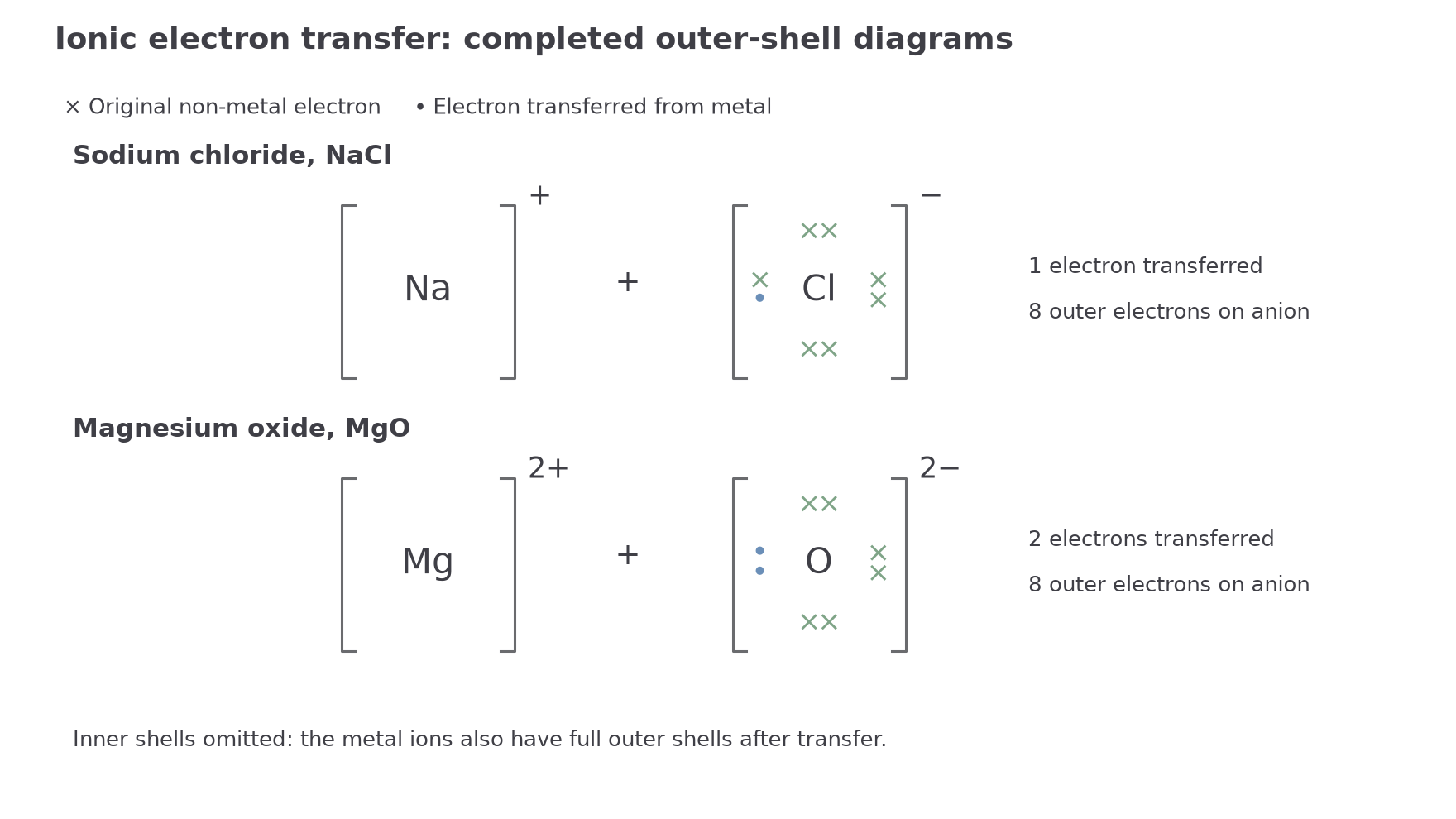
For sodium chloride, draw seven crosses for chlorine's original outer electrons and one dot for sodium's transferred electron around . The sodium symbol has no electron from its original outer shell left beside it; its newly outer shell is full but is not drawn in this outer-shell-only convention. Write on sodium and on chloride.
For magnesium oxide, draw six crosses and two transferred dots around , and write on magnesium. For magnesium chloride, the magnesium atom supplies two electrons but each chlorine atom gains only one. Draw one and two separate ions, each chloride with seven original electrons and one transferred electron. This gives , rather than an impossible chloride ion carrying two gained electrons and a charge of 1−.
A Group 1 or 2 metal paired with a Group 6 or 7 non-metal follows the same electron accounting. Two Group 1 atoms supply the two electrons needed by one Group 6 atom, so sodium oxide has two sodium ions per oxide ion. Check that the electrons gained equal the electrons lost and that the total ionic charge is zero.
Giant ionic lattices
In solid sodium chloride, ions form a regular three-dimensional arrangement that extends throughout the crystal.
Giant ionic lattice
A repeating structure containing many positive and negative ions, held together by strong electrostatic attraction in all directions.
The sodium and chloride ions alternate. Within the sodium chloride lattice, each ion has six nearest neighbours of the opposite charge: left and right, forwards and backwards, above and below. Attraction does not act only along a single line or between a special pair of ions. A sodium ion is attracted to surrounding chloride ions throughout the lattice.
[DIAGRAM: asset_name: Sodium chloride lattice in two and three dimensions; asset_slug: 8462_c10_salt_lattice; caption: A flat slice and a three-dimensional fragment show alternating positive and negative ions.; description: A square two-dimensional slice of a sodium chloride lattice shows alternating smaller blue sodium ions and larger sage chloride ions. A projected three-dimensional lattice fragment extends the alternating pattern along three perpendicular directions. Connecting lines locate neighbours rather than representing physical sticks. Both fragments continue beyond their drawn edges.]
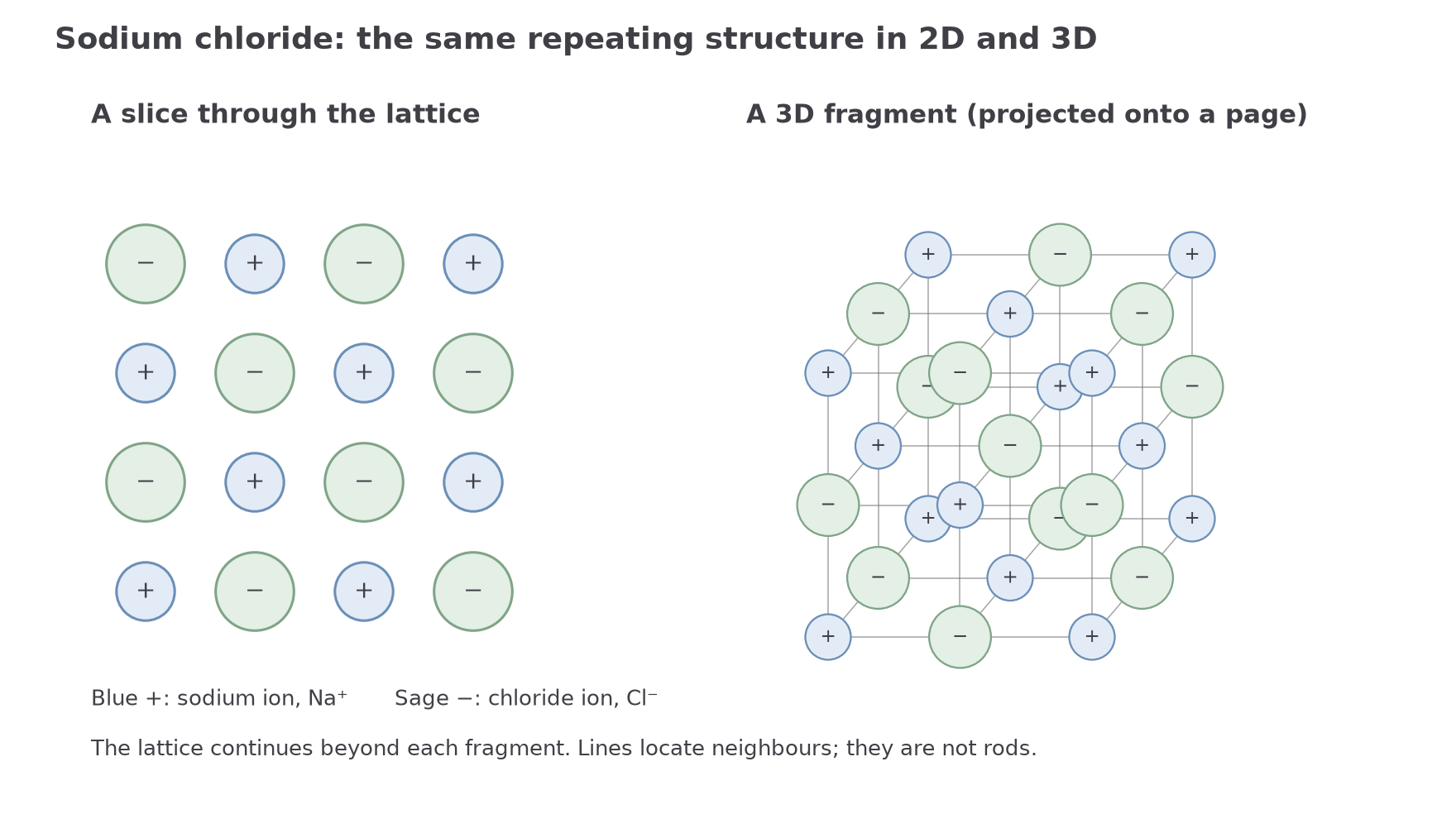
The flat picture is a slice through the lattice. Imagine another alternating layer above it and another below it: this adds neighbours that a single flat layer cannot show. The three-dimensional projection helps reveal depth, although some rear ions are partly hidden. Neither picture is a complete crystal.
To recognise an ionic structure, look for a repeating arrangement of positive and negative ions, rather than separate neutral molecules. Ion labels or a key are essential; circles alone do not establish ionic bonding. Other ionic compounds can have different arrangements, so use the supplied model rather than assuming every lattice has sodium chloride's geometry.
Formulae and the limits of lattice models
An ionic formula gives the simplest whole-number ratio of ions, rather than the number of atoms in a separate molecule.
An empirical formula expresses that simplest ratio. For a representative model containing eight sodium ions and eight chloride ions:
Do not write : the drawn number depends on the fragment selected. For a complete representative fragment containing four magnesium ions and eight chloride ions:
The simplified ratio gives both the empirical formula and balanced total charge.
When reading a model, identify the particles from its key, count them using any stated boundary-counting convention, then simplify the ratio. An arbitrary cropped edge of a lattice can contain unbalanced numbers; use the full repeating unit or the charge and ratio information supplied. The formula must describe the compound, not an accidental cut through the drawing.
Different representations answer different questions. A dot and cross diagram shows electron transfer and ion charges, but usually does not show the extended lattice or realistic ion sizes. A ball and stick model reveals arrangement and neighbours, but the sticks are not material rods and the gaps may exaggerate the spaces between ions. A space-filling model gives a better impression of occupied space but hides some ions and connections. A two-dimensional diagram loses depth and some neighbours. A three-dimensional projection shows depth more clearly but still flattens a structure onto a page, can obscure rear particles and shows only a tiny fragment. Colours and sphere sizes are model choices unless a scale is explicitly given.
Melting and electrical conduction
The strong attractions and the ability of ions to move explain the main physical properties of ionic compounds.
Ionic compounds generally have high melting and boiling points because a large amount of energy is needed to overcome the many strong electrostatic attractions in their giant structures. Heating sodium chloride does not break it into neutral sodium and chlorine atoms. At melting, the ions gain freedom to move past one another, while remaining charged.
An electric current requires mobile charged particles. In a solid ionic lattice, the ions are held in fixed positions. They can vibrate but cannot travel through the solid, so solid sodium chloride does not conduct. When the compound is molten, its ions can move and carry charge through the liquid. When an ionic compound dissolves in water, separated ions move through the solution and carry charge. This explanation applies when it actually dissolves; a solid that is insoluble does not become an ionic solution merely because water is added.
The particles carrying current are ions, not free electrons. This distinguishes ionic liquids and solutions from metals. Dissolving and melting are also different processes: a molten salt is the liquid salt itself, whereas an aqueous salt solution contains water as well as dissolved ions.