4.2.2.4,4.2.2.5 - Small molecules and polymers
Learn why strong covalent bonds inside a molecule can coexist with a low boiling point, and why increasing molecular size changes physical properties. You will compare small molecules with very large polymer molecules and explain their states and electrical behaviour from the particles and forces involved.
Intermolecular forces and changes of state
A molecular substance contains strong bonds within each molecule but much weaker attractions between separate molecules.
Intermolecular force
A force of attraction between molecules, rather than a covalent bond joining atoms within a molecule.
For example, an oxygen molecule contains two oxygen atoms joined by a strong double covalent bond. Many oxygen molecules form a sample of oxygen. Weak intermolecular forces act between those separate molecules. The two kinds of attraction act in different places, so saying simply “oxygen has weak bonds” does not identify which interaction is meant.
When a molecular substance melts or boils, the intermolecular forces are overcome enough to change the arrangement and separation of the molecules. The strong covalent bonds inside the molecules are not broken. Liquid water becoming steam remains ; it does not split into hydrogen and oxygen as a normal part of boiling.
[DIAGRAM: asset_name: Bonds within molecules and forces between molecules; asset_slug: 8462_c14_molecular_and_polymer_forces; caption: Strong bonds link atoms inside each molecule, while weaker forces act between molecules or chains.; description: One panel shows separate diatomic molecules with solid lines joining each pair of atoms and dashed lines between molecules. A second panel shows three long polymer-chain fragments with many solid covalent-bond lines within each chain and dashed intermolecular attractions between chains. A key distinguishes solid covalent bonds from dashed intermolecular forces. Chain fragments continue beyond the shown area.]
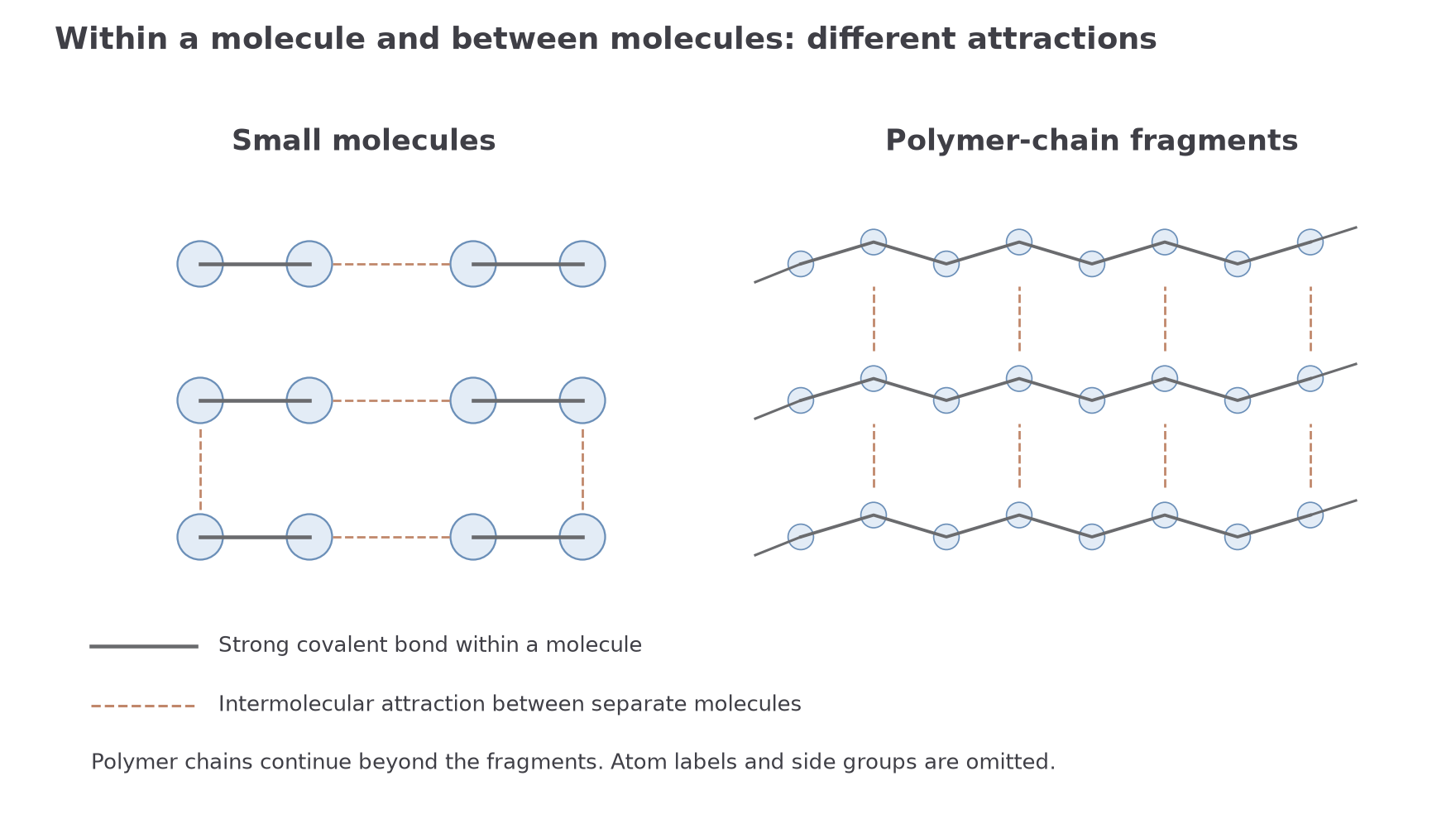
Because relatively little energy is needed to overcome their weak intermolecular forces, small molecular substances generally have relatively low melting and boiling points. They are often gases or liquids at room temperature. Some are solids, so state alone is not proof of structure. The explanation is always based on the particles and the attractions that the particular change of state overcomes.
Molecular size and boiling temperature
For comparable molecular substances, larger molecules have stronger intermolecular forces and generally higher melting and boiling points.
A larger molecule offers more interaction with nearby molecules, so comparable larger molecules have stronger overall intermolecular attraction. More energy is needed to separate them when a substance boils, giving a higher boiling temperature. The change concerns forces between molecules, while the strong covalent bonds within them remain intact.
An illustrative set of related compounds demonstrates the reasoning:
| Substance | Number of carbon atoms per molecule | Boiling point at the same pressure |
|---|---|---|
| A | 1 | |
| B | 3 | |
| C | 6 |
At , A and B are above their boiling points and are gases; C is below its boiling point and could be liquid if it is also above its melting point. The ordered boiling data support stronger intermolecular forces as molecular size increases in this related set. Boiling data alone do not prove every detail of a molecule's structure.
This trend is especially useful for comparisons within a similar group of compounds. Do not claim that atom count alone precisely orders every unrelated substance: the nature of its molecules also matters. Use any provided melting and boiling data when a question asks for the actual state.
Why molecular substances do not conduct
An ordinary pure small molecular substance does not have mobile charged particles that can carry an electric current through it.
The molecules are electrically neutral overall. Although a molecule contains positive nuclei and negative electrons, the electrons involved in its bonds are not free to move throughout the sample in the way that delocalised electrons do in a metal. There are no mobile ions in the pure molecular substance. Molecules moving through a liquid or gas therefore do not automatically create an electrical current.
This separates two questions: can the particles move? and can mobile particles carry charge? Liquid methane has mobile molecules but no mobile charged particles. Molten sodium chloride has mobile charged ions and conducts. A solid metal has mobile delocalised electrons and also conducts. “It is a liquid” is not a sufficient explanation of electrical conduction.
Some molecular substances react or ionise when dissolved in water. Hydrogen chloride, for example, produces ions in its aqueous acid solution. Such a solution can conduct because ions have formed. That does not mean the separate neutral hydrogen chloride molecules in the pure molecular substance are themselves the charge carriers. Always identify what particles are present in the actual sample.
Polymer chains and their properties
A polymer contains very large molecules, so the attractions between its molecules are stronger overall than those between small molecules.
A polymer molecule is a long chain containing many repeating units. Strong covalent bonds link its atoms along the chain. Different chains are separate molecules, with intermolecular forces acting between them. In the diagram, solid lines within a chain and dashed lines between chains represent those different interactions.
For polyethene, the repeating unit contains two carbon atoms with two hydrogen atoms bonded to each carbon. Bonds through the ends of the drawn brackets continue into other repeating units. The symbol indicates a large number of units. In a structure diagram, this repeated chain and the continuation bonds identify a polymer; a giant number of unconnected small molecules would be a different structure.
The intermolecular forces between these very large molecules are relatively strong compared with those between small molecules. Considerable energy is needed to allow whole chains to move freely past and away from one another, so these polymers are solids at room temperature. Chain length and arrangement also affect their behaviour, while molecular size explains the stronger overall intermolecular attraction.
Many ordinary polymers are useful electrical insulators because they have neither mobile ions nor delocalised electrons throughout the material. Their atoms are strongly joined within chains, yet a polymer is not automatically a single giant covalent network such as diamond. The separate chains still matter when explaining its structure and physical behaviour.