4.1.1.6,4.1.1.7 - Relative atomic mass and electronic structure
Calculate relative atomic mass from isotope abundances, then build electronic structures for the first twenty elements. Connect the average mass printed in the periodic table with isotope populations and the table's chemical patterns with electron arrangements.
Isotope abundance and an average mass
A sample of an element can contain several isotopes, so the mass associated with the element must take account of how common each isotope is.
Isotopes have the same proton number but different neutron numbers. Abundance describes the proportion of atoms belonging to each isotope. A percentage abundance of 80% means eighty of every hundred atoms on average, not that each individual atom is 80% of an isotope.
Relative atomic mass
Relative atomic mass, , is an average mass of an element's atoms that takes account of the abundances of its isotopes. The relative scale compares atomic masses with one-twelfth of the mass of a carbon-12 atom.
Relative atomic mass has no unit: it is a ratio on a comparison scale. A mass number is different. It counts protons and neutrons in one atom and is a whole number; relative atomic mass can be a decimal because it describes a mixture of isotopes.
Suppose an illustrative sample contains 80% atoms of isotope X-20 and 20% of X-22, using relative isotopic masses 20 and 22. Most atoms have mass 20, so the average must be between 20 and 22 and closer to 20. The unweighted midpoint, 21, would incorrectly assume equal abundances. The average does not mean that an individual atom has a fractional neutron number.
Calculating a weighted relative atomic mass
A weighted average multiplies each isotope's mass by its abundance before combining the contributions.
For numbers of atoms or other relative abundances, divide by the total abundance instead of automatically dividing by 100.
For the earlier sample with 80% X-20 and 20% X-22:
The result lies between 20 and 22 and is closer to 20, agreeing with the abundance reasoning. Multiplying by 80 and 20 treats a representative hundred atoms; dividing by 100 returns an average for one atom.
Illustrative chlorine sample: 75% of the atoms are chlorine-35 and 25% are chlorine-37. Using relative isotopic masses 35 and 37:
The result is between 35 and 37 and nearer 35, the more abundant isotope. These percentages are rounded teaching data; use the values supplied for the particular sample.
Percentages for all isotopes in a sample must total 100%. If a two-isotope sample has 30% of one isotope, the other has . A ratio table uses a different denominator. If atoms of relative isotopic masses 24 and 26 occur in the ratio 3:1:
Dividing this weighted total by 100 would incorrectly treat 3 and 1 as percentages and give an average below both isotope masses. The denominator must match the abundance data.
Filling the lowest available electron shells
Electrons in an atom occupy the lowest available energy levels first, starting with the innermost shell.
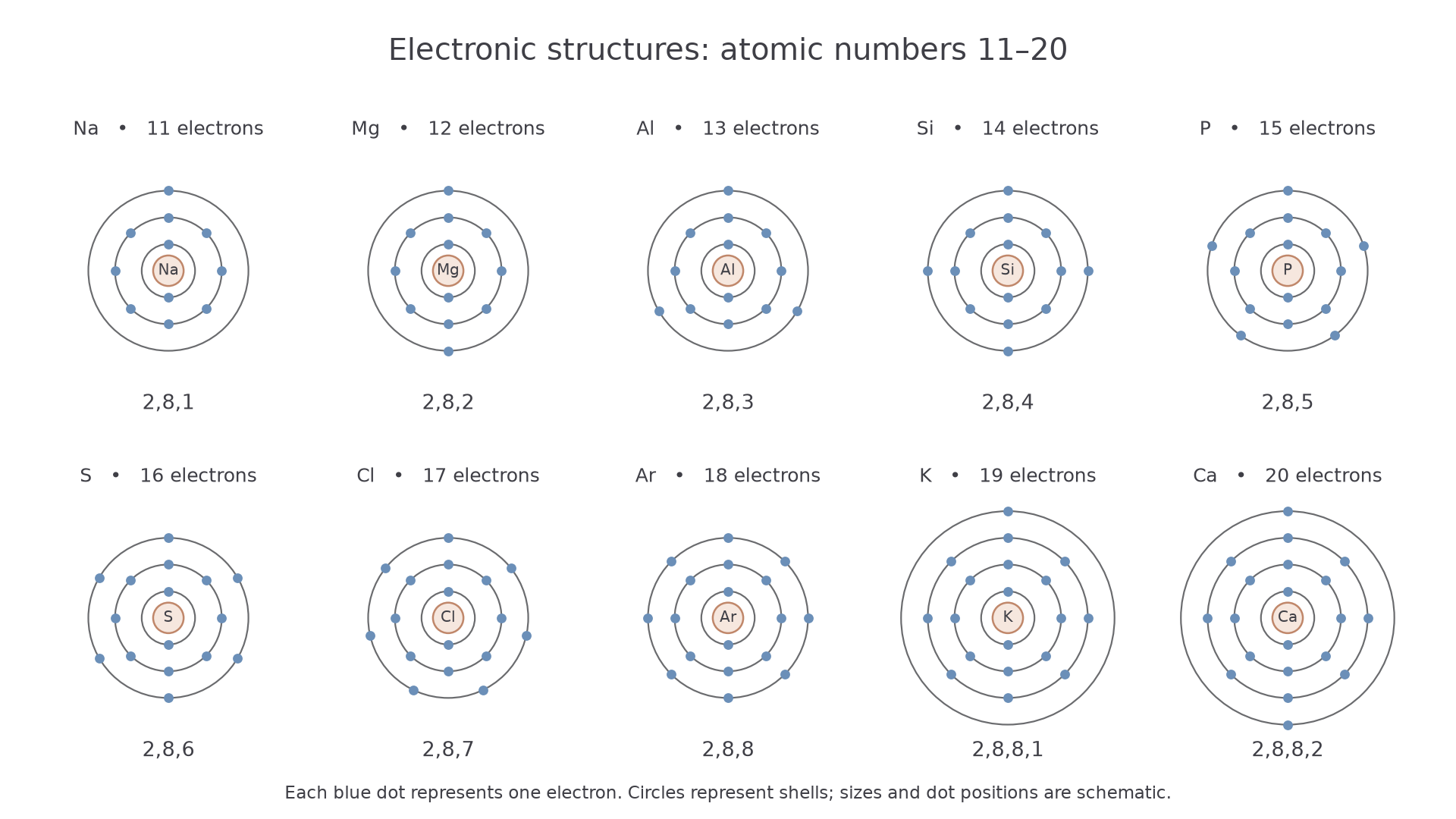
For the first twenty elements, two electrons fill the first shell, up to eight fill the second, and up to eight fill the third before the fourth begins. Potassium and calcium therefore have arrangements 2,8,8,1 and 2,8,8,2. Atoms beyond the first twenty require a more detailed filling pattern: the third shell's maximum capacity is greater than eight.
A neutral atom has as many electrons as protons. For sodium, atomic number 11:
For magnesium, atomic number 12:
Both sums match the electron total. Use atomic number rather than mass number: neutrons do not provide electrons.
A comma-separated arrangement lists occupied shells from inside to outside. The last number is the number of outer-shell electrons, which matters in chemical reactions. The sum must equal the electron number: for magnesium. Shells are also called energy levels.
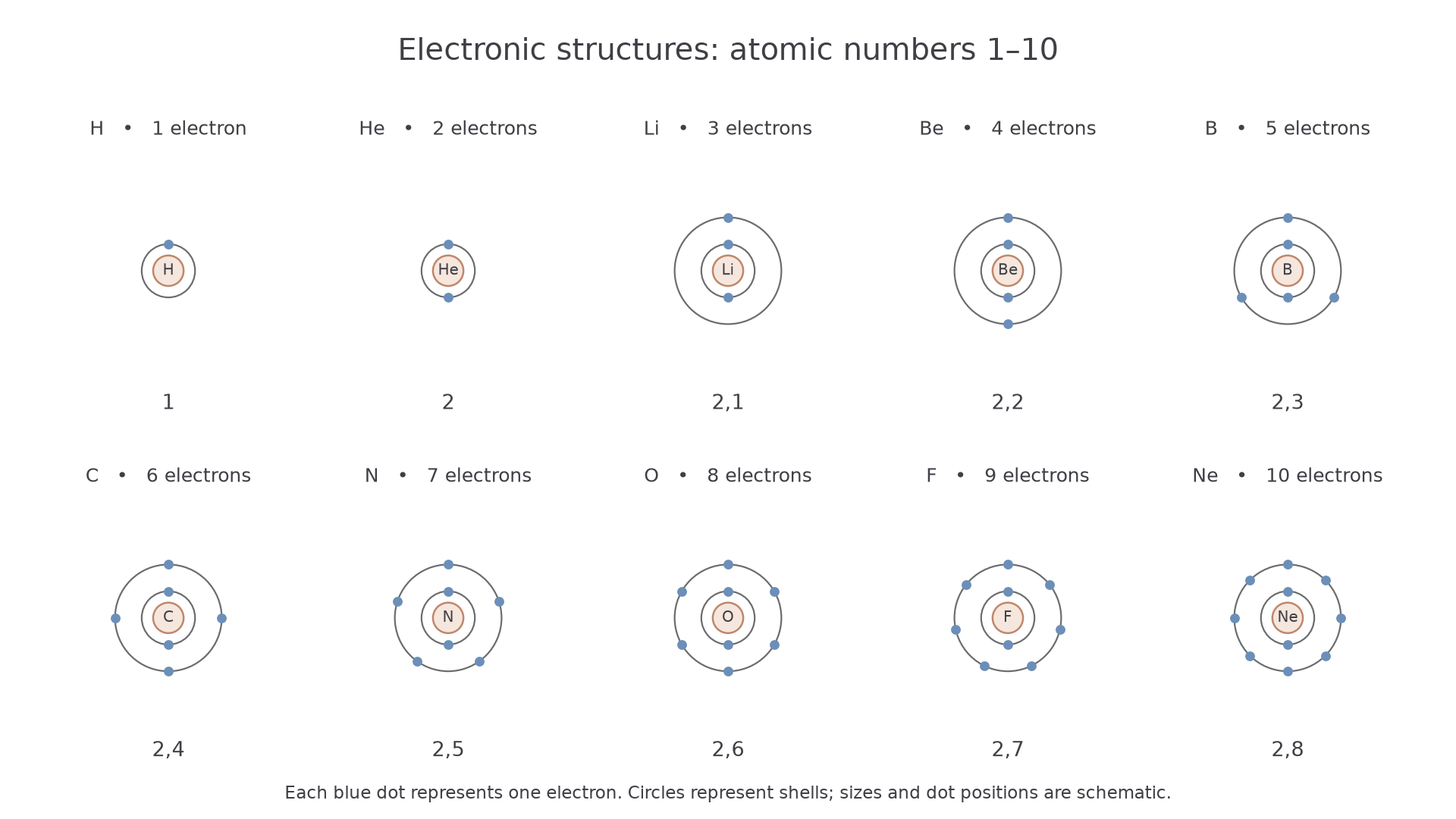
To draw an electronic structure, label a central nucleus with the element symbol, draw one circle for each occupied shell and place the stated number of dots or crosses on each circle. For sodium, draw three circles and place two, eight and one electron on them. Count every mark after drawing. The circles and dot positions are a simplified two-dimensional representation; they do not show literal tracks or fix the exact positions of electrons in an atom.
Electronic structures of the first twenty elements
Numerical arrangements and shell diagrams show the same electron counts in different forms.
| Atomic number | Element | Electronic structure | Atomic number | Element | Electronic structure |
|---|---|---|---|---|---|
| 1 | Hydrogen | 1 | 11 | Sodium | 2,8,1 |
| 2 | Helium | 2 | 12 | Magnesium | 2,8,2 |
| 3 | Lithium | 2,1 | 13 | Aluminium | 2,8,3 |
| 4 | Beryllium | 2,2 | 14 | Silicon | 2,8,4 |
| 5 | Boron | 2,3 | 15 | Phosphorus | 2,8,5 |
| 6 | Carbon | 2,4 | 16 | Sulfur | 2,8,6 |
| 7 | Nitrogen | 2,5 | 17 | Chlorine | 2,8,7 |
| 8 | Oxygen | 2,6 | 18 | Argon | 2,8,8 |
| 9 | Fluorine | 2,7 | 19 | Potassium | 2,8,8,1 |
| 10 | Neon | 2,8 | 20 | Calcium | 2,8,8,2 |
[DIAGRAM: asset_name: Electronic structures from hydrogen to neon; asset_slug: 8462_c05_shells_1_10; caption: The first ten elements fill the first shell and then the second.; description: Ten labelled shell diagrams show H 1, He 2, Li 2,1, Be 2,2, B 2,3, C 2,4, N 2,5, O 2,6, F 2,7 and Ne 2,8, with a counted dot for every electron. Shell radii and nuclei are schematic.]
[DIAGRAM: asset_name: Electronic structures from sodium to calcium; asset_slug: 8462_c05_shells_11_20; caption: Sodium to argon fill the third shell in this model; potassium and calcium start a fourth.; description: Ten labelled shell diagrams show Na 2,8,1, Mg 2,8,2, Al 2,8,3, Si 2,8,4, P 2,8,5, S 2,8,6, Cl 2,8,7, Ar 2,8,8, K 2,8,8,1 and Ca 2,8,8,2, with a counted dot for every electron. Shell radii and nuclei are schematic.]
To read a diagram, count its electrons shell by shell from the centre outward. A diagram with two on the first circle and six on the second gives:
To construct a diagram from the structure 2,8,7:
Draw three circles and place two, eight and seven electron marks on them, then recount each circle.
For nitrogen, atomic number 7, a construction has two shells with two and five electron marks. Calcium, atomic number 20, needs four shells with two, eight, eight and two. The position of marks around each circle can vary; the electron counts and shell order identify the electronic structure.