4.7.2.1,4.7.2.2 - Alkenes and addition reactions
Learn to recognise and draw the first four alkenes, then use their carbon–carbon double bond to predict addition products. The structures in 4.7.2.1 explain the common reactions in 4.7.2.2, including making alkanes, alcohols and halogen-containing compounds.
Alkene structure and formulae
An alkene is a hydrocarbon containing a carbon–carbon double bond, written .
The double bond is the alkene functional group, the atom or group of atoms responsible for its characteristic reactions. Compounds in a homologous series react in similar ways because they have the same functional group. Changing the length of the carbon chain changes the molecule, but an alkene's double bond still undergoes addition reactions.
For the alkene homologous series with one double bond and no ring, the general formula is .
| Alkene | Molecular formula | Comparable alkane formula |
|---|---|---|
| Ethene | ||
| Propene | ||
| Butene | ||
| Pentene |
Ethene is the first member because a carbon–carbon double bond needs at least two carbon atoms. Each alkene contains two fewer hydrogen atoms than the alkane with the same number of carbons. Alkenes are unsaturated: atoms can add across the double bond. This means the bond can become a single bond while new atoms attach to its two carbons.
Recognise the first four names by the ending “ene”, then confirm a given displayed structure has a bond and contains only carbon and hydrogen. A molecular formula fitting is consistent with this alkene series, but the formula alone does not prove a double bond is present: a ring compound can have the same atom count. When a structure is supplied, use its bonds as evidence.
Fully displayed alkene structures
A fully displayed formula shows every atom and bond, so it must include the hydrogen atoms as well as the double bond.
Build a carbon chain first, place one double bond, then add hydrogen atoms until each carbon has four bonds in total. Count a double bond as two. In ethene, each carbon has the double bond to the other carbon plus two single bonds to hydrogen. In propene, , the first carbon has two hydrogen neighbours, the middle carbon one and the last carbon three. These condensed groups are useful for counting, but a fully displayed drawing must replace each group with its individual atoms and bonds.
[DIAGRAM: asset_name: First four alkenes; asset_slug: 8462_c48_alkenes; caption: Ethene, propene, butene and pentene are drawn with every atom and bond shown.; description: Four fully displayed structures with a double bond between the first two carbons. The butene and pentene examples are but-1-ene and pent-1-ene; every carbon has four bonds and every hydrogen one.]
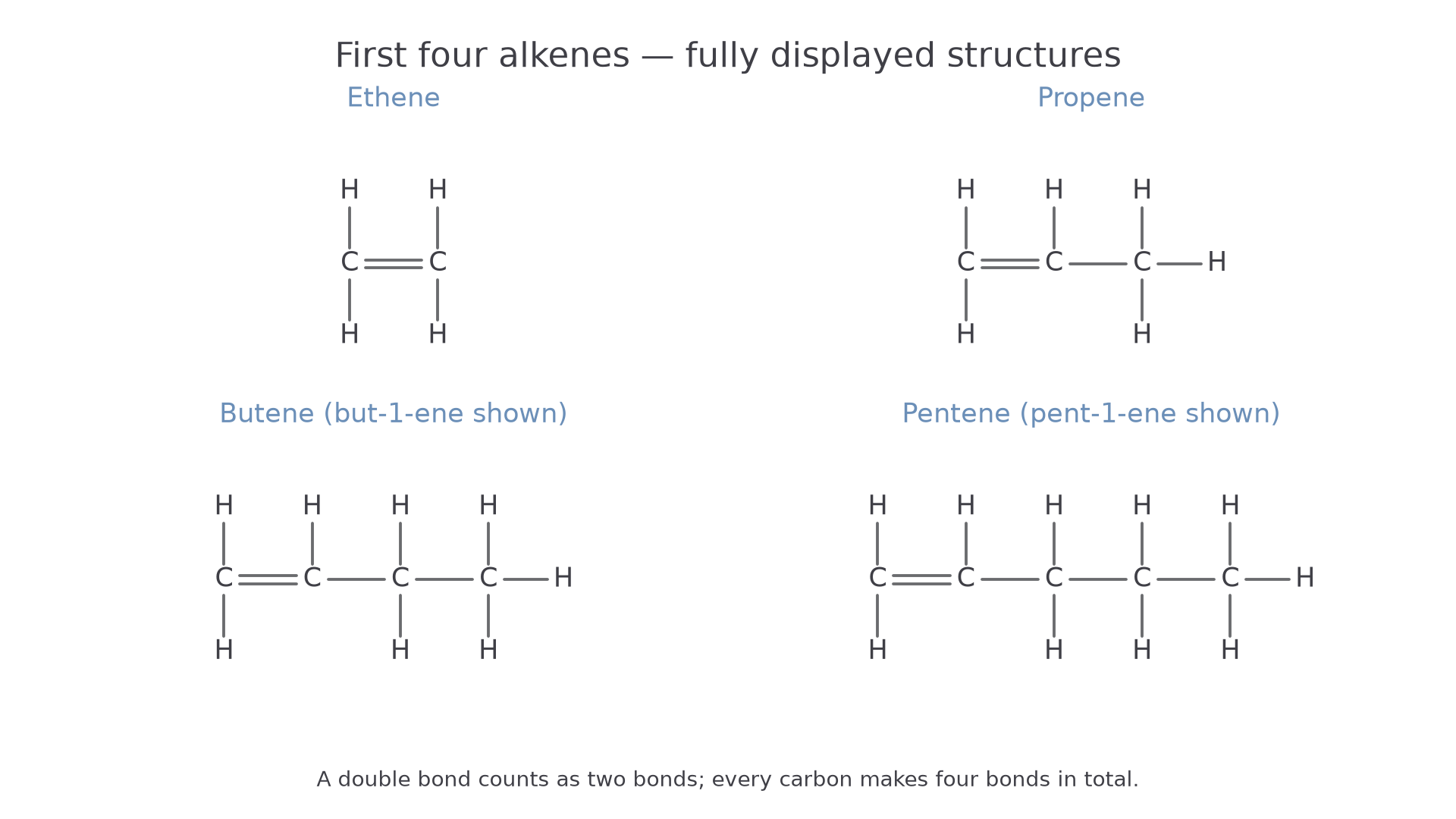
For butene and pentene, the plate uses a double bond at the end of a straight chain. A double bond can occur at another position in some molecules with the same molecular formula. The position number distinguishes such structures when needed; the four family names to learn here are ethene, propene, butene and pentene. Product drawings must follow the position of the double bond in the actual reactant supplied.
A molecular model helps translate between three-dimensional objects and a flat drawing. Turning the model over does not create a new substance. Bond connections and bond types must remain the same in the drawing. Do not turn a displayed propene molecule into ethene by omitting its third carbon, or add an extra hydrogen to a carbon already making four bonds.
To check a drawing, count its carbon and hydrogen atoms, compare with , then inspect the bonds around each carbon. Atom count and bond count are complementary checks: the right total number of hydrogen atoms does not excuse attaching them to the wrong carbon.
Addition of hydrogen and steam
Hydrogen and water add across an alkene's double bond, but they produce different families of compounds.
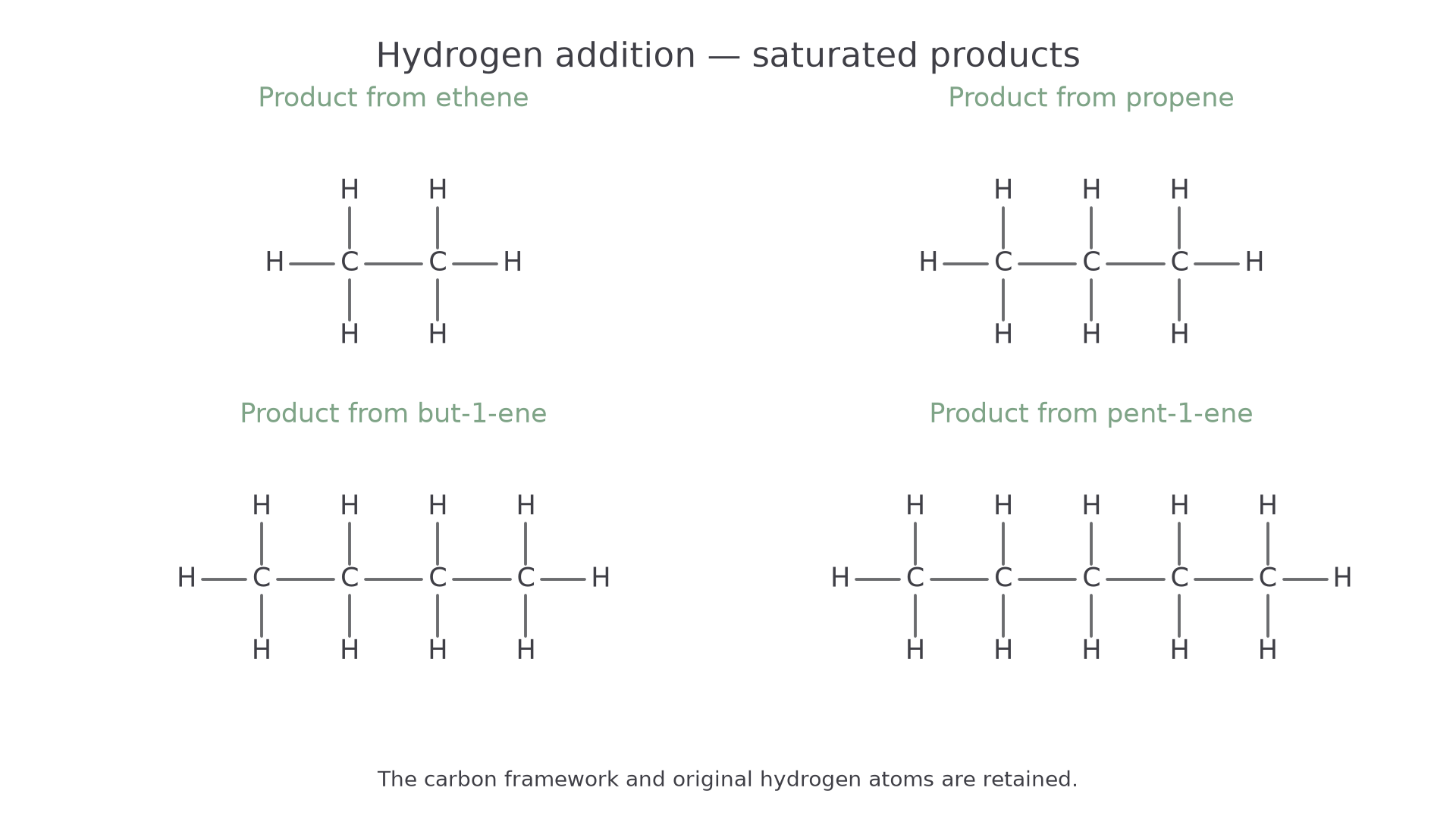
In hydrogenation, the alkene reacts with hydrogen gas over a nickel catalyst at an elevated temperature, commonly about . One hydrogen atom attaches to each of the two double-bonded carbons. The becomes , producing a saturated alkane. No carbon atoms disappear. For ethene:
[DIAGRAM: asset_name: Hydrogen addition products; asset_slug: 8462_c48_hydrogen_products; caption: Hydrogen addition gives a single bond and one extra hydrogen on each former double-bonded carbon.; description: Fully displayed hydrogenation products of ethene, propene, but-1-ene and pent-1-ene, giving two-, three-, four- and five-carbon saturated chains.]
Continue this lesson.
You’re previewing NovaLearn without an account. Create a free account to read the rest.
Create free account