4.4.2.5 - Acid–alkali titration
Learn how a pipette, burette and suitable indicator measure the reacting volumes of a strong acid and a strong alkali accurately. Required practical 2 includes repeat titrations, careful readings and a justified mean, allowing a salt to be prepared without excess acid or alkali.
Why reacting volumes must be measured
An acid and an alkali both remain in solution, so an excess of either cannot be removed by ordinary filtration.
In the insoluble-solid salt method, unused oxide could be filtered off. With sodium hydroxide and hydrochloric acid, however, both reactants are aqueous. Too much acid leaves acid in the sodium chloride solution; too much alkali leaves alkali. The method therefore needs to find the volumes that react completely without leaving either reagent in excess.
Titration
A technique that measures the volume of one solution required to react with a measured volume of another solution.
For strong acid–strong alkali titrations, a suitable indicator changes colour sharply close to the completion of neutralisation. This visible end point signals when to stop adding solution. The titre is the volume delivered from the burette, not the burette's final reading by itself.
Hydrochloric, nitric and sulfuric acids are the required strong acids. Strong alkalis such as sodium hydroxide are suitable partners. Equal reacting volumes are not a universal rule: concentrations may differ, and sulfuric acid reacts with two sodium hydroxide units per acid unit:
Titration determines the reacting volumes directly. Use the measured end point rather than assuming that equal volumes will neutralise each other.
Pipette, burette and end point
Accurate titration combines a precisely measured fixed volume with controlled addition of the other solution.
Rinse a volumetric pipette with the solution it will measure, then use a pipette filler to transfer, for example, of alkali to a conical flask. Read the bottom of the meniscus at eye level when filling to the calibration mark. Let the pipette drain as designed; do not blow out the small residual drop unless the pipette is specifically made for that. Never pipette by mouth.
Add a few drops of phenolphthalein or methyl orange. With alkali in the flask, phenolphthalein is pink and becomes colourless as acid is added; methyl orange changes from yellow to the end-point orange. For the reverse arrangement, use the corresponding reverse colour change. Universal indicator is unsuitable for an accurate visual titration because it passes gradually through several colours rather than giving one sharp change.
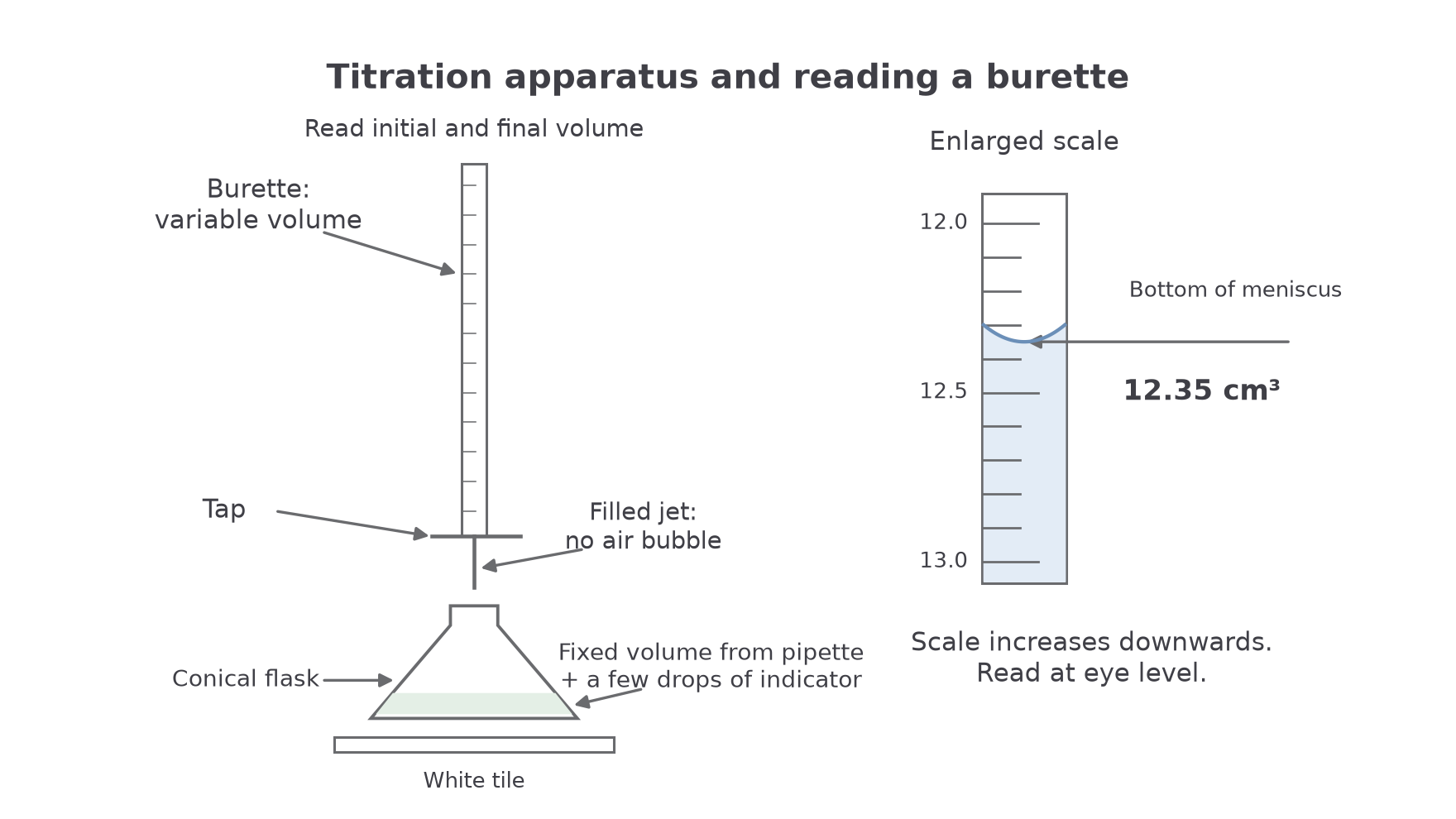
Rinse the burette with the solution it will deliver, fill it, and run some solution through the tap to fill the jet and remove any air bubble. Remove the filling funnel so later drops cannot alter the volume unexpectedly. Record the initial reading; it need not be exactly zero. The scale increases downwards. Read the bottom of the meniscus at eye level to avoid parallax. With a burette graduated every , estimate halfway between divisions and record readings consistently, for example .
Clamp the burette vertically above the flask on a white tile. Add acid while swirling so each addition mixes and reacts. Near the end point, add it drop by drop, stopping at the first persistent appropriate colour change after mixing. A white tile makes that change easier to see. Rinse any splashes down the flask's inner walls with distilled water: this changes the solution volume but does not add acid or alkali reactant.
[DIAGRAM: asset_name: Titration apparatus and burette reading; asset_slug: 8462_c31_titration_apparatus; caption: A burette delivers a measured variable volume into a flask; its scale increases downwards and is read at the meniscus bottom.; description: Labelled vertical burette with tap and filled jet above a conical flask on a white tile, alongside an enlarged burette scale with the bottom of the meniscus at 12.35 cubic centimetres.]
Wear eye protection and use dilute solutions; acids and alkalis can harm eyes. Secure the clamp and fill at a safe height to avoid spilling solution above eye level.
Continue this lesson.
You’re previewing NovaLearn without an account. Create a free account to read the rest.
Create free account